

The AI-First Content Workflow: A Step-by-Step Playbook for Scaling Quality Content
It’s the start of the quarter. Your CEO just asked: “Our top competitor published 20 articles last month. We published four. How are we going to close that gap without hiring five more writers?”
If this scenario feels familiar, you’ve hit the content scaling wall. The traditional, manual workflow where every word is born from a blank page simply doesn’t work when you need both quality and velocity. The answer isn’t to work longer hours; it’s to build a smarter system.
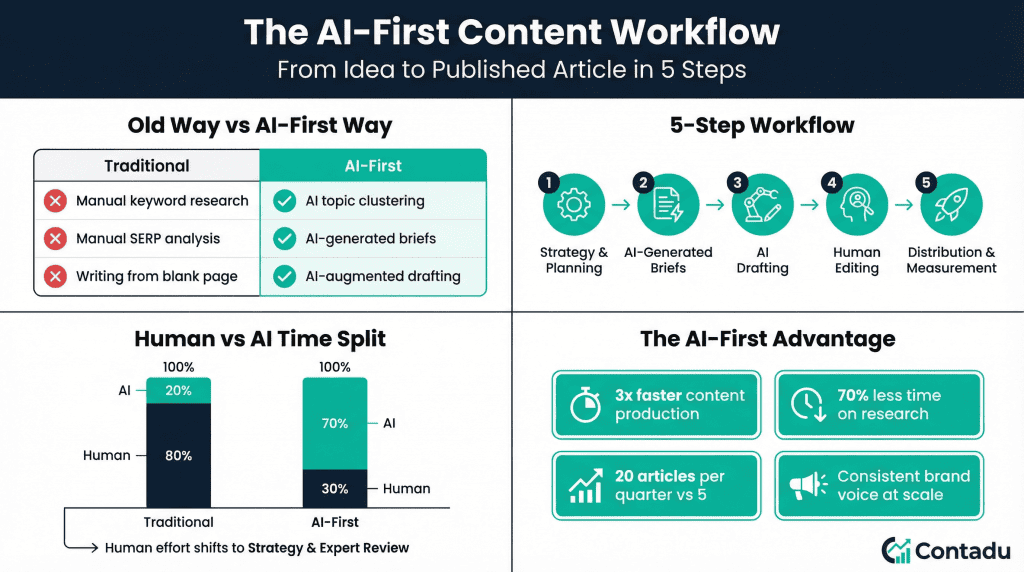
This playbook is not another high-level guide. It is a step-by-step, tactical walkthrough for implementing an AI-first content workflow in your organization. We will take a single topic—”content velocity” and walk it through all five stages, from a strategic idea to a published, high-quality article, showing you exactly what to do at each step.
The Real-World Example: From Topic to Article.
- Core Topic: Content Velocity
- Target Keyword: what is content velocity
- Goal: Create a comprehensive, expert-level guide that outranks competitors and serves as a pillar for the “Content Pacing” topic cluster.
The 5-Step AI-First Playbook.
Step 1: AI-Assisted Strategy & Planning.
The Goal: Stop guessing what to write. Build a data-driven content plan based on what your audience is actually searching for.
The Process:
1.Define Your Core Topic: Start with a broad business theme. In our example, it’s Content Pacing.
2.Generate the Topic Cluster: Use an AI tool like Contadu’s Topic Discovery. Input “Content Pacing.” The AI will analyze the SERPs and generate a map of related subtopics. For our example, it finds:
- what is content velocity (our target)
- how to increase content velocity
- content publishing frequency SEO
- content calendar for high velocity teams
3.Prioritize and Schedule: Review the AI-generated list. Our target, what is content velocity, has good volume and high strategic value. Add it to your Content Calendar for the current sprint.
What Most Teams Get Wrong Here: They rely on manual keyword research, creating a list of disconnected keywords instead of a strategic map of topics. This leads to random acts of content, not topical authority.
Step 2: The 5-Minute, AI-Generated Brief.
The Goal: Create a perfect, data-backed brief that leaves no room for error, in less time than it takes to drink a coffee.
The Process:
1.Input the Keyword: In Contadu, go to the Content Brief module and enter the target keyword: what is content velocity.
2.Let AI Do the Research: The AI engine analyzes the top 20+ ranking articles in real-time. It extracts:
- The ideal structure and common H2/H3 headings.
- Critical user questions from Google’s “People Also Ask” and related searches.
- Key semantic terms and entities (e.g., “publishing rhythm,” “topical authority,” “content decay”).
3.Review and Refine (The Human Touch): The AI-generated brief is 90% complete. Your job is to spend 5 minutes adding the final 10%:
- Define the Angle: Add a note: “Frame this as a strategic advantage, not just a production metric.”
- Specify the Audience: “Target: Heads of Content at B2B SaaS companies.”
- Add a Unique Requirement: “Include a section on the 80/20 rule: 80% evergreen content, 20% reactive/seasonal.”
What Most Teams Get Wrong Here: They create vague, subjective briefs (“Write a 2000-word article on content velocity”). This forces the writer to guess, leading to endless revisions.
Step 3: AI-Augmented First Draft.
The Goal: Go from a blank page to a structured, 2,000-word draft in under 15 minutes.
The Process:
1.Connect Brief to Writer: In Contadu, assign the brief to the AI writer.
2.Generate the Draft: The AI uses the brief as its single source of truth. It generates a full draft that follows the structure, includes the keywords, and answers the questions from the brief.
3.Receive the Structured Draft: The output is not a finished article. It is a high-fidelity draft, complete with headings, paragraphs, and placeholders like [Insert expert quote here] or [Add a case study example], ready for human expertise.
What Most Teams Get Wrong Here: They use generic AI writers (like ChatGPT) without a data-driven brief. The result is a shallow, generic article that hallucinates facts and misses the mark on SEO.
Step 4: The Human-Led Expert Polish.
The Goal: Transform the 80% complete AI draft into a 100% unique, publish-ready asset.
The Process: This is where your team’s expertise shines. The writer/editor now focuses exclusively on high-value tasks:
1.Add the Story: Weave in the opening scenario about the CEO’s question.
2.Inject Unique Insights: Add the 80/20 rule section and a personal anecdote about a past project.
3.Verify and Fortify: Fact-check all claims and add a quote from a recognized marketing expert.
4.Optimize for Quality: Use Contadu’s Content Score to ensure the article’s topical coverage and readability exceed the competition before hitting “publish.”
What Most Teams Get Wrong Here: They do a quick proofread and publish the AI draft as-is. This creates low-quality, generic content that Google’s Helpful Content System is designed to penalize.
Step 5: AI-Powered Distribution & Measurement.
The Goal: Maximize the ROI of your published article by atomizing it for every channel.
The Process:
1.Automated Atomization: Use an AI tool to execute your content atomization strategy. From our “Content Velocity” article, it generates:
- A 5-post LinkedIn carousel on the key takeaways.
- A 10-tweet thread breaking down the 80/20 rule.
- A short video script for a YouTube Short or Reel.
2.Track Performance: Monitor the article’s content performance (traffic, rankings) and use AI Tracking to see if it’s being cited in AI Overviews.
3.Close the Loop: The performance data informs your next strategy session, making the entire system smarter.
What Most Teams Get Wrong Here: They “publish and pray,” letting the article sit on the blog with no distribution plan. This wastes 90% of the content’s potential value.
Your AI-First Workflow Checklist
Phase 1: Strategy
-
-
☐ Define core topic
-
☐ Generate topic cluster with AI
-
☐ Prioritize topics and add to Content Calendar
Phase 2: Briefing
-
☐ Generate AI brief from target keyword
-
☐ Add unique angle, audience, and requirements (5-min human review)
Phase 3: Drafting
-
☐ Generate first draft with AI from the brief
Phase 4: Editing
-
☐ Add unique story, insights, and data
-
☐ Fact-check and refine brand voice
-
☐ Optimize to target Content Score (>80)
Phase 5: Distribution
-
☐ Atomize article into social/email/video assets
-
☐ Schedule distribution in Content Calendar
-
☐ Monitor performance and AI citations
-
FAQ
Does this workflow replace content writers?
No, it elevates them. It automates the repetitive, time-consuming parts of the job (research, structuring, basic drafting) so writers can focus on high-value tasks like analysis, storytelling, and adding unique expertise.
What is the biggest mistake teams make when adopting an AI workflow?
Over-reliance on the AI draft. The AI-generated text is a starting point, not the final product. The human editing and optimization step (Step 4) is where you create a competitive advantage.
How do you maintain a consistent brand voice with AI?
By using a platform with a persistent brand core (like Contadu). The AI learns your brand voice, style, and terminology once, then applies it consistently across all generated content, avoiding the generic “AI voice.”
What is the ideal human-to-AI time split in this workflow?
It shifts from 80% human / 20% tool to roughly 30% human / 70% AI. The human effort becomes highly focused on strategic input at the beginning and expert-level refinement at the end.
Can this workflow be used for content other than blog posts?
Absolutely. The same 5-step process can be adapted for creating landing pages, white papers, email sequences, and video scripts. The core principles of data-driven briefing and AI-augmented drafting apply to any content format.
