
Creating BoFu Content That Actually Converts: The B2B Guide · Contadu
Semantic Summary
The Idea: Most B2B companies obsess over top-of-funnel traffic, pouring resources into high-volume keywords. However, the true revenue engine lies at the bottom of the funnel. BoFu content is what ultimately persuades qualified leads to make a purchase and transition into paying customers.
The Challenge: A marketer often struggles to bridge the gap between educational content and the final sales cycle. Generic blog posts do not build trust or address the specific pain points of a buyer who is ready to convert. If your marketing strategy lacks dedicated bottom-of-funnel assets, your sales team is left doing the heavy lifting of product education during a demo.
The Summary: To maximize conversion rate and accelerate the sales funnel, you must deploy high-intent BoFu content. This includes deep-dive case studies, aggressive versus pages, and ROI calculators. By optimizing this funnel content for both traditional SEO and AI Answer Engines using Contadu, you ensure your brand wins the final click before the transaction.
Read the full guide below, or explore related topics:
- Account-Based Content Marketing: Personalization at Scale
- Aligning Content Strategy with Product-Led Growth (PLG)
- The B2B Buyer’s Journey in the Age of AI Search
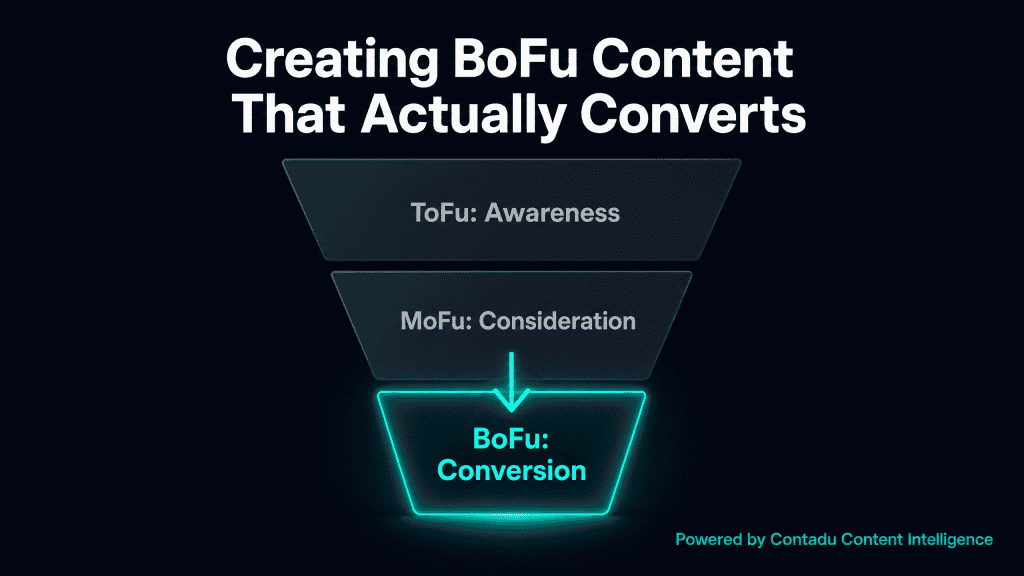
Top-of-Funnel (ToFu) vs. Bottom-of-Funnel (BoFu) Content Structure
| Element | Top-of-Funnel (ToFu) Content | Bottom-of-Funnel (BoFu) Content |
| Primary Goal | Brand awareness and initial lead generation | Direct conversion and pipeline acceleration |
| Target Audience | Broad audience researching general industry problems | Highly qualified leads ready to make a purchase |
| Content Formats | How-to guides, industry trends, newsletter signups | Case studies, competitor comparisons, ROI calculators |
| Primary Call to Action (CTA) | “Subscribe,” “Download eBook,” “Read More” | “Book a Demo,” “Start Free Trial,” “Talk to Sales” |
| Key Metrics | Organic traffic, time on page, social shares | Conversion rate, pipeline generated, sales cycle length |
In the world of B2B content marketing, the top of the funnel gets all the glory. It drives the massive traffic numbers that look great on a quarterly marketing report. But traffic does not pay the bills. The real heroes of the marketing funnel operate quietly at the bottom.
Bottom-of-funnel (BoFu) content is the sharp end of the spear. It is designed for prospects who already understand their problem, know the available solutions, and are actively deciding which vendor to choose. If your marketing strategy fails to deliver compelling BoFu content, you are essentially warming up leads only to hand them over to your competitors.
Here is how to create high-converting funnel content that empowers your sales team, shortens the sales cycle, and turns prospects into paying customers.
The Psychology of the Bottom of the Funnel
To write effective bofu content, a marketer must understand the mindset of the buyer at this specific stage of the sales funnel.
At the top of the funnel, the buyer is asking, “What is my problem?”
In the middle of the funnel, they ask, “How do I solve this problem?”
At the bottom of the funnel, they are asking, “Why should I choose your product over the alternative, and how can I justify this cost to my boss?”
Your goal here is not education; it is validation. You must build trust, alleviate risk, and directly address the final, highly specific pain points that could derail a deal. This requires moving away from generic SEO advice and leaning heavily into product-led storytelling.
The 3 Pillars of High-Converting BoFu Content
1. Deep-Dive Case Studies
Nothing accelerates conversion quite like social proof. However, a standard “challenge-solution-result” PDF is no longer enough. Modern case studies must read like compelling business narratives.
To make a case study effective at the bottom of the funnel, it must focus on metrics that matter to the CFO: time saved, revenue generated, and operational costs reduced. When a prospect reads a case study about a company exactly like theirs achieving a massive ROI, it makes the decision to book a demo feel like a logical next step rather than a risk.
2. The “Versus” Comparison Page
When a buyer is ready to make a purchase, they will almost always search for “[Your Brand] vs [Competitor].” If you do not own the narrative on this keyword, your competitor (or a third-party affiliate site) will.
A high-converting comparison page does not just list features. It frames the narrative. It should objectively acknowledge where the competitor is strong, but clearly highlight why your solution is the superior choice for your specific target audience. This transparency is crucial to build trust with qualified leads.
3. ROI Calculators and Interactive Tools
B2B purchases require internal buy-in. An ROI calculator is the ultimate piece of bofu content because it gives your champion the exact numbers they need to sell your product to their executive team. By allowing prospects to input their own data, you provide a personalized business case that pushes them over the finish line.
How Contadu Elevates Your BoFu Strategy
Creating bottom-of-funnel content requires precision. Because the search volume for BoFu keywords (like “best alternative to [Competitor]”) is often lower, every click matters. Contadu provides the content intelligence needed to ensure these critical pages rank and convert.
Identifying Semantic Gaps in Competitor Comparisons
When writing a versus page, Contadu analyzes the top-ranking competitor pages to identify exactly which features, pricing models, and integrations the AI Answer Engines and Google expect to see. This ensures your comparison page is semantically complete and authoritative.
Optimizing for High-Intent Long-Tail SEO
BoFu queries are highly specific. Contadu helps you identify the exact long-tail phrases and entity relationships your buyers use right before a transaction. By optimizing your case studies and product pages for these precise terms, you capture the highest-intent traffic available.
Structuring for AI Extraction
As buyers increasingly use ChatGPT and Perplexity for their final vendor shortlists, your BoFu content must be structured for LLM extraction. Contadu real-time editor ensures your unique selling propositions and ROI metrics are formatted as “Quotable Statements,” maximizing your chances of being recommended by AI when a buyer asks for a final vendor comparison.
FAQ
Q1: How much of my content marketing budget should be dedicated to BoFu?
A: A healthy B2B marketing strategy typically allocates about 20-30% of its resources to bottom-of-funnel content. While ToFu requires more volume, BoFu requires more depth, product expertise, and design resources.
Q2: Can a newsletter be considered BoFu content?
A: Generally, a newsletter is a middle-of-funnel (MoFu) nurturing tool. However, highly segmented, product-specific update emails sent to warm leads can act as a BoFu trigger to prompt a demo request.
Q3: How do I measure the success of bottom-of-funnel content?
A: Look past traffic. The primary KPIs for BoFu content are conversion rate, demo requests generated, pipeline velocity (how fast a lead moves through the sales cycle after viewing the content), and assisted revenue.
Q4: Should BoFu content be gated behind a form?
A: Usually, no. If a buyer is actively comparing you to a competitor or trying to read a case study to justify a purchase, putting a form in their way creates friction. Un-gate your BoFu content to accelerate the sales funnel.
Q5: How do I get my sales team to actually use the BoFu content we create?
A: Involve them in the creation process. Ask the sales team what specific objections they hear on demo calls, and create content that directly addresses those pain points. Then, organize the content in an easily accessible internal library.
Q6: Is traditional SEO still relevant for BoFu content?
A: Yes. While search volume for terms like “[Competitor] alternatives” is low, the intent is massive. Ranking #1 for these highly specific queries is often more valuable than ranking #1 for a broad industry term.
Q7: How long should a B2B case study be?
A: There is no strict word count, but it should be long enough to tell a complete story (usually 800-1,200 words). Focus on formatting: use clear headers, pull quotes, and bold metrics so busy executives can scan it in 60 seconds.