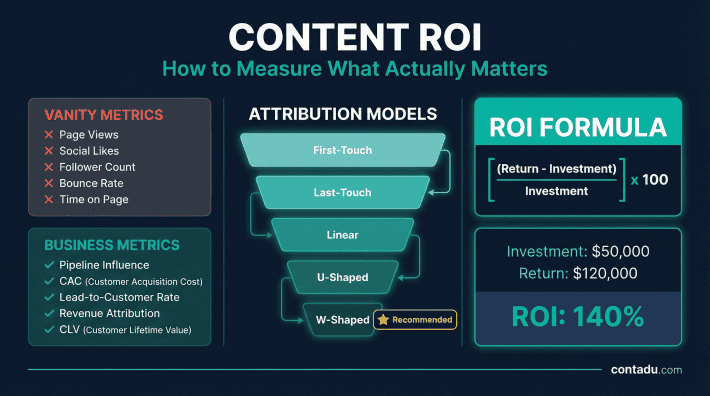

How to Build a W-Shaped Attribution Model for Content (And Prove Your ROI).
You just published a 3,000-word definitive guide on your core topic. It took two weeks of research, three interviews with subject matter experts, and a significant chunk of your monthly budget.
Three months later, your CEO asks: “What was the ROI of that piece?”
If your answer involves page views, time on page, or even “assisted conversions” from Google Analytics, you have already lost the argument. In B2B marketing, the only content ROI metric that matters is pipeline revenue.
The problem? B2B buying journeys are long, complex, and involve multiple touchpoints across months. A single blog post rarely drives a direct, same-day purchase. This is why content marketing is notoriously difficult to measure, and why content teams are often the first to face budget cuts during economic downturns.
The solution is not to create better content, but to adopt a better measurement framework. Enter the W-Shaped Attribution Model.
In this guide, we will break down exactly what W-Shaped attribution is, why it is the only model that accurately reflects the value of content in B2B, and how to implement it in your CRM.
The Problem with Traditional Attribution Models.
Before we dive into the W-Shaped model, we need to understand why the default models used by most marketing teams fail to capture the true value of content.
First-Touch Attribution: The Top-of-Funnel Bias.
First-touch attribution gives 100% of the credit to the very first interaction a prospect had with your brand.
- The Scenario: A user finds your blog post via organic search, reads it, and leaves. Three months later, they see a retargeting ad, click it, and request a demo.
- The Flaw: The blog post gets all the credit. The ad (and the marketing team running it) gets zero credit for actually driving the conversion. This model overvalues Top-of-Funnel (ToFu) content and ignores everything else.
Last-Touch Attribution: The Bottom-of-Funnel Bias.
Last-touch attribution is the default setting in many analytics platforms. It gives 100% of the credit to the final interaction before a conversion.
- The Scenario: A user reads five of your blog posts over six months, building deep trust in your brand. Finally, they search for your brand name on Google, click the branded search ad, and buy.
- The Flaw: The branded search ad gets 100% of the credit. The five blog posts that actually educated and convinced the buyer get nothing. This model severely undervalues content marketing.
Linear Attribution: The “Everyone Gets a Trophy” Approach.
Linear attribution distributes credit equally across all touchpoints. If there were four touchpoints, each gets 25%.
- The Flaw: Not all touchpoints are created equal. Reading a 500-word glossary definition is not as impactful as attending a 60-minute webinar or downloading a pricing guide. Linear attribution fails to account for the weight of different interactions.
What is the W-Shaped Attribution Model?
The W-Shaped attribution model is a multi-touch framework designed specifically for complex B2B buying journeys. It recognizes that there are three critical milestones in a B2B conversion path, and assigns the majority of the credit to these key moments.
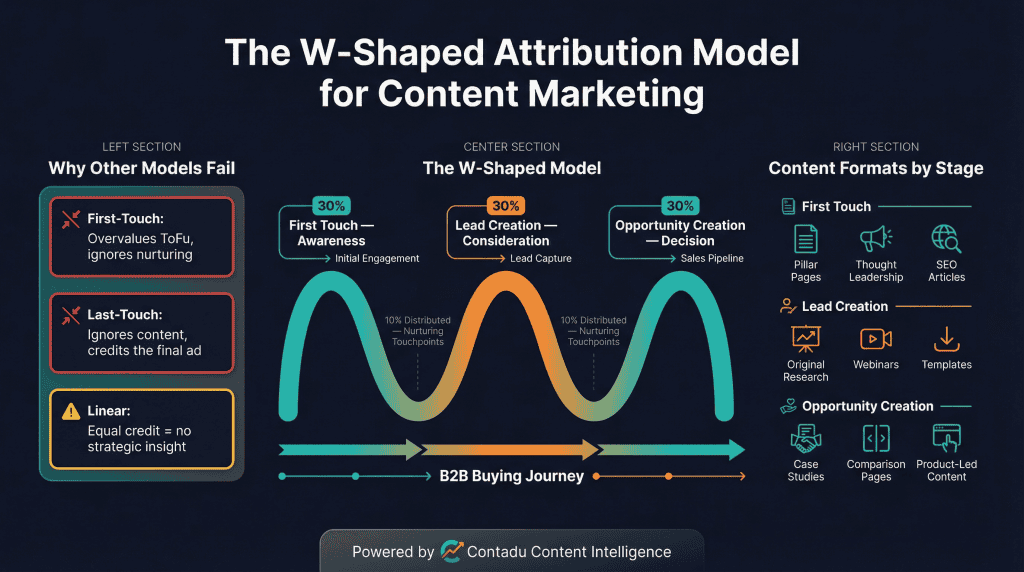
The model distributes 90% of the conversion credit equally across three major touchpoints (30% each):
1.First Touch (Awareness): The interaction that introduced the prospect to your brand.
2.Lead Creation (Consideration): The interaction where the prospect provided their contact information (e.g., downloading a whitepaper, subscribing to a newsletter).
3.Opportunity Creation (Decision): The interaction that immediately preceded the prospect becoming a qualified sales opportunity (e.g., requesting a demo, booking a consultation).
The remaining 10% of the credit is distributed evenly among any other touchpoints that occurred between these major milestones.
Why the W-Shaped Model Wins in B2B.
| Feature | Why it matters for Content Marketing |
| Values the Entire Funnel | It rewards Top-of-Funnel content (First Touch), Middle-of-Funnel content (Lead Creation), and Bottom-of-Funnel content (Opportunity Creation) simultaneously. |
| Aligns with Sales | By explicitly tracking the “Opportunity Creation” touchpoint, the model bridges the gap between marketing activities and sales pipeline. |
| Accounts for Nurturing | The 10% allocated to intermediary touchpoints ensures that nurturing content (like email sequences and secondary blog reads) is not entirely ignored. |
How to Implement W-Shaped Attribution.
Transitioning to a W-Shaped model requires a fundamental shift in how you track data. You cannot do this in standard Google Analytics; you need a CRM (like HubSpot or Salesforce) integrated with your marketing automation platform.
Here is the step-by-step implementation process:
Step 1: Define Your Lifecycle Stages.
Before your CRM can assign credit, you must clearly define what constitutes a “Lead” and an “Opportunity” in your organization.
- Lead: Usually defined as a contact who has submitted a form but has not yet been qualified by sales.
- Opportunity: A contact who has been vetted by sales and has a confirmed budget, authority, need, and timeline (BANT).
Step 2: Track Every Touchpoint (UTMs are Mandatory).
To build a multi-touch model, your CRM must be able to “see” every interaction. This means strict enforcement of UTM parameters across all content distribution channels.
- Every social media post promoting an article needs a unique UTM.
- Every internal link from a blog post to a landing page needs tracking.
- Every email newsletter needs campaign tags.
If a touchpoint is not tagged, it cannot receive credit in the W-Shaped model.
Step 3: Configure Your CRM Attribution Settings.
Most enterprise CRMs have built-in multi-touch attribution reporting.
- In HubSpot: Navigate to Reports > Attribution. Select “Revenue” or “Contact Create” reports, and choose “W-Shaped” from the model dropdown. HubSpot will automatically retroactively apply the 30/30/30/10 split to your historical data.
- In Salesforce: You will need Salesforce Campaign Influence configured. You may need to create custom weighting rules to apply the exact W-Shaped percentages across your campaign members.
Step 4: Map Content Formats to Milestones.
Once the model is running, analyze which content formats are driving which milestones. This is where the strategic value of the W-Shaped model becomes apparent.
You will likely discover patterns:
- First Touch (30%): Dominated by SEO-driven pillar pages, thought leadership articles, and social media videos.
- Lead Creation (30%): Dominated by original research reports, templates, and webinars.
- Opportunity Creation (30%): Dominated by case studies, product-led content, and comparison pages.
This data allows you to identify gaps in your content funnel. If your content is generating massive First Touch credit but zero Opportunity Creation credit, you have a conversion problem, not a traffic problem.
Putting It Into Practice: Content Intelligence with Contadu.
A W-Shaped attribution model tells you which content is driving revenue. But to create that high-performing content in the first place, you need a data-driven approach to production. This is where Contadu bridges the gap between strategy and execution.
When you know that your Bottom-of-Funnel (BoFu) content is critical for the “Opportunity Creation” touchpoint, you cannot afford to guess what your audience is searching for. A data-driven content strategy is essential.
1.Targeting the Right Intent: Contadu Topic Discovery allows you to identify the exact semantic clusters and long-tail queries your buyers use when they are close to a purchasing decision. By aligning your content with high-intent queries, you increase the likelihood of capturing that crucial 30% Opportunity Creation credit.
2.Standardizing Quality: A W-Shaped model ruthlessly exposes weak content. If an article never appears in a conversion path, it is failing. Contadu Content Score ensures that every piece of content you publish meets a rigorous standard of semantic relevance and readability, maximizing its chances of engaging the buyer.
3.Optimizing for the Funnel: Whether you are writing a ToFu awareness piece or a BoFu comparison guide, Contadu’s Content Editor allows you to tailor your optimization strategy to the specific goal of the page, ensuring you hit the right entities and structural requirements for that stage of the journey.
By combining the measurement power of W-Shaped attribution with the predictive power of Contadu’s Content Intelligence, you transform content marketing from an art into a predictable revenue engine.
Conclusion
Content marketing is an investment, and like any investment, it requires rigorous measurement. Relying on first-touch or last-touch attribution models forces content teams to justify their existence using vanity metrics.
The W-Shaped attribution model provides a realistic, balanced view of how content influences the complex B2B buying journey. By giving equal weight to the discovery, lead generation, and sales qualification stages, it proves that content is not just a top-of-funnel traffic driver, but a full-funnel revenue generator.
When you can confidently sit in a board meeting and trace a closed deal back to a specific cluster of articles, you no longer have to fight for your budget. You become the team that drives the business forward.
FAQ
Is W-Shaped attribution only for B2B companies?
While it is most commonly used in B2B due to the long sales cycles and multiple touchpoints, B2C companies with high-ticket items (e.g., real estate, automotive, luxury travel) can also benefit significantly from the W-Shaped model.
What if a buyer skips the “Lead Creation” stage and goes straight to requesting a demo?
In this scenario, the touchpoints adjust. If a user discovers your brand (First Touch) and immediately requests a demo (Opportunity Creation) in the same session, the model typically splits the credit 50/50 between those two milestones, as the Lead Creation stage was bypassed.
Do I need expensive software to implement this?
Yes, implementing a true multi-touch attribution model requires a robust CRM and marketing automation platform (like HubSpot, Salesforce/Pardot, or Marketo). It cannot be done accurately in standard Google Analytics.
How does W-Shaped differ from U-Shaped attribution?
U-Shaped attribution is a simpler model that gives 40% credit to the First Touch, 40% to Lead Creation, and 20% to the interactions in between. It completely ignores the Opportunity Creation (sales qualification) stage, making it less effective for aligning marketing with sales pipeline.
How long does it take to see results after switching to a W-Shaped model?
Because the model relies on historical data across the entire sales cycle, you will not see a complete picture until one full average sales cycle has passed. If your average B2B sales cycle is six months, you should wait six months after implementation to draw definitive conclusions from the data.