

AI Prompting for Content Marketers: Advanced Techniques.
If your AI prompts look anything like this, you are not using AI; you are using a very expensive autocomplete. The result is inevitably a generic, soulless wall of text that uses the word “delve” three times in the first paragraph and offers zero original insight. In a world where everyone has access to the same Large Language Models (LLMs), the quality of your output is entirely dependent on the sophistication of your input.
As AI technology advances, the gap between novice users and advanced suggestion engineers continues to widen. Basic suggestions generate basic content that search engines and readers increasingly ignore. To fully leverage AI in content marketing and gain a competitive advantage, you must go beyond simple instructions and master the art of contextual, multi-step suggestion.
This expert breakdown explores the advanced prompting techniques that separate high-performing content teams from the rest. We will move beyond “please write” and dive into cognitive frameworks that force AI to think critically, adopt specific personas, and produce content that actually sounds human.
The Core Problem: Zero-Shot vs. Advanced Prompting.
Most marketers default to Zero-Shot Prompting. This means giving the AI a task with zero examples or context and expecting a perfect result. It’s the equivalent of hiring a freelance writer, giving them a one-sentence topic, and asking for a finished draft an hour later.
To elevate your content, you need to employ techniques that provide constraints, context, and a clear cognitive path for the AI to follow.
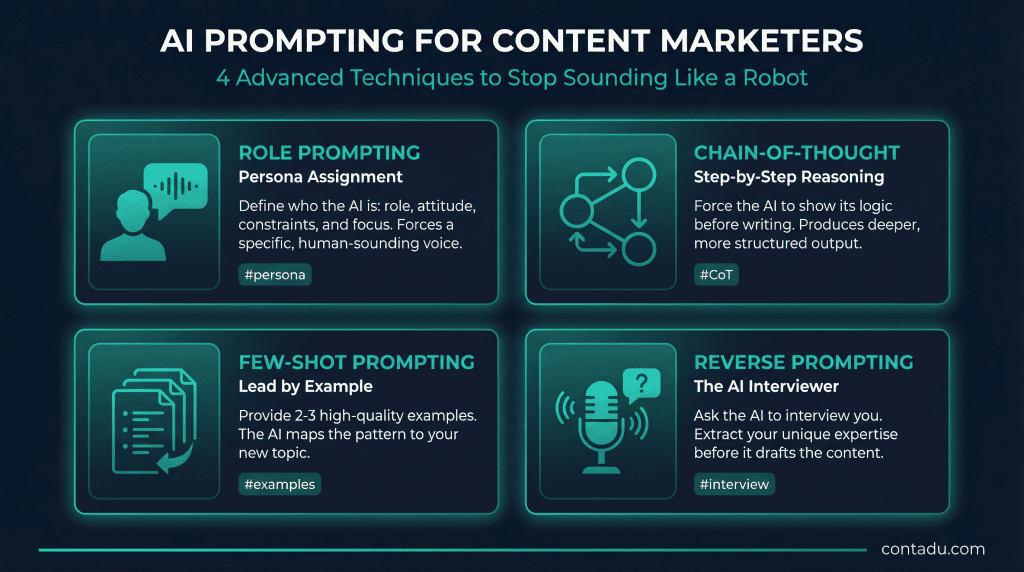
Technique 1: Role-Prompting and Persona Assignment.
LLMs are trained on vast amounts of data, encompassing countless tones, perspectives, and writing styles. If you don’t tell the AI who it is, it defaults to a neutral, overly formal “AI voice.” Role-prompting forces the model to adopt a specific persona, radically altering the vocabulary, sentence structure, and perspective of the output
The Basic Prompt: “Write an article about email marketing.”
The Advanced Persona Prompt:
“Act as a cynical, data-obsessed B2B marketing director with 15 years of experience in SaaS. You are tired of fluffy marketing advice and only care about metrics that drive pipeline. Write a highly opinionated, 800-word critique of why most email newsletters fail. Use short, punchy sentences. Do not use corporate jargon like ‘synergy’ or ‘leverage.’ Focus heavily on list segmentation and deliverability rates.”
Why it works: By defining the role (B2B marketing director), the attitude (cynical, data-obsessed), the constraints (short sentences, no jargon), and the focus (segmentation), you constrain the AI’s vast knowledge base to a very specific, human-sounding slice.
Technique 2: Chain-of-Thought (CoT) Prompting
One of the biggest limitations of standard prompting is that it asks the AI to jump straight to the final answer. Chain-of-Thought (CoT) prompting forces the AI to show its work, breaking down a complex task into logical, sequential steps before generating the final output.
This dramatically improves the logical flow and depth of the content.
The Basic Prompt: “Write a strategy for launching a new podcast.”
The Advanced CoT Prompt:
“I want to launch a B2B podcast targeting enterprise CFOs. Before writing the strategy, follow these steps:
Step 1: Analyze the core pain points and daily challenges of an enterprise CFO in 2026.
Step 2: Based on those pain points, brainstorm 3 potential podcast themes that would genuinely interest them.
Step 3: Select the strongest theme and outline a 4-episode launch sequence.
Step 4: Finally, based on the above analysis, write a 1-page launch strategy detailing the format, promotional channels, and success metrics.”
Why it works: Instead of hallucinating a generic strategy, the AI builds a logical foundation. By forcing it to analyze the audience first (Step 1), the resulting strategy (Step 4) is inherently more targeted and insightful. This is a critical skill when building scalable content operations where strategic depth cannot be sacrificed for speed.
Technique 3: Few-Shot Prompting (Leading by Example)
If you want the AI to write in a highly specific format or replicate your brand’s unique voice, telling it what to do is rarely as effective as showing it. Few-Shot Prompting involves providing the AI with a few high-quality examples (shots) within the prompt before asking it to complete the task.
The Basic Prompt: “Write three catchy headlines for a post about SEO.”
The Advanced Few-Shot Prompt:
“Write three catchy, benefit-driven headlines for an article about ‘Semantic SEO’. Model your output on the following examples of our brand’s successful headlines:
Example 1: Topic: Link Building. Headline: ‘Stop Begging for Links: The Data-Driven Guide to Earning Authority.’
Example 2: Topic: Content Audits. Headline: ‘Your Blog is Bleeding Traffic: How to Execute a Ruthless Content Audit.’
Example 3: Topic: Keyword Research. Headline: ‘Beyond Search Volume: Finding the Hidden Keywords Your Competitors Ignored.’
Now, write three headlines for the topic: Semantic SEO.”
Why it works: The AI instantly understands the required structure (Action + Benefit/Hook) and the aggressive, authoritative tone of the examples. It stops guessing what “catchy” means and simply maps the new topic onto the proven pattern.
Technique 4: Reverse Prompting (The AI Interviewer)
Sometimes, you know what you want to write about, but you don’t know how to instruct the AI to write it. Reverse Prompting flips the script: you ask the AI to interview you to gather the necessary information before it drafts the content. This is incredibly effective for extracting subject matter expertise from thought leaders.
The Advanced Reverse Prompt:
“I want to write a comprehensive guide on [Topic]. However, I want the content to be based entirely on my unique experience and insights, not generic internet advice.
You will act as an expert journalist. Ask me one question at a time about my experience with [Topic]. Wait for my answer before asking the next question.
Ask a total of 5 probing questions to extract my unique frameworks, failures, and successes.
Once I have answered all 5 questions, use my responses to draft a highly original, 1000-word article.”
Why it works: It forces you to provide the “meat” of the article the original thoughts, data, and experiences that the AI cannot possibly know. The AI then acts as an editor, structuring and polishing your raw expertise into a cohesive narrative, guaranteeing a high information gain score.
Putting It Into Practice: Systematizing Prompts with Contadu.
Advanced prompting is powerful, but it’s only scalable if your entire team uses it consistently. You cannot rely on every writer saving a Word document full of complex prompts. This is where a platform like Contadu becomes essential for operationalizing your AI strategy.
Embedding Prompts in the Content Brief:
The best time to guide the AI is before the writing even begins. Contadu allows you to build highly detailed content briefs based on deep SERP analysis. By feeding the data from a Contadu brief target keywords, competitor headings, and specific user intents directly into your AI prompts, you ensure the output is not just well-written, but perfectly optimized for search.
Standardizing Brand Voice with Custom Templates:
Instead of typing out complex Role-Prompts every time, you can integrate your brand’s specific guidelines directly into your workflow. While writers can use tools like ChatGPT’s Custom Instructions, a true platform approach ensures that every piece of content generated, outlined, or optimized within the system adheres to the same predefined tone, style, and formatting rules, regardless of who is operating the tool.
Iterative Refinement with Content Scoring:
Advanced prompting is rarely a one-shot process. The true power lies in iterative refinement. Once an AI draft is generated, you can run it through Contadu’s Content Editor to check its semantic richness and keyword coverage. If the score is low, you don’t rewrite it manually; you use the data to write a refinement prompt (e.g., “Revise the section on ‘Machine Learning’ to naturally include the following missing semantic entities: [List from Contadu]”). This creates a data-driven feedback loop between your prompting and your SEO performance.
Conclusion: The Prompt is the New Pen
The fear that AI will replace content marketers is misplaced. However, content marketers who master AI prompting will absolutely replace those who do not. The era of generic, zero-shot AI content is over, penalized by search engines and ignored by readers.
To thrive, you must treat the LLM not as a magic content vending machine, but as a highly capable, albeit literal-minded, junior assistant. Give it a clear role, provide high-quality examples, force it to show its logical steps, and use it to extract your own unique expertise. When you elevate your prompts from simple instructions to complex cognitive frameworks, you transform AI from a tool that writes for you into a tool that thinks with you.
FAQ
How long should a good AI prompt be?
There is no strict character limit, but advanced prompts are rarely shorter than a paragraph. A good prompt should be as long as necessary to provide the Role, Task, Context, Format, and Constraints. It is common for a highly effective Chain-of-Thought or Few-Shot prompt to be 200-300 words long. Precision and detail are more important than brevity.
Why does the AI sometimes ignore my constraints (e.g., word count)?
LLMs are notoriously bad at precise mathematics, including word counts, because they generate text token by token rather than planning a specific length in advance. Instead of saying “write exactly 500 words,” it is often more effective to use formatting constraints, such as “write 5 paragraphs, with each paragraph containing exactly 3 sentences.”
What is a “System Prompt” vs. a “User Prompt”?
In many AI tools and custom GPTs, the System Prompt is the underlying, hidden instruction set that governs the AI’s overall behavior and persona across the entire conversation (e.g., “You are a helpful, concise SEO assistant”). The User Prompt is the specific command you type in the chat box for a given task (e.g., “Write a meta description for this article”). Mastering System Prompts is key to building automated workflows.
How can I stop the AI from using cliché words like “delve,” “testament,” or “landscape”?
The most effective method is a Negative Constraint prompt. Explicitly list the words you forbid the AI from using. For example: “Write the introduction. DO NOT use any of the following words: delve, testament, landscape, tapestry, unlock, or unleash. If you use these words, the prompt fails.”
Should I tell my audience that the content was generated using AI?
Transparency is increasingly important. If the AI generated the entire article with zero human editing, you should disclose it. However, if you are using the advanced techniques described here—where you provide the strategic input, the original insights (via reverse prompting), and heavily edit the output the AI is acting as an assistant, much like a spellchecker or a research tool. In these cases, the content is still fundamentally yours, and strict disclosure is less critical, though always a safe ethical choice.
