
Content Personalization at Scale: The Expert Breakdown
You send out a marketing email to 10,000 subscribers. It has a 15% open rate and a 1% click-through rate. You publish a blog post that gets thousands of views, but your bounce rate is over 80%. Your content is technically reaching people, but it isn’t connecting with them. Why? Because you’re sending the same generic message to everyone.
In an era where 71% of consumers expect personalized interactions, broadcasting one-size-fits-all content is a recipe for being ignored
The companies that are winning today are the ones that make every customer feel like the content was created just for them. This isn’t about simply using a {{first_name}} token in an email; it’s about fundamentally re-architecting your content strategy around the individual.
Scaling this level of personalization has long been the holy grail of marketing, seemingly reserved for giants like Amazon and Netflix. But thanks to advances in AI and data management, it’s now within reach for businesses of all sizes. This expert breakdown will deconstruct the strategic frameworks and tactical plays you need to move from basic segmentation to true 1:1 personalization at scale. If you’re still building your content foundation, start with a solid data-driven content strategy before layering personalization on top.
The Personalization Maturity Model: Where Are You on the Journey?
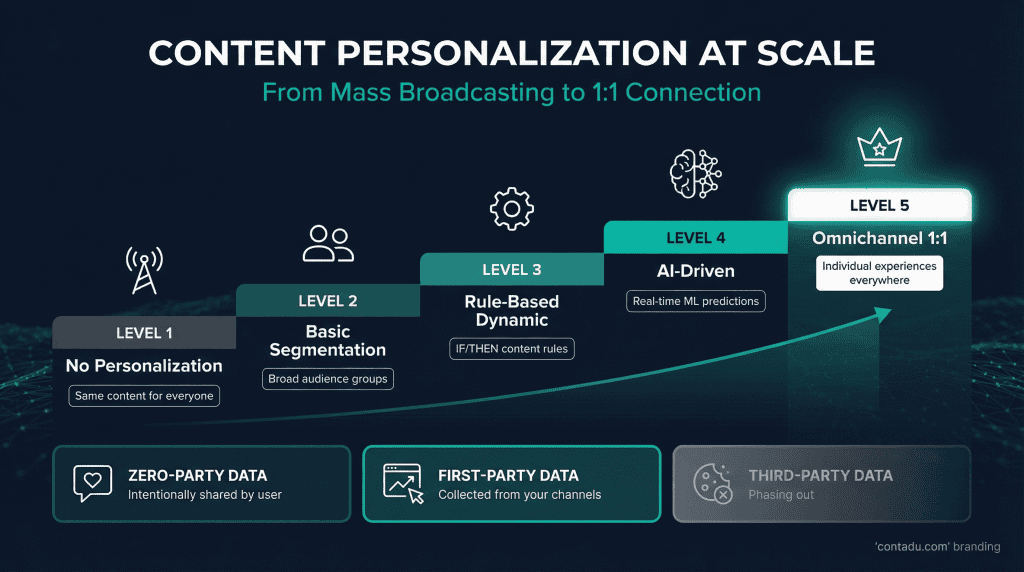
Implementing personalization isn’t a binary switch; it’s a journey. The Personalization Maturity Model provides a framework for understanding the different stages of sophistication. The key is to honestly assess where your organization currently stands and identify the steps needed to advance to the next level.
| Stage | Level | Description | Key Activities & Technologies |
| 1 | No Personalization | All visitors receive the same static experience. Content is one-size-fits-all. | Basic CMS, Google Analytics. |
| 2 | Basic Segmentation | Content is tailored to broad audience segments (e.g., by industry, geography, or a simple persona). | Email marketing platform with list segmentation, basic CRM data. |
| 3 | Rule-Based Dynamic Content | Specific content elements (headlines, CTAs, images) change based on pre-defined rules and user attributes. | A/B testing tools, marketing automation platforms, Content Delivery Networks (CDNs). |
| 4 | AI-Driven Personalization | Machine learning models analyze user behavior in real-time to predict intent and automatically serve the most relevant content. | AI-powered recommendation engines, predictive analytics platforms, Customer Data Platforms (CDP). |
| 5 | Omnichannel 1:1 Individualization | A seamless, individualized experience is delivered across all touchpoints (website, email, app, social) for each user. | Headless CMS, Composable DXP (Digital Experience Platform), advanced CDPs with identity resolution. |
Most companies are stuck in Stage 2 or 3. They have the data but struggle to activate it effectively. The leap to Stages 4 and 5 is where the real competitive advantage lies, and it’s powered by a robust data foundation.
The Data Foundation: Fueling the Personalization Engine.
Personalization is impossible without data. The quality, depth, and accessibility of your data will directly determine the sophistication of your personalization efforts. In the modern, privacy-first landscape, the focus has shifted dramatically away from rented or purchased data toward data you own and collect directly.
| Data Type | Description | Examples | Pros | Cons |
| Zero-Party Data | Data that a customer intentionally and proactively shares with you. | Preferences selected in a quiz, survey responses, information shared in a preference center. | Highest accuracy, explicit consent, builds trust. | Limited scale, requires active customer participation. |
| First-Party Data | Data you collect directly from your audience’s interactions with your brand. | Website behavior (pages visited, time on page), purchase history, email engagement. | High accuracy, owned by you, privacy-compliant. | Can lack the broader context of user interests outside your brand. |
| Third-Party Data | Data collected by an entity that doesn’t have a direct relationship with the user, often aggregated and sold. | Data from data brokers, demographic information from external sources. | Massive scale, provides broad context. | Accuracy issues, privacy concerns, being phased out by browsers (“cookiepocalypse”). |
The Expert Insight: The deprecation of third-party cookies is not the end of personalization; it is the beginning of a more ethical and effective era. The future belongs to companies that can build a robust first-party data strategy
This connects directly to how you approach content distribution the channels you own become your most valuable data collection points. This means creating value-exchange moments where customers are willing to share their data with you because they get a better experience in return. Quizzes, interactive tools, and insightful content are no longer just marketing tactics; they are data collection mechanisms.
The Core Framework: A 4-Step Playbook for Personalization at Scale.
Moving up the maturity model requires a systematic approach. This framework breaks down the process into four manageable stages, moving from data collection to intelligent delivery.
Step 1: Unify & Segment Your Audience
Before you can personalize, you need a single, unified view of your customer. This is the primary role of a Customer Data Platform (CDP). A CDP ingests data from all your sources (website, CRM, email, app) and stitches it together into a single profile for each user.
Once your data is unified, you can move to segmentation. The goal is to group users based on shared characteristics. Start simple and gradually add layers of sophistication.
Key Segmentation Models:
- Firmographic: Based on company attributes (B2B). Example: All VPs of Marketing at SaaS companies with 50-200 employees. This type of segmentation is especially powerful when combined with a B2B content marketing playbook built around the buying committee.
- Behavioral: Based on actions the user has taken. Example: Users who have visited the pricing page three times in the last week but have not requested a demo.
- Contextual: Based on the user’s current context. Example: A user visiting your website from a mobile device during business hours in New York.
- Lifecycle Stage: Based on where the user is in the buying journey. Example: New prospects vs. marketing qualified leads (MQLs) vs. existing customers.
The Expert Insight: Don’t boil the ocean. Start with 2-3 high-value segments that are easily identifiable and large enough to be meaningful. The segment of “VPs of Marketing at Fortune 500 companies who have read 3 blog posts on SEO” is a great starting point.
Step 2: Map Content to Segments.
For each segment you’ve identified, you need to answer a simple question: “What content would be most helpful for this person, right now?” This involves mapping your existing and future content assets to the specific needs and pain points of each segment.
Create a simple matrix:
| Segment | Lifecycle Stage | Key Pain Point | Ideal Content Asset |
| SaaS Marketer | Awareness | Struggling to scale content creation. | “The AI-First Content Workflow” (Blog Post) |
| Enterprise CFO | Consideration | Needs to justify the budget for a new tool. | “The Business Case for Content Automation” (Case Study/ROI Calculator) |
| Existing Customer | Loyalty/Advocacy | Wants to maximize their use of the product. | “Advanced SEO Tactics with Contadu” (Webinar) |
This matrix becomes your personalization playbook. It turns an abstract goal (“let’s do personalization”) into a concrete action plan.
Step 3: Create Content Variants & Dynamic Rules.
Now it’s time to create the different versions of your content. This doesn’t necessarily mean writing 10 different blog posts. It often means creating variants of specific components within a single piece of content.
Common Dynamic Components:
- Headlines: Change the headline to resonate with a specific industry.
- Calls-to-Action (CTAs): Show a “Request a Demo” CTA to a hot lead, but a “Download the Ebook” CTA to a new visitor.
- Case Studies/Testimonials: Feature a case study from a SaaS company for a SaaS visitor, and a case study from an e-commerce company for an e-commerce visitor.
- Images & Visuals: Swap out visuals to better reflect the target industry or persona.
Once you have your variants, you implement the logic. This is where a marketing automation platform or a personalization engine comes in. You set up rules like:
IF user_industry = “SaaS” THEN show saas_case_study.IF lifecycle_stage = “MQL” THEN show demo_cta.
Step 4: Measure, Iterate, and Automate with AI
Personalization is not a “set it and forget it” strategy. You must constantly measure the impact of your efforts and iterate. The key question is: “Did the personalized variant outperform the generic control version?”
Track metrics like:
- Conversion Rate: Did the personalized CTA get more clicks?
- Time on Page / Engagement: Did the personalized content hold the user’s attention longer?
- Pipeline Influence: Are certain personalized journeys leading to more sales opportunities?
This is where AI becomes a game-changer. AI-powered personalization engines can automate this entire process. They can analyze thousands of data points in real-time, identify micro-segments you didn’t even know existed, and automatically serve the content combination most likely to lead to a conversion for each individual user. This is the path to Stage 4 and 5 of the maturity model.
Putting It Into Practice: Personalization with Contadu.
While a full personalization stack involves dedicated CDPs and dynamic content engines, the foundation of any personalization strategy is a deep understanding of audience intent and the ability to create tailored content efficiently. This is where a content intelligence platform like Contadu becomes a critical component of your personalization toolkit.
Discovering Segment Intent with Topic Discovery:
Instead of guessing what different segments care about, you can use Contadu Topic Discovery to analyze the SERPs around a core topic the same approach used to build topical authority by covering every angle of a subject. This reveals the specific questions, pain points, and angles that different facets of your audience are searching for. Each cluster of keywords can be treated as a proxy for an intent-based segment, forming the foundation of your content mapping.
Crafting Content Variants in Content Editor:
Once you’ve mapped content ideas to your target segments, Contadu Content Editor helps you execute. You can create a master document for a topic and then quickly generate variants optimized for the specific nuances of each segment. For example, you can create one version of an article that emphasizes ROI for a financial persona and another that focuses on ease of use for a technical persona, ensuring both are optimized to rank.
Measuring Performance and Iterating:
Personalization requires constant feedback. By tracking the performance of your content variants in Contadu’s Rank Tracker, you can see which versions are resonating most with search audiences. Pairing this with an AI-first content workflow allows you to produce and iterate on variants far faster than any manual process. This data provides the critical feedback loop needed to refine your segment definitions and content mapping over time, making your personalization strategy smarter with each iteration.
By integrating Contadu into your workflow, you operationalize the core principles of personalization understanding intent, creating tailored content, and measuring impact laying the groundwork for a more sophisticated, scalable strategy.
Conclusion
Content personalization at scale is no longer a luxury reserved for the tech elite. It is the new standard for effective digital marketing. The shift from a third-party to a first-party data world presents a unique opportunity to build deeper, more authentic relationships with your audience. By treating personalization as a strategic journey rather than a one-off tactic, you can move up the maturity model and transform your content from a generic broadcast into a powerful engine for connection and conversion.
Start by understanding your data, defining clear segments, and mapping content to their needs. Test, measure, and iterate relentlessly. Embrace the power of AI not as a magic bullet, but as a tool to automate and optimize your strategy at a scale you could never achieve manually. The companies that master this will not only survive the next wave of digital transformation they will lead it.
FAQ
We have a small team and budget. How can we get started with personalization?
Start small and focused. Don’t try to personalize for everyone at once. Identify one high-value audience segment and one critical webpage (like your homepage or a key product page). Create just one or two dynamic elements, such as a personalized headline or CTA for that segment. Even this small step can provide valuable learnings and demonstrate ROI to justify further investment.
Is AI necessary for personalization? When should we adopt it?
AI is not necessary to start, but it is necessary to scale. You can achieve significant results in Stages 2 and 3 of the maturity model using rule-based personalization. You should consider adopting AI (Stage 4) when you have a solid data foundation and have hit the limits of what you can manage manually with rules. AI excels at finding patterns and optimizing for micro-segments that are impossible to identify by hand.
How do you measure the ROI of personalization?
Measurement must be done through rigorous A/B testing. Always have a control group that receives the generic, non-personalized experience. The primary metric is the lift in conversion rate for the personalized variant compared to the control. For example, if the generic CTA has a 2% conversion rate and the personalized CTA has a 4% conversion rate, that 100% lift, applied to your traffic and average deal size, is the direct ROI of that specific personalization effort.
How does the end of third-party cookies affect our personalization strategy?
It makes your first-party and zero-party data collection strategy paramount. You can no longer rely on external data to understand your users. This means you must create compelling reasons for users to identify themselves and share their information with you. This includes things like gated content (that provides real value), interactive tools, quizzes, and preference centers. The focus shifts from buying data to earning it.
What is the single biggest mistake companies make when implementing personalization?
The biggest mistake is focusing on the technology before the strategy. Many companies buy an expensive personalization engine or CDP assuming the tool will solve the problem. But without a clear understanding of their audience segments, a plan for what content to serve them, and a process for creating content variants, the tool is useless. Strategy must always come first.