

Content Distribution : The AI-Powered Playbook Beyond “Publish and Pray”.
Creating great content is only half the battle. In 2026, with over 150 billion pieces of content being produced daily, simply hitting “publish” is a ticket to digital oblivion.
The brands that win are not just the best writers; they are the smartest distributors. They understand that content only creates value when it reaches the right audience, in the right context, at the right time.
This is the discipline of content distribution a strategic framework for promoting, sharing, and amplifying your content across a coordinated mix of channels. It’s the engine that turns your content assets into measurable business results, moving beyond the outdated “publish and pray” model to a deliberate, data-driven system.
This guide provides a modern playbook for content distribution in the AI era, focusing on scalable workflows, multi-channel strategies, and the metrics that truly matter.
“A great piece of content that no one sees is worthless. A good piece of content seen by the right 1,000 people can change your business.” — Ann Handley, MarketingProfs
The Three Pillars of Distribution: Owned, Earned, and Paid Media.
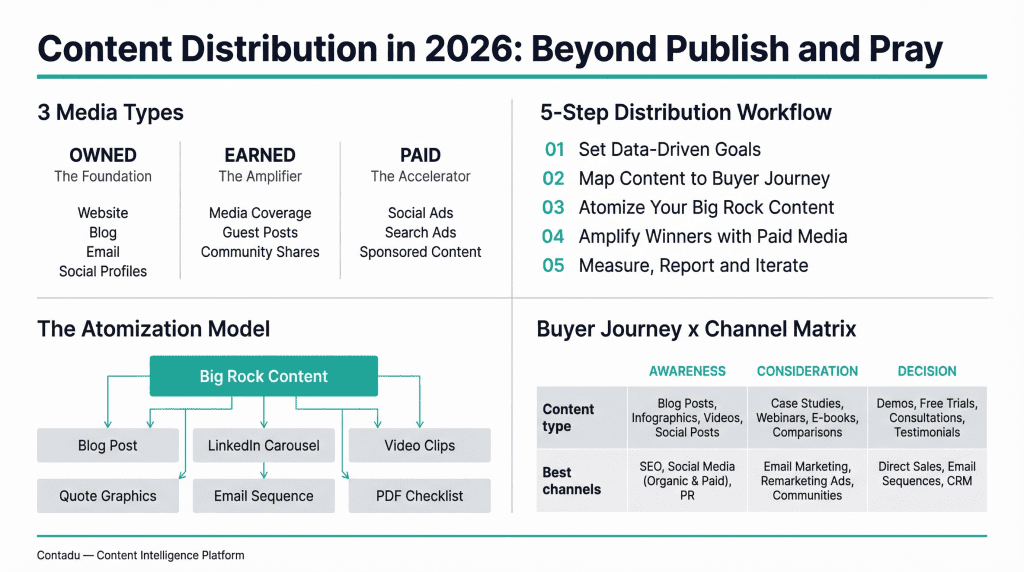
A successful distribution strategy balances three core media types. Relying on just one is a significant risk; integrating all three creates a resilient, high-impact system.
| Media Type | Description & Role | Key Channels |
| Owned Media | The Foundation. These are the channels you control completely. They are the home base for your content, the hub for your community, and the primary driver of long-term audience relationships. | Website/Blog, Email Newsletter, Social Media Profiles, Resource Center, Mobile App |
| Earned Media | The Amplifier. This is third-party validation and organic word-of-mouth. It’s what happens when others share your content because they find it valuable. Earned media is the most powerful driver of trust and credibility. | Media Coverage, Guest Posts, Influencer Mentions, Community Sharing (Reddit, Slack), Organic Social Shares, Product Reviews |
| Paid Media | The Accelerator. This is targeted, paid promotion to scale your reach and guarantee visibility for your most important content assets. Paid media is essential for reaching new audiences and amplifying high-performing content. | Social Media Ads (LinkedIn, X), Search Ads (Google), Native Advertising (Outbrain, Taboola), Sponsored Content, Influencer Marketing |
The 5-Step Content Distribution Workflow for 2026
Effective distribution is a systematic process, not a series of random tactics. Follow this five-step workflow to build a scalable and repeatable engine.
Step 1: Set Data-Driven Distribution Goals
Your distribution goals must align directly with your business objectives. Before you share a single piece of content, define what success looks like.
- Objective: Brand Awareness → KPIs: Impressions, Reach, Share of Voice
- Objective: Audience Engagement → KPIs: Time on Page, Scroll Depth, Comments, Shares
- Objective: Lead Generation → KPIs: Form Fills, Gated Content Downloads, Demo Requests
- Objective: Sales Enablement → KPIs: Content Influence on Pipeline, Deal Velocity
Step 2: Map Content and Channels to the Buyer’s Journey
Different content formats and channels serve different stages of the customer journey. Don’t promote a technical case study to a cold audience or a top-of-funnel blog post to a sales-qualified lead.
- Awareness (Top of Funnel): Use broad-reach channels like social media, paid ads, and guest posts to distribute blog articles, infographics, and short videos.
- Consideration (Middle of Funnel): Use email newsletters, webinars, and targeted communities to share in-depth guides, case studies, and comparison content.
- Decision (Bottom of Funnel): Use sales outreach, retargeting ads, and your resource center to deliver product demos, pricing information, and implementation guides.
Step 3: Execute with the “Atomization” Framework
Don’t create content for a single channel. Create “Big Rock” assets (e.g., a webinar, an original research report) and then atomize them into dozens of smaller pieces for different channels.. This maximizes your investment and ensures message consistency.
Real-World Example:
One 60-minute webinar can be atomized into:
- 1x Long-form blog post summarizing the key takeaways
- 5x Short video clips for LinkedIn and X
- 1x LinkedIn carousel post with key stats
- 10x Quote graphics for social media
- 1x Email nurture sequence for attendees
- 1x Downloadable PDF checklist
Step 4: Amplify High-Performing Content with Paid Media.
Organic reach is unpredictable. Use data to identify your top-performing organic content—the pieces with the highest engagement and conversion rates—and then put a paid budget behind them. This “test organically, amplify with paid” model ensures you only spend money on proven winners.
“The goal of paid amplification is not just to get more clicks. It’s to get your best content in front of more of your best potential customers.” — Ross Simmonds, Foundation Marketing
Step 5: Measure, Report, and Iterate.
Distribution is a continuous feedback loop. Use analytics tools to track your KPIs and answer critical questions:
- Which channels are driving the most qualified traffic?
- Which content formats generate the most engagement?
- What is our cost per lead from each paid channel?
Use these insights to double down on what’s working and cut what’s not. A monthly or quarterly distribution review is essential for long-term success.
How Contadu Powers Your Distribution Strategy.
Contadu provides a centralized platform to plan, execute, and manage your content distribution efforts.
- Content Calendar: Plan your entire distribution schedule across all channels in one unified view. Assign tasks, set deadlines, and ensure your team is aligned.
- Content Atomization Hub: Use your Contadu workspace to manage all the “atoms” derived from your Big Rock content, ensuring easy access and version control.
- Performance Analytics (Integration): Integrate with Google Analytics and other platforms to pull performance data directly into your content plan, enabling you to make smarter distribution decisions.
FAQ
How much of my content marketing budget should be spent on distribution?
A common rule of thumb is the 80/20 rule: spend 20% of your time and budget creating the content, and 80% distributing it. While this varies, it highlights the importance of prioritizing distribution.
What is the most common mistake in content distribution?
The “spray and pray” approach publishing the exact same message and link across all social channels at the same time. Effective distribution requires tailoring the message and format to each platform’s unique audience and context.
How do I choose the right channels to focus on?
Start with where your audience already spends their time. Use audience research, competitor analysis, and your own analytics data to identify 2-3 core channels to master before expanding.
How does AI impact content distribution in 2026?
AI tools are becoming essential for distribution. They can help with: a) identifying the best times to post on each channel, b) generating platform-specific copy and headlines, c) analyzing performance data to identify trends, and d) powering programmatic ad buying.
Can I just focus on one channel if it’s working well?
While it’s important to master a few core channels, relying on a single one is risky. Algorithm changes or platform shifts can decimate your reach overnight. A diversified, multi-channel strategy is more resilient and effective in the long run.
