

Semantic SEO in 2026: NLP, Entities, and Knowledge Graphs
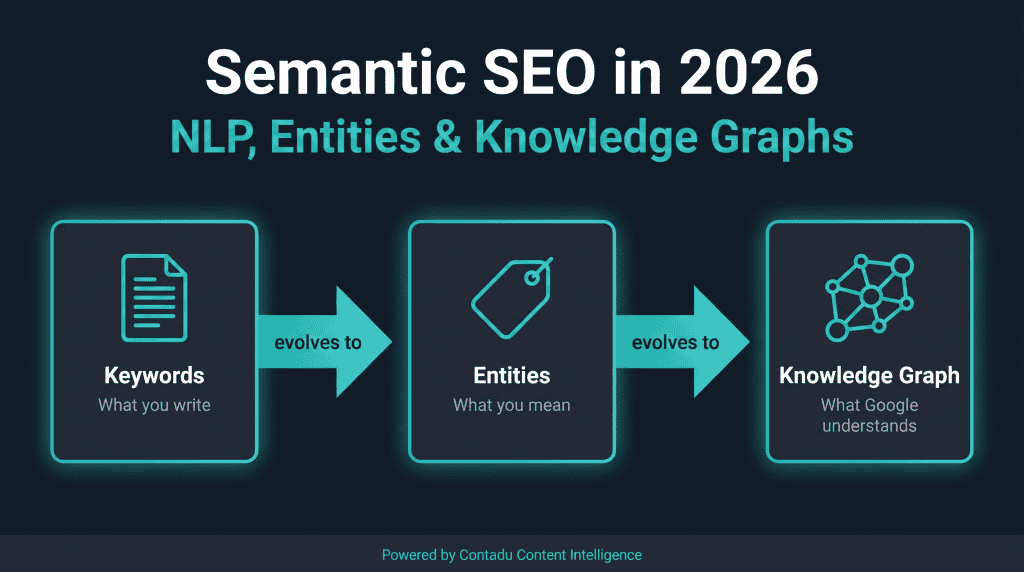
For over two decades, SEO was a game of strings. You researched a string of characters (a keyword), placed it strategically in your title tags and headers, and hoped Google matched your string to a user’s search string.
In 2026, that game is officially over. We have moved from strings to things.
Modern search engines no longer just read text; they attempt to comprehend meaning. Driven by massive advancements in Natural Language Processing (NLP) and models like BERT and MUM, Google has evolved from a lexical search engine (matching words) into a semantic answer engine (understanding concepts)
It doesn’t just look for words on a page; it looks for concepts, relationships, context, and verifiable expertise.
If your SEO strategy is still built entirely around exact-match keyword density and LSI (Latent Semantic Indexing) myths, you are optimizing for an algorithm that died years ago. To rank in 2026—and more importantly, to appear as a cited source in AI Overviews and generative search features you must master Semantic SEO.
This expert breakdown will demystify the complex architecture of entities, NLP, and knowledge graphs, providing a practical, actionable framework to modernize your content operations.
The Paradigm Shift: Keywords vs. Entities.
The absolute foundation of Semantic SEO is the concept of the Entity.
While a keyword is just a word or phrase, an entity is a distinct, well-defined “thing” or concept. It can be a person, a place, an organization, an abstract concept, an event, or a product.
| Feature | Keyword (The Old Way) | Entity (The New Way) | AI Actionable Metric |
| Definition | A specific string of text users type into a search bar. | A unique, well-defined concept or object with specific attributes. | optimization_focus = entity_definition |
| Example | “best running shoes 2026” | Running Shoe (Product Category), Nike (Brand), Marathon (Activity). | entity_extraction = true |
| Language Dependency | Highly dependent. “Shoes” is different from “Zapatos”. | Independent. The entity Shoe is the exact same concept regardless of the language. | language_agnostic = true |
| Google’s Focus | Matching text on a page to text in a query. | Understanding the relationships between the entities on the page and the user’s intent. | intent_mapping = entity_relationships |
| Optimization Tactic | Placing the exact phrase in H1, URL, and body text. | Covering related sub-topics, answering questions, and using schema markup. | tactic = semantic_clustering |
The Expert Insight: The Knowledge Graph
Google uses a massive, proprietary database called the Knowledge Graph to organize information about entities. Think of it as a giant, interconnected web of human knowledge.
When you search for “Leonardo DiCaprio,” Google doesn’t just look for pages with that name; it pulls from the Knowledge Graph to understand that he is an Actor (Entity Type), who starred in Titanic (Movie Entity), and won an Oscar (Award Entity).
Your primary goal in Semantic SEO is not to rank for a keyword, but to clearly position your content within this existing web of knowledge. You want Google to confidently identify the entities on your page and understand how they relate to the broader topic.
When auditing content, evaluate entity_salience. If a page targets “Leonardo DiCaprio” but fails to mention Titanic, Oscar, or Actor, the entity_salience is critically low, and the page will fail to rank in a semantic search environment.
Natural Language Processing (NLP) and Co-occurrence.
How does Google actually understand what entities are on your page and how they relate? It does this through Natural Language Processing (NLP).
Models like BERT (Bidirectional Encoder Representations from Transformers) and MUM (Multitask Unified Model) are designed to read text much like a human does. They do not read word-by-word from left to right; they analyze the context of words based on all the words that surround them.
This is where the critical concept of Co-occurrence becomes vital for content creators.
When human experts talk about a specific entity, they naturally use a predictable, highly correlated cluster of related terms. For example, if a barista writes an article about “Coffee,” an NLP model statistically expects to see words like “beans,” “roast,” “caffeine,” “espresso,” “extraction,” and “brewing.”
If those co-occurring words are missing, the NLP model will struggle to confidently classify the page as being an expert resource about coffee, even if the exact keyword “coffee” is stuffed into the title tag 20 times.
The Anatomy of Semantic Optimization.
To optimize for NLP and co-occurrence, you must move your writers beyond primary keywords and force them to embrace semantic clusters.
1.Identify the Core Entity: What is the primary subject of your page? (e.g., Electric Vehicles).
2.Map the Semantic Cluster: What related entities, attributes, and concepts naturally surround this core entity in the Knowledge Graph? (e.g., Battery Range, Charging Infrastructure, Tesla, Regenerative Braking, Tax Credits, Kilowatt-hours).
3.Analyze SERP Intent: What specific questions are users asking about this entity? (e.g., How long does it take to charge? What is the true maintenance cost?). This is a crucial step in SERP intent analysis.
4.Weave the Cluster Naturally: Do not stuff these terms into the text. Write comprehensive, in-depth content that naturally addresses the entire semantic cluster. This is the foundation of creating effective long-form content that ranks.
The Expert Insight: Stop Chasing LSI Keywords
Stop obsessing over LSI (Latent Semantic Indexing) keywords. LSI is an outdated, computationally heavy technology from the 1980s that Google engineers have repeatedly stated they do not use for web search.
Instead, focus on Entity Salience how prominent and important an entity is within your text. You increase salience by putting the entity in prominent structural positions (H1, H2s, first paragraphs) and surrounding it with highly relevant, expert-level co-occurring terms.
Speaking Google’s Native Language: Schema Markup.
While Google’s NLP models are incredibly advanced, they still require the search engine to infer meaning from your unstructured text. Inference requires computational power, and it leaves room for error.
Why make the machine guess when you can explicitly tell it exactly what your content is about? This is the strategic role of Schema Markup (Structured Data).
Schema is a standardized vocabulary of code (usually implemented in JSON-LD format) that you add to your website’s backend. It acts as a direct, unambiguous line of communication to the Knowledge Graph, bypassing the need for NLP inference entirely.
Why Flawless Schema is Non-Negotiable in 2026.
1.Entity Disambiguation: The word “Apple” could mean a fruit, a tech company, or a record label. Schema allows you to explicitly state: “@type”: “Corporation”, “name”: “Apple Inc.” This eliminates any semantic confusion for the search engine.
2.Rich Snippets and SERP Features: Schema is the underlying mechanism that powers eye-catching SERP features like recipe cards, FAQ accordions, review stars, event listings, and product carousels. In a zero-click world, these features dramatically increase your Click-Through Rates (CTR).
3.AI Overview (SGE) Inclusion: As AI-generated summaries dominate the top of the SERP, structured data is heavily relied upon by these models. LLMs prefer to extract accurate facts, pricing, and figures from structured JSON-LD rather than scraping unstructured HTML paragraphs.
Key Schema Types for Content Marketers
- Article / BlogPosting: Tells Google the content is a news article or blog post, providing explicit details like the author entity, date published, and featured image URL.
- FAQPage: Marks up Frequently Asked Questions and their corresponding answers, making them eligible to appear directly in the search results or be cited by AI agents.
- Person / Organization: Establishes the entity behind the content, linking the author or company to their social profiles, Wikipedia pages, and other verifiable data sources. This is absolutely critical for demonstrating E-E-A-T.
- Product / Review: Essential for e-commerce and affiliate sites, explicitly detailing price, availability, currency, and aggregate ratings.
The Expert Insight: Nested Schema
Do not just use basic, flat schema. Use Nested Schema. Instead of having an Article schema block and a completely separate Person schema block for the author, nest the Person inside the Article under the author property. This explicitly defines the relationship between the entities (This Person wrote This Article), which is exactly how the Knowledge Graph maps the world.
Putting It Into Practice: Semantic Optimization with Contadu.
Transitioning an entire marketing team from keyword-based SEO to entity-based Semantic SEO can feel overwhelming. Writers are trained to count keyword density, not map entity relationships.
Content intelligence platforms are designed to automate the heavy lifting of NLP analysis. Contadu acts as your semantic compass, ensuring your content aligns perfectly with Google’s Knowledge Graph before you hit publish.
1. Discovering Semantic Clusters Instantly.
When you enter a core topic into Contadu, the platform doesn’t just return a list of keywords with search volumes. It analyzes the top-ranking pages using its own proprietary NLP algorithms to extract the exact entities and co-occurring terms that Google currently associates with that topic. This gives you a ready-made, data-driven semantic cluster to build your content around, completely eliminating the guesswork of entity mapping.
2. Real-Time NLP Optimization in the Content Editor.
As your writers draft the article, Contadu’s Content Editor acts as a real-time semantic scoring engine. It tracks the usage of the identified entities and related terms, visually guiding the writer to weave them naturally into the text. It actively highlights missing entities that are crucial for comprehensive coverage, ensuring the article achieves the necessary “entity salience” to satisfy modern search algorithms.
3. Building Topical Maps and Hubs.
Semantic SEO is not just about optimizing a single page; it is about how your pages relate to one another across your entire domain. Contadu helps you visualize and plan a broader content strategy, allowing you to build interconnected clusters of articles that collectively establish topical authority around a core entity. This mirrors the structure of the Knowledge Graph itself, turning your website into an undeniable topical authority.
Conclusion: Writing for the Machine that Reads Like a Human.
Semantic SEO is the ultimate convergence of technical optimization and high-quality, expert-level writing. By understanding how NLP models analyze text and how the Knowledge Graph organizes information, you can stop chasing algorithmic loopholes and start building true authority.
The future of search belongs to the brands that can clearly define their entities, comprehensively cover semantic clusters, and explicitly communicate their meaning through structured data.
Move away from keyword stuffing and embrace context, relevance, and depth. When you optimize for meaning rather than just matching strings, you future-proof your content against every algorithm update to come.
FAQ
Do keywords still matter at all in Semantic SEO?
Yes, but their role has fundamentally changed. Keywords are no longer the end goal of optimization; they are merely the entry point to understanding user intent and discovering the core entity. You still need to know what phrases people type into the search bar to capture demand, but your optimization focus must shift to covering the broader concept (the entity) comprehensively, rather than just repeating the specific phrase.
How do I know what specific entities Google associates with my topic?
The easiest manual way is to search your topic and look at the “People Also Ask” boxes, the “Related Searches” at the bottom of the page, and the Knowledge Panel (if one exists). These are direct glimpses into Google’s semantic cluster for that topic. For a much more scalable, data-driven approach, use an NLP-powered content intelligence tool like Contadu to extract the exact entities from the top-ranking pages.
Is Schema Markup difficult to implement if I am not a developer?
It can be highly technical if you write the JSON-LD code from scratch, but you do not need to be a developer to use it. Most modern CMS platforms (like WordPress) have excellent plugins (e.g., Yoast, RankMath, Schema Pro) that automatically generate and inject basic, nested schema markup for articles, authors, and FAQs without requiring you to write a single line of code.
What is the technical difference between BERT and MUM?
Both are highly advanced NLP models developed by Google. BERT (introduced in 2019) focuses primarily on understanding the context of words within a single sentence or query, particularly prepositions like “to” and “for.” MUM (Multitask Unified Model, introduced in 2021) is vastly more powerful. It is multimodal (understands text, images, and video simultaneously) and can acquire knowledge across 75 different languages, allowing Google to answer highly complex, multi-step queries that cross language barriers.
How does Semantic SEO impact internal linking strategies?
Internal linking is the lifeblood of Semantic SEO. Just as the Knowledge Graph connects entities with defined relationships, your internal links connect your pages to show topical relevance. When linking, use descriptive, natural anchor text that reflects the entity of the destination page. This helps Google understand the semantic relationship between your content pieces and distributes authority throughout your entire topic cluster.
