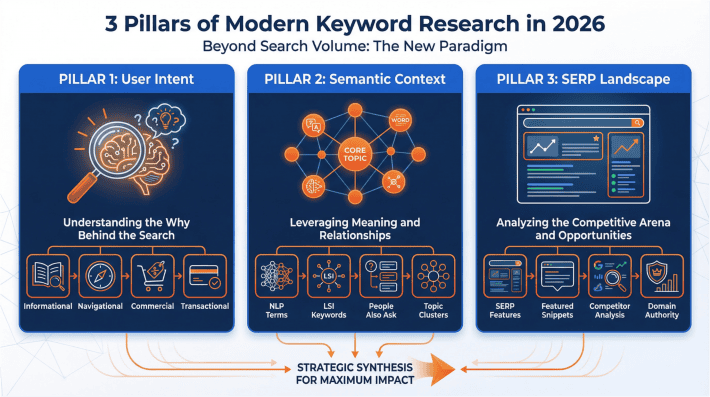

SERP Intent Analysis: How to Decode What Google Really Wants
You will understand that the key to winning at SEO in 2026 is not what you think users want to find, but what Google already knows they want to find. This guide will teach you how to stop guessing and start analyzing the search engine results page (SERP) like a detective. You will learn to decode the signals that Google leaves in plain sight to understand the true intent behind every query and create content that perfectly matches it.
What Is SERP Intent and Why Is It More Important Than Keywords?
SERP Intent is the collective will of millions of users, interpreted and presented by Google’s algorithm. It’s not the intent of a single user, but the dominant goal that Google has identified for a given query based on behavioral data (click-through rate, dwell time, pogo-sticking).
Traditional keyword research tells us what people type. SERP intent analysis tells us why they type it and what content format best solves their problem.
Example:
- Keyword: “best laptop”
- SERP Analysis: Google shows comparison lists, video reviews, tables with specifications.
- SERP Intent: The user isn’t looking for a definition of a laptop, but wants to compare models before making a purchase decision (commercial intent).
Creating an article about the history of laptops for this query is doomed to fail because it ignores the dominant SERP intent.
Four Faces of Intent: The Typology You Must Know.
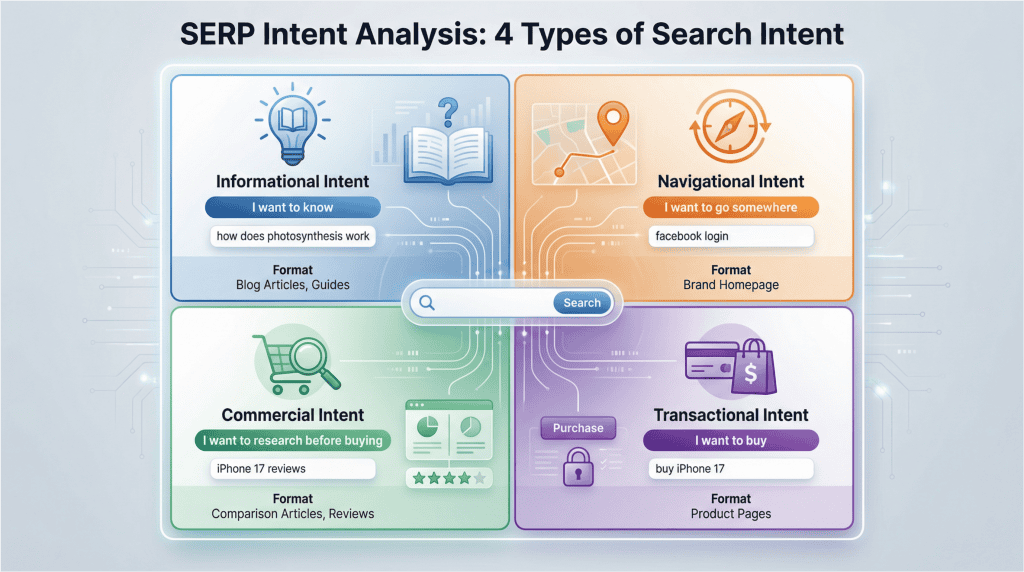
Every query can be assigned to one of four main intent categories. Understanding them is the foundation.
| Intent Type | User Question | Example Query | Dominant Content Format |
| Informational | “I want to know something” | “how does photosynthesis work” | Blog articles, guides, definitions (Wikipedia) |
| Navigational | “I want to go somewhere” | “facebook login” | Brand homepage or login page |
| Commercial | “I want to research before buying” | “iPhone 17 reviews” | Comparison articles, reviews, “best of” lists |
| Transactional | “I want to buy something” | “buy iPhone 17” | Product pages, e-commerce category pages |
Anatomy of SERP: How to Read the Results Page Like a Map.
SERP is not just 10 blue links. It’s a rich ecosystem of elements, each one a clue.
Key elements to analyze:
- Featured Snippets: Does Google promote a short, concise answer? That’s a signal users are looking for quick definitions.
- People Also Ask (PAA): What other questions are users asking? This is a goldmine of ideas for H2/H3 sections and FAQ.
- Top Stories: Is the topic related to current events? It requires freshness.
- Video Carousels: Does Google promote video content? Maybe it’s worth creating a YouTube video?
- Image Packs: Is the query visual? (e.g., “living room ideas”)
- Shopping Ads / Product Carousels: Is the intent strongly transactional?
SERP Analysis Methodology Step by Step.
1.Choose a keyword and open an incognito window
2.Identify the intent type: Is the SERP informational, commercial, transactional, or navigational?
3.Scan SERP elements: What modules (PAA, video, images) do you see? Write them down.
4.Analyze the top 5 organic results:
- What is the dominant format? (list, guide, review)
- What is the content depth? (superficial vs. in-depth)
- What is the tone and style? (formal, casual, technical)
- What are the common headings and subtopics?
5.Synthesize conclusions: Create an “ideal content profile” for this query that considers intent type, format, depth, and key subtopics.
Common Mistakes in Intent Interpretation.
- Ignoring format: Creating a blog article when the SERP is dominated by product pages.
- Depth mismatch: Writing a short, 500-word article when competitors have 3000-word guides.
- Confusing similar keywords: “How to make coffee” (informational) vs. “coffee maker” (commercial/transactional).
- Ignoring freshness: Creating a static article on a topic that requires continuous updates (e.g., “marketing trends 2026”).
How Contadu Automates SERP Intent Analysis.
Contadu was built around the idea of decoding SERP intent to give you an advantage:
- Real-Time SERP Analysis: When creating a new project, Contadu analyzes the top 10-30 results for your keyword. You’re not relying on outdated data, but on the current SERP picture.
- Competitor Structure Extraction: Contadu shows you what headings (H1-H6) competitors are using. You can see the dominant structure of winning articles and build a better, more comprehensive version.
- Question Identification (PAA): Contadu automatically pulls questions from the “People Also Ask” section, giving you ready-made ideas for sections that directly address user needs.
- Content Score: Your content score is based on comparison with competitors who are already satisfying SERP intent. The higher the score, the better you match what Google expects.
Summary and Next Step
Stop creating content in a vacuum. SERP is your cheat sheet that shows you how to pass Google’s exam. SERP intent analysis is a process that turns guessing into science and allows you to create content that’s destined for success because it’s perfectly matched to the expectations of both the algorithm and users.
Suggested next step: Choose one of your most important keywords. Open an incognito window and analyze the first page of results. Write down: what is the dominant content format? What questions appear in PAA? What SERP elements (video, images) do you see? Compare this with your existing article on this topic. The differences you notice are your action plan.
FAQ
Do I always have to copy the competitor format?
Don’t copy, but model. Understand why a given format wins, then create a better, more valuable, and comprehensive version. Add unique data, better examples, a newer perspective.
What if the SERP is very diverse (mix of formats)?
This is called “fractured intent.” It means Google isn’t sure what users are looking for. This is your opportunity! Create a comprehensive article that satisfies multiple micro-intents at once (e.g., a “how-to” guide with elements of a list and review).
How often does SERP intent change?
For informational (evergreen) queries, rarely. For queries related to trends, news, or products, it can change very dynamically. That’s why regular analysis is important.
Is intent the same on mobile and desktop?
Usually yes, but not always. For local queries (“restaurant near me”), mobile intent will be more strongly tied to navigation and quick action.
Can I “change” SERP intent?
Very difficult and rarely seen. It would require creating content so revolutionary and gaining such enormous authority that it would change the behavior of millions of users. It’s better to play by Google’s rules than try to change them.