
Why Your “Ultimate Guides” Aren’t Converting (And What to Do Instead).
Semantic Summary
Idea: The era of publishing 5,000-word “Ultimate Guides” for top-of-funnel (ToFu) keywords to drive conversions is over. AI answer engines now satisfy these broad informational queries instant
Challenge: SaaS and B2B companies are pouring thousands of dollars into massive guides that generate vanity traffic but zero pipeline, leading executives to question the ROI of content marketing.
Summary: To drive revenue in 2026, content teams must pivot from generic ToFu guides to Product-Led Content (MoFu/BoFu). This means creating use-case deep dives, comparison pages, and opinionated essays that demonstrate exactly how your product solves a specific, painful problem for a ready-to-buy audience.
Read the full guide below, or explore related topics:
- The Barbell Strategy for Content Marketing in 2026
- How to Build a W-Shaped Attribution Model for Content
- The Customer Success Content Playbook
Imagine you are the VP of Marketing at a growing SaaS company. You just spent three months and $4,000 producing “The Ultimate Guide to Project Management.” It is 6,000 words long. It has custom illustrations. It covers the history of project management from the pyramids of Giza to Agile methodology.
You publish it, build some backlinks, and six months later, it hits page one of Google. The traffic pours in. The chart goes up and to the right. High fives all around.
Then, the end of-quarter revenue review happens. The CEO looks at the CRM data and asks a simple question: “How many customers did that guide actually generate?”
You pull the report. The answer is zero.
If this scenario sounds painfully familiar, you are not alone. The B2B content marketing playbook from 2019 publish massive, generic guides to capture high-volume top-of-funnel (ToFu) traffic and hope they convert is fundamentally broken in 2026.
Here is why your ultimate guides are failing to generate pipeline, and exactly what you need to do instead.
Why the “Ultimate Guide” Playbook is Broken.
For years, the standard SEO advice was to target broad, high-volume keywords. If you sold accounting software, you wrote the ultimate guide to “What is Accounting?” The logic was that if you captured enough eyeballs, a small percentage would eventually trickle down the funnel and buy your software.
This logic fails today for three critical reasons.
1. The Intent Mismatch.
When someone searches for “What is project management?”, they are not looking to buy enterprise software. They are likely a student writing a paper, a junior employee trying to understand a new concept, or someone looking for a quick definition. Their search intent is purely informational.
Trying to convert someone who is asking for a definition into a buyer of a $10,000/year software platform is like trying to sell a sports car to someone who just asked for directions to the bus stop. The intent is entirely mismatched.
2. The AI Overview Interception.
In 2026, broad informational queries are the primary target of Generative AI. When a user searches for a broad topic, Google AI Overviews, ChatGPT, or Perplexity will instantly generate a comprehensive summary.
The user gets their answer without ever clicking a link. Your 6,000-word guide is effectively invisible. If your entire strategy relies on answering basic questions, you are competing directly against AI models that can do it faster and right on the search results page.
3. The Lack of Product Context.
Most ultimate guides are written to be as objective and comprehensive as possible. To achieve this, writers often strip out the most important part: the product itself.
If a potential buyer reads a 5,000-word guide on your website and leaves without understanding exactly how your specific product makes that process easier, faster, or cheaper, the content has failed its commercial objective.
The Pivot: From ToFu Guides to Product-Led Content.
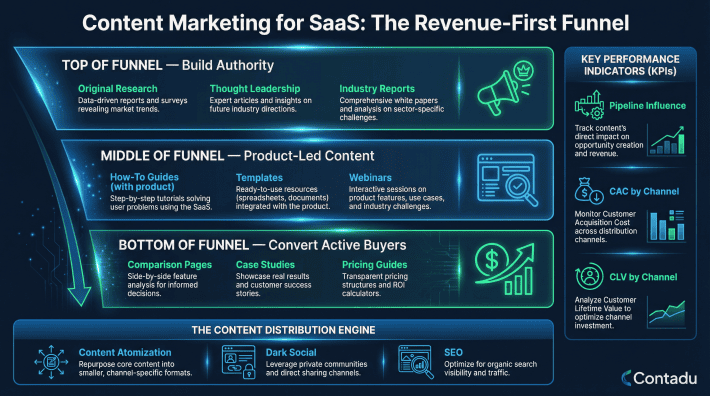
To generate revenue, you must stop writing for the top of the funnel and start writing for the middle and bottom of the funnel (MoFu/BoFu). You need to shift your focus from informational content to product-led content.
Product-led content weaves your product directly into the narrative. It doesn’t just talk about a problem; it shows exactly how your tool solves it.
Here are the three types of content you should be creating instead of generic ultimate guides.
1. Use-Case Deep Dives (Instead of “What is X”).
Instead of writing “The Ultimate Guide to Inventory Management,” write “How to Automate Multi-Warehouse Inventory Syncing.”
The first topic targets a beginner looking for a definition. The second topic targets an operations manager who is actively experiencing a painful problem.
In a use-case deep dive, you don’t waste time defining basic terms. You assume the reader is a professional. You outline the specific pain point (e.g., overselling stock because two warehouses aren’t syncing), and then you use screenshots, GIFs, and step-by-step instructions to show exactly how your software solves that exact problem.
Why it converts: The reader sees your product in action, solving their specific pain point. It acts as an asynchronous product demo.
2. Opinionated “Point of View” (POV) Essays.
Ultimate guides try to be everything to everyone. They are objective to the point of being boring. In a crowded market, objectivity does not sell; a strong point of view does.
Instead of writing “10 Ways to Manage a Sales Team,” write an opinionated essay like “Why the Traditional Sales Funnel is Dead (And How We Built a Better One).”
Take a stand against a common industry practice. Explain why the old way is broken, outline your new philosophy, and show how your product was built specifically to support this new, better way of working.
Why it converts: It builds extreme trust. Buyers don’t just buy features; they buy into a philosophy. If a reader agrees with your worldview, they are highly likely to want the tool you built to execute it.
3. High-Fidelity Comparison Pages.
When a buyer is at the bottom of the funnel, they are not reading ultimate guides. They are comparing you against your competitors. If you don’t control that narrative, a third-party affiliate site will.
Create detailed, honest comparison pages (e.g., “Your Brand vs. Competitor X”). Do not just create a feature matrix where you have all the green checkmarks and your competitor has all the red X’s. Buyers see right through that.
Instead, explain who each tool is for.
For example: “If you are a solo freelancer looking for a cheap, simple invoicing tool, Competitor X is a great choice. But if you are a 50-person agency that needs advanced resource allocation and margin tracking, here is why our platform is built for you.”
Why it converts: It intercepts high-intent buyers right before they make a purchasing decision and positions your product honestly, building immense credibility.
How Contadu Helps You Pivot.
Transitioning from a high-volume ToFu strategy to a high-conversion MoFu/BoFu strategy requires a shift in how you plan and measure content. Contadu’s Content Intelligence platform is designed to support this pivot:
- Intent-Based Keyword Clustering: Stop chasing raw search volume. Contadu’s Topic Discovery module groups keywords by semantic intent, allowing you to easily identify and prioritize high-intent, commercial queries over broad informational ones.
- Information Gain Scoring: When writing opinionated POV essays, you cannot just rehash what is already on page one. Contadu’s Content Score measures your Information Gain, ensuring your content introduces unique entities and perspectives that differentiate you from competitors.
- Content Inventory Auditing: Use Contadu to audit your existing library of “Ultimate Guides.” Identify the guides that get traffic but no conversions, and use the platform to map out a strategy for rewriting them into product-led use cases.
Frequently Asked Questions (FAQ).
Should we delete our existing Ultimate Guides?
Do not delete them if they are driving traffic. Instead, audit them. Can you insert a strong, product-led use case into the middle of the guide? Can you add a prominent call-to-action (CTA) for a relevant MoFu asset, like a template or a webinar? If the guide is completely irrelevant to your product, consider unpublishing it or redirecting it to a more focused page to preserve your site’s topical relevance.
Does Product-Led Content mean we just write sales pitches?
No. Product-led content must still be highly educational and valuable. The difference is that the education is centered around solving a problem, and your product happens to be the best mechanism for solving it. If the reader leaves without buying, they should still have learned a valuable framework or strategy.
Won’t we lose a lot of organic traffic if we stop targeting high-volume ToFu keywords?
Yes, your overall traffic graph might dip or flatten. However, your goal is not to maximize traffic; it is to maximize pipeline. It is far better to have 1,000 highly qualified buyers reading your comparison pages than 50,000 students reading your ultimate guides.
How do we measure the success of MoFu/BoFu content?
You must move away from top-line metrics like pageviews and bounce rate. Measure success through pipeline influence, demo requests, sign-ups, and multi-touch attribution models (like a W-Shaped model) that track how often a specific piece of content was viewed by an account before they closed.
How long should a Use-Case Deep Dive be?
As long as it needs to be to thoroughly explain the solution, and not a word longer. Unlike ultimate guides, which are often artificially inflated to hit a word count, product-led content should be concise and actionable. Typically, 1,000 to 1,500 words is sufficient to explain a complex use case with screenshots.
How do we find the right topics for Product-Led Content?
Stop looking at keyword research tools and start looking at your customers. Talk to your sales team to find out what specific features close deals. Talk to your customer success team to find out what “aha!” moments lead to long-term retention. Mine your support tickets for common problems that your product solves elegantly.
Can AI write Product-Led Content?
AI is excellent at summarizing broad, informational topics (which is why ultimate guides are dying). However, AI cannot write an authentic, opinionated POV essay, nor does it have firsthand experience using your product to solve a nuanced workflow problem. You can use AI to outline or edit, but the core insights and product expertise must come from your internal subject matter experts (SMEs).