
The Zero-Click SEO Survival Guide for Q3 2026: Advanced Tactics & Measurement.
In January 2026, we discussed how the phenomenon of “zero-click searches” was changing the fundamental nature of online visibility. Fast forward to Q3 2026, and the situation has accelerated from a trend to an undeniable reality.
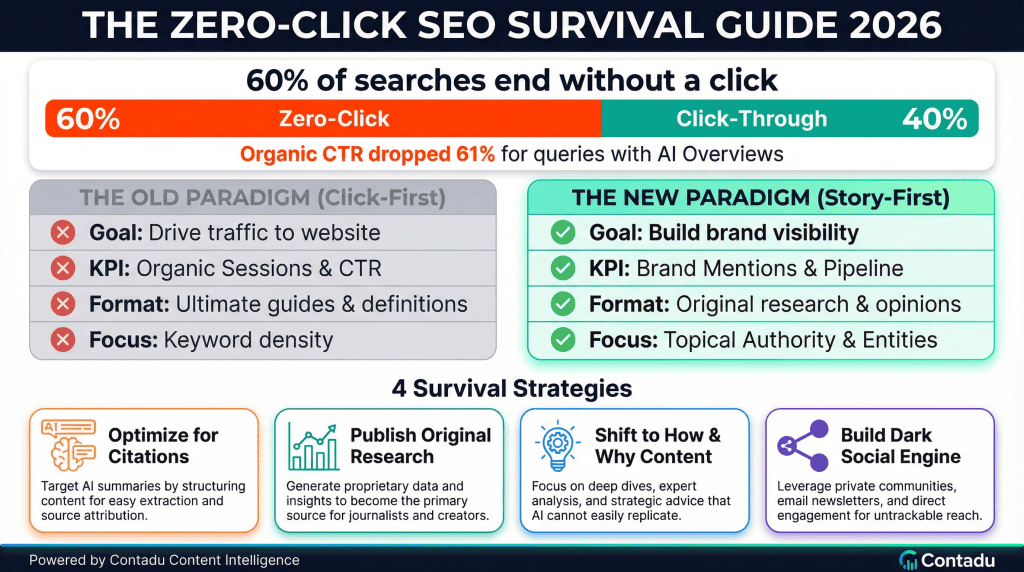
Recent industry data paints a stark picture: organic Click-Through Rates (CTR) have plummeted by over 61% for informational queries dominated by AI Overviews, and nearly 60% of all searches now end without a click to an external website
The introductory advice—”just write better content”—is no longer sufficient.
This guide moves beyond the basics of zero-click search. It provides an advanced, tactical playbook for Q3 2026, focusing on how to structurally optimize for AI citations and, more importantly, how to measure ROI when your traditional traffic metrics are in freefall.
The Q3 2026 Reality: The “Story-First” Paradigm.
The old SEO paradigm was built on a “Click-First” mentality: drive traffic to your website at all costs. The new paradigm is “Story-First”: deliver value exactly where the user is, and let brand affinity drive the ultimate conversion.
| Metric | The Old Paradigm (Click-First) | The New Paradigm (Story-First) |
| Primary Goal | Drive users to your website. | Deliver value where the user already is. |
| Key KPI | Organic Sessions & CTR. | Brand Mentions & Pipeline Influence. |
| Content Format | Fluffed-up recipes and ultimate guides. | Concise, highly opinionated, original data. |
| SEO Focus | Keyword density and traditional backlinks. | Topical Authority and Entity Salience. |
Advanced Tactics for Generative Engine Optimization (GEO).
If AI Overviews are stealing your clicks, your new objective is to become the primary source cited within those overviews. This requires a structural shift in how you write.
1. The “Inverted Pyramid” Citation Strategy.
AI models prioritize content that is easy to parse and extract. They do not want to read a 500-word introduction to find the definition of a term.
To optimize for citations, adopt the Inverted Pyramid structure:
- The Apex (Top 10%): Provide the direct, factual, and concise answer immediately below the heading. Use bullet points or a bolded summary paragraph.
- The Body (Middle 40%): Provide supporting data, original research, and context.
- The Base (Bottom 50%): Offer the deep dive, expert opinions, and nuanced analysis.
By placing the most quotable information at the very top, you drastically increase the likelihood that an AI model will extract and cite your text.
2. Original Research as the Ultimate Moat.
AI models are synthesis engines; they cannot generate net-new data. If you publish an article summarizing the “Top 10 Marketing Trends,” the AI will simply summarize your summary.
However, if you publish original research such as proprietary survey data or platform analytics the AI is forced to cite you as the primary source. Original data creates a high Information Gain Score, which is the most powerful signal you can send to modern search algorithms.
3. Exploiting the “Experience” Gap.
Informational queries (the “What is X?”) are effectively dead for driving traffic. To survive, you must shift your content calendar toward complex, experiential content that AI cannot legally or logically replicate.
Users will still click through to a website when they need:
- Step-by-step tutorials that require screenshots or video demonstrations.
- Strong opinions from industry experts.
- Case studies detailing specific, real-world implementations.
If your article can be accurately summarized in one paragraph, it will be. Write content that demands to be read in full.
The Zero-Click Measurement Framework.
The biggest challenge in Q3 2026 is proving the ROI of content when traffic drops. You must transition your reporting from vanity metrics to business impact.
Tracking Brand Mentions and Share of Voice (SOV).
When users get their answers from AI Overviews citing your brand, they don’t click, but they remember. The metric to track here is Branded Search Volume. Are more people searching for your company name directly? Additionally, use social listening tools to track your Share of Voice against competitors in your niche.
Pipeline Influence over Direct Attribution.
Move away from first-click attribution. Instead, use your CRM to track Pipeline Influence. Did the buyer consume your content (even via a downloaded PDF or a gated asset) at any point before purchasing?
The Dark Social Engine.
If search engines are keeping users on the SERP, you must reach users where search engines cannot go. Practice content atomization by taking your best insights and formatting them as native, zero-click posts for LinkedIn, Slack communities, or Twitter. The goal is to build such strong brand affinity that when the user is ready to buy, they bypass Google entirely and type your URL directly into their browser.
Navigating Q3 2026 with Contadu Content Intelligence.
Adapting to zero-click search requires a data-driven approach to content creation. You can no longer rely on gut feelings or outdated search volume metrics. Contadu is designed to help you navigate this transition.
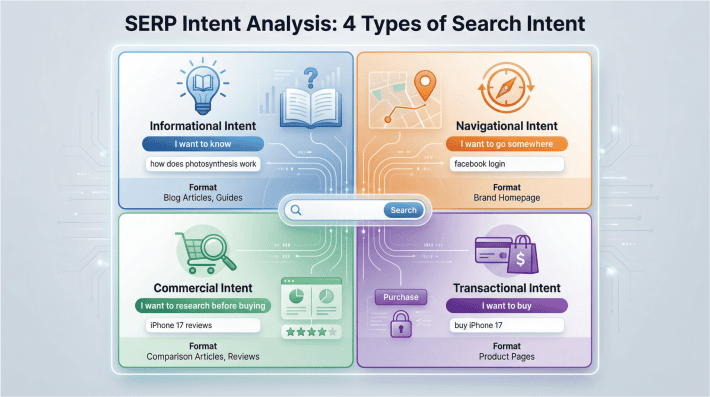
- Decoding True Search Intent: Contadu SERP Intent Analysis allows you to instantly see if a keyword is dominated by AI Overviews or if it still offers click-through potential. This prevents you from wasting budget on “dead” informational keywords.
- Maximizing Entity Salience: To get cited by AI models, your content must clearly define entities and their relationships. Contadu real-time Content Score guides your writers to include the exact semantic terms required to build strong entity associations.
- Structuring for Citations: Contadu automated content briefs help you enforce the Inverted Pyramid structure, ensuring that your most quotable, factual statements are positioned exactly where AI models look for them.
By using Contadu, you ensure your content is not just written for humans, but structurally optimized for the AI agents that now control the top of the funnel.
Conclusion.
The rise of zero-click search is not the death of SEO; it is the death of lazy SEO. The days of farming clicks with generic, top-of-funnel definitions are over.
In Q3 2026, the winners will be the brands that accept the new reality. They will optimize for citations instead of clicks, invest in original data, and build deep, experiential content that AI cannot replicate. By shifting your mindset from “traffic capture” to “brand authority,” you can turn the zero-click trend from a threat into your greatest competitive advantage.
FAQ.
If I get zero clicks, how do I prove the ROI of my content?
You must move away from vanity metrics like pageviews. Track brand search volume (are more people searching for your company name?), pipeline influence (did the buyer consume your content before purchasing?), and direct conversions from high-intent, bottom-of-funnel pages.
Should I block AI bots from crawling my site?
Generally, no. Blocking AI bots (like Googlebot-Extended or OpenAI’s crawler) prevents your brand from being cited in AI Overviews and ChatGPT. In a zero-click world, visibility and citation are better than invisibility.
Does traditional keyword research still matter?
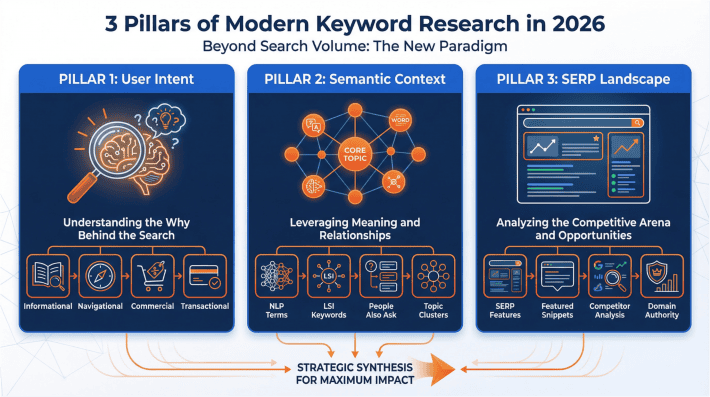
Yes, but the focus has changed. Instead of looking purely at search volume, you must analyze the SERP features. Focus your keyword research on long-tail, transactional, and experiential queries where AI Overviews are less likely to satisfy the user’s intent.
How does zero-click affect e-commerce sites?
E-commerce is highly affected. AI Overviews now pull product specs, reviews, and pricing directly into the SERP. E-commerce brands must ensure their Schema Markup is flawless and focus on building strong brand loyalty so customers come directly to their store.
Can E-E-A-T help with zero-click search?
Absolutely. Google uses E-E-A-T signals to determine which sources to trust for its AI Overviews. Demonstrating strong Experience and Expertise increases your chances of being the cited source when the AI generates an answer.