

Content Marketing for SaaS.
SaaS content marketing is fundamentally broken. Most software companies are running a playbook from 2019: publishing generic “Ultimate Guides,” chasing high-volume keywords with zero commercial intent, and wondering why their blog traffic isn’t converting into trials or pipeline.
In 2026, the software landscape is more crowded, more competitive, and more AI-driven than ever before. Your buyers are not reading 3,000-word beginner guides to learn what a CRM is. They are using AI to synthesize solutions, consulting peer communities on Slack, and demanding deep, expert-level insights before they ever agree to a demo.
If you want to win in B2B SaaS today, you must stop acting like a publisher trying to monetize page views, and start acting like a media company designed to drive product adoption.
This is the definitive guide to SaaS content marketing in 2026. We’ll explain how to build a content engine that actually generates revenue from mapping the modern customer journey to creating product-focused content that converts readers into users.
Chapter 1: The Modern SaaS Content Funnel.
The traditional marketing funnel (Awareness, Consideration, Decision) is too simplistic for the modern SaaS buyer. Software purchases, especially in B2B, are non-linear, multi-stakeholder processes.
To build a strategy that works, you must understand how your content maps to the specific cognitive stages of your buyer.
The Problem with the “Traffic First” Approach.
Many SaaS companies start by looking for the highest volume keywords in their industry and writing “Top of Funnel” (ToFu) content to capture them.
For example, a project management SaaS might write an article targeting “how to manage a team.” They might get 10,000 visitors a month to that post. But those visitors are students, junior managers, and people looking for free templates. They are not software buyers.
This creates the Traffic Illusion: a beautiful, up-and-to-the-right Google Analytics chart, paired with a flatlining MRR (Monthly Recurring Revenue) chart.
The “Revenue First” Content Funnel.
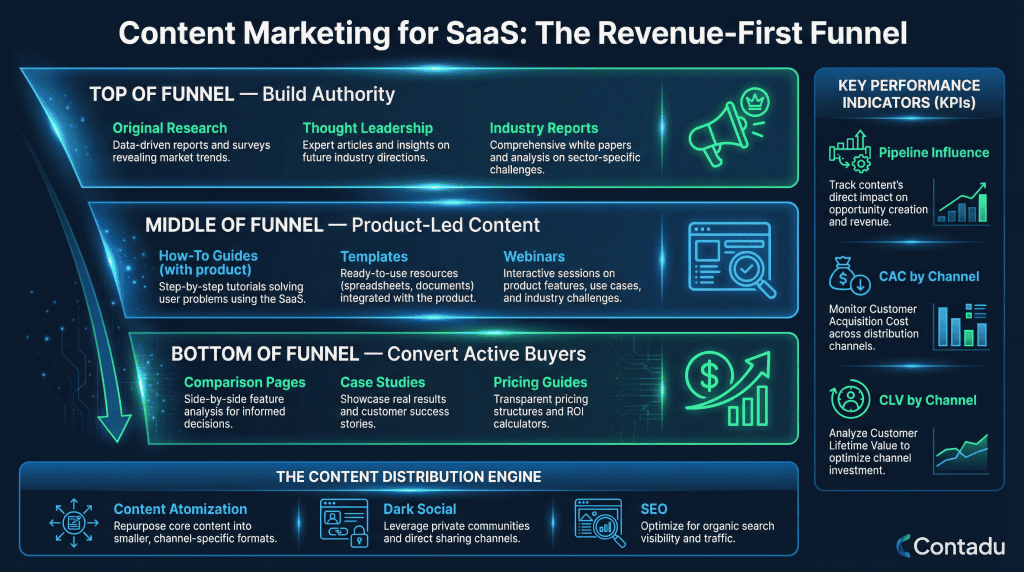
In 2026, successful SaaS companies flip the funnel upside down. They start by creating content for people who are actively looking to buy software, and work their way up.
| Stage | Buyer Mindset | Content Goal | Primary Content Formats |
| Bottom of Funnel (BoFu) | “I need a tool to solve X. Which one is best?” | Conversion & Differentiation | Comparison pages, Case Studies, Pricing Guides |
| Middle of Funnel (MoFu) | “I have a problem. How do others solve it?” | Education & Product-Led Growth | “How-to” guides (featuring your product), Templates |
| Top of Funnel (ToFu) | “What are the new trends in my industry?” | Brand Awareness & Audience Building | Original Research, Thought Leadership, Industry Reports |
If you are a new or scaling SaaS, you must build your BoFu content first. There is no point in driving 10,000 people to a thought leadership piece if you don’t have the comparison pages and case studies needed to convert the 1% who actually want to buy.
Read more: The B2B Content Marketing Playbook: From First Touch to Closed Deal
Chapter 2: Bottom of Funnel (BoFu) – Winning the Active Buyer.
BoFu content targets users with the highest commercial intent. These users know they have a problem, they know software is the solution, and they are actively evaluating vendors.
If you do not have content answering their specific questions, your competitors will answer them for you.
1. The “Alternative To” and Comparison Pages
When a buyer is unhappy with their current software, the first thing they search is “[Competitor] alternatives.” When they are evaluating two tools, they search “[Tool A] vs [Tool B].”
You must own these narratives. Do not leave it to third-party review sites like G2 or Capterra to explain why your product is better.
How to write a high-converting comparison page:
- Be Objective (But Opinionated): Do not say the competitor is terrible. Acknowledge their strengths. (e.g., “Competitor X is great for enterprise companies with massive budgets, but if you are a fast-moving startup, you need Tool Y.”)
- Focus on the “Why,” Not Just Features: Do not just list a feature matrix. Explain why your approach to a feature is better for a specific use case.
- Include Social Proof: Embed G2 reviews or customer quotes directly on the page that validate your claims.
Read more: Competitor Content Analysis: The Expert Framework
2. The “Use Case” Pages.
Buyers don’t buy “project management software.” They buy “agency workflow management” or “software development sprint tracking.”
Create dedicated landing pages for every specific use case and industry your product serves. These pages should speak the exact language of that specific buyer. An agency owner cares about “billable hours,” while a software developer cares about “story points.” Your content must reflect that nuance.
3. The Pricing Guide.
Pricing is the number one thing B2B buyers want to know, yet many SaaS companies hide it behind a “Book a Demo” button.
Even if you have complex, enterprise pricing, you should have a comprehensive article explaining how your pricing works. What factors increase the cost? What are the hidden fees to watch out for in the industry? By being transparent, you build immense trust.
Chapter 3: Middle of Funnel (MoFu) – Product-Led Content.
Middle of the funnel content is where the magic happens for SaaS. This is where you target users who are trying to solve a specific problem, and you teach them how to solve it using your product.
This strategy is known as Product-Led Content.
The Anatomy of Product-Led Content.
Traditional content marketing says, “Teach the user how to solve the problem without pitching your product.”
Product-led content says, “The best way to solve the problem is our product, so we are going to show you exactly how to do it.”
If you are writing an article about “How to conduct a content audit,” and you sell a content auditing tool, it is a disservice to the reader to tell them to do it manually in a spreadsheet. Show them the manual way, but then show them the automated, superior way using your software.
How to execute Product-Led Content:
- The “Show, Don’t Tell” Rule: Use high-quality screenshots, GIFs, and short video clips of your product in action within the article.
- The “Template” Strategy: Give away a free, valuable template (e.g., a Google Sheet). Then, explain how much easier the process is if they use your software instead of the template.
- Solve the Problem Immediately: Do not make the user read 1,000 words of fluff before getting to the solution. Give them the answer, show them how your product facilitates it, and then provide the deep-dive context.
Read more: SERP Intent Analysis: How to Decode What Google Really Wants
Chapter 4: Top of Funnel (ToFu) – Building Authority.
Once you have a strong foundation of BoFu and MoFu content that converts, you can invest in Top of Funnel (ToFu) content.
The goal of ToFu content is not to generate immediate trials or demos. The goal is to capture mindshare, build an email list, and establish your brand as the definitive authority in your category.
If a user reads your ToFu content and thinks, “These people really understand my industry,” they are significantly more likely to consider your software when they eventually experience a problem you solve.
1. The Power of Original Research.
In a world drowning in AI-generated “Ultimate Guides,” original research is the ultimate differentiator. It is the most powerful way to generate backlinks, social shares, and industry authority.
How to execute Original Research:
- Survey Your Audience: Ask your existing customers or email list about their biggest challenges, salaries, or technology stacks.
- Analyze Proprietary Data: If you have a SaaS product, you have data. Analyze anonymized usage data to find interesting trends. (e.g., A project management tool could publish a report on “The Average Length of Software Development Sprints in 2026.”)
- Create “State of the Industry” Reports: Publish an annual report that becomes the definitive resource for your niche.
Read more: Original Research: The Ultimate Guide to Building Authority and Backlinks
2. Opinionated Thought Leadership.
Stop publishing generic advice that everyone agrees with. True thought leadership requires a point of view.
How to execute Thought Leadership:
- Take a Stand: Identify a common practice in your industry that you believe is wrong, and explain why. (e.g., “Why the Traditional Sales Funnel is Dead in 2026.”)
- Share Failures: People connect with vulnerability. Share a mistake your company made, what it cost you, and what you learned.
- Interview Internal Experts: Your founders, product managers, and customer success teams have deep expertise. Interview them and turn their insights into compelling narratives.
Read more: E-E-A-T in 2026: How to Demonstrate Expertise, Experience, Authority, and Trust
Chapter 5: The SEO Foundation for SaaS.
You cannot build a successful SaaS content engine without a strong SEO foundation. However, the rules of SEO have changed significantly.
1. Topical Authority Over Search Volume.
In the past, SEO strategy was driven by search volume. You found a keyword with 10,000 monthly searches and wrote an article about it.
Today, Google rewards Topical Authority. This means you must comprehensively cover an entire topic, not just individual keywords.
How to build Topical Authority:
- Create Topic Clusters: Organize your content into clusters. Create a comprehensive Pillar Page (like this one) that covers a broad topic, and link it to dozens of specific, long-tail cluster articles.
- Use Content Scoring: Use a tool like Contadu to ensure your content covers all the necessary semantic entities related to your topic.
- Fill Content Gaps: Identify topics your competitors are covering that you are not, and create better content to fill those gaps.
Read more: Topic Clusters: Dominating Google
2. Technical SEO for SaaS Websites.
Your content cannot rank if Google cannot crawl and index your website.
Key Technical Focus Areas:
- Site Architecture: Ensure a logical, flat site structure where every important page is no more than three clicks from the homepage.
- Page Speed: SaaS buyers are impatient. Ensure your site loads instantly, especially on mobile devices.
- Schema Markup: Use structured data (e.g., FAQPage, SoftwareApplication) to help search engines understand the context of your pages.
Chapter 6: The Content Distribution Engine.
Creating great content is only 20% of the job. The other 80% is distribution. If you publish an incredible article and only share it once on your company’s LinkedIn page, you have failed.
You must build a distribution engine that maximizes the ROI of every piece of content you create.
1. Content Atomization.
Never publish an article and walk away. You must atomize it.
How to execute Content Atomization:
- Turn a 3,000-word guide into a 5-part email course.
- Extract the key statistics and turn them into a LinkedIn carousel.
- Take the most controversial opinion and turn it into a Twitter thread.
- Record a short video summarizing the main points for YouTube Shorts or TikTok.
Read more: Content Atomization: How to Create 20 Pieces from One Article
2. The “Dark Social” Strategy.
“Dark Social” refers to the places where buyers share information that cannot be tracked by traditional analytics software: Slack communities, Discord channels, private WhatsApp groups, and direct messages.
This is where the real buying decisions are made in B2B SaaS.
How to penetrate Dark Social:
- Create “Zero-Click” Content: Publish content on LinkedIn or Twitter that provides the full value natively, without requiring the user to click a link to your blog. This encourages sharing and discussion within the platform.
- Build Relationships with Community Leaders: Identify the people who run the major Slack or Discord communities in your niche. Provide them with exclusive insights or early access to your research.
- Host Webinars and AMAs: Create interactive events that encourage live discussion and networking among your target audience.
Read more: Content Distribution Strategy: Beyond “Publish and Pray”
Chapter 7: Measuring SaaS Content ROI.
If you cannot prove the ROI of your content, your budget will be cut. It is that simple.
In 2026, measuring page views, bounce rates, and time-on-page is not enough. You must connect your content directly to the pipeline and revenue.
1. Moving Beyond Vanity Metrics.
Vanity metrics look good on a dashboard but do not correlate with business growth.
Vanity Metrics to Ignore:
- Total Page Views: 100,000 views from irrelevant users are worthless.
- Bounce Rate: A high bounce rate on a glossary page is fine; the user got their definition and left.
- Social Likes: Likes do not pay salaries.
2. The Metrics That Matter.
To prove ROI to your CFO, you must track metrics that indicate commercial intent and revenue generation.
Business Metrics to Track:
- Pipeline Influence: How many closed-won deals interacted with your content during the sales cycle?
- Sign-ups / Demos: How many users clicked a primary CTA directly from a piece of content?
- Customer Acquisition Cost (CAC) by Channel: Is organic content cheaper than paid ads?
- Customer Lifetime Value (CLV) by Channel: Do customers acquired through organic content stay longer and spend more?
Read more: Content ROI: How to Measure What Actually Matters
3. Implementing a Multi-Touch Attribution Model.
A buyer rarely reads one blog post and immediately purchases enterprise software. They might read an industry report, attend a webinar, click a retargeting ad, and then request a demo.
If you use a “First-Touch” or “Last-Touch” attribution model, you are ignoring the complexity of the buyer’s journey.
The Solution: W-Shaped Attribution
A W-Shaped model assigns credit to the three key milestones in the journey: the first touch (discovery), the lead creation touch (conversion), and the opportunity creation touch (sales engagement). It also distributes a smaller percentage of credit to the touchpoints in between. This provides the most accurate picture of how your content is driving revenue.
Chapter 8: Scaling the SaaS Content Engine with Contadu.
Executing this playbook manually is impossible. You cannot manage a content calendar, track semantic entities, measure ROI, and manage a team of writers in a spreadsheet.
This is why top SaaS marketing teams rely on Content Intelligence platforms like Contadu.
1. Centralized Content Operations (ContentOps).
Contadu acts as the command center for your entire content operation. You can manage dozens of projects simultaneously, assign tasks to internal writers or external freelancers, and track the progress of every piece of content from ideation to publication.
Read more: How to Manage 50 Content Projects Simultaneously in Contadu
2. Data-Driven Brief Creation.
Stop guessing what to write. Contadu analyzes the top-ranking pages for your target keywords and generates comprehensive content briefs. These briefs tell your writers exactly what semantic entities to include, what questions to answer, and what structure to follow to maximize the Content Score.
Read more: How to Create the Perfect Brief for a Copywriter.
3. Real-Time Content Scoring and NLP Analysis.
As your writers draft content, Contadu provides real-time feedback. The proprietary Content Score uses Natural Language Processing (NLP) to evaluate semantic relevance, readability, and structure. This ensures every piece of content is optimized for both human readers and search engine algorithms before it is published.
Read more: Content Scoring: How to Measure Quality Before Publishing
Conclusion: The Era of Revenue-Driven Content
The days of “publish and pray” are over. In 2026, SaaS content marketing is a precise, data-driven discipline.
To win, you must stop chasing vanity metrics and start building a content engine designed to drive revenue. This requires a fundamental shift in strategy:
1.Flip the Funnel: Start by creating Bottom of Funnel (BoFu) content that converts active buyers, then work your way up to Product-Led Middle of Funnel (MoFu) content.
2.Build Topical Authority: Stop chasing individual keywords and start comprehensively covering entire topic clusters.
3.Distribute Relentlessly: Spend as much time atomizing and distributing your content as you do creating it. Penetrate the “Dark Social” channels where real buying decisions are made.
4.Measure What Matters: Prove your ROI by tracking pipeline influence, CAC, and CLV using a multi-touch attribution model.
By implementing this playbook and leveraging a Content Intelligence platform like Contadu, you will transform your blog from a cost center into your most powerful revenue generation engine.
FAQ
How long does it take to see results from SaaS content marketing?
Content marketing is a long-term investment. If you are starting from scratch, expect to wait 6 to 9 months to see significant organic traffic growth, and 9 to 12 months to see a consistent impact on pipeline and revenue. However, you can accelerate this by prioritizing BoFu content and leveraging aggressive distribution strategies.
Should we gate our content (require an email address) or leave it ungated?
In 2026, the trend is moving strongly toward ungated content. Buyers are reluctant to hand over their email addresses for generic ebooks. Ungate your educational content to maximize reach and build authority. Only gate high-value, proprietary assets like original research reports or interactive tools.
How much should a SaaS company spend on content marketing?
This varies wildly based on your stage of growth and average contract value (ACV). A general benchmark for high-growth SaaS companies is allocating 20-30% of the total marketing budget to content creation, distribution, and operations.
Can we just use AI to write all our content?
No. While AI is a powerful tool for outlining, summarizing, and overcoming writer’s block, purely AI-generated content lacks the unique insights, proprietary data, and distinct voice (Information Gain) required to stand out in a crowded market. Use AI to assist your experts, not to replace them.
What is the biggest mistake SaaS companies make with content?
The biggest mistake is writing about themselves instead of their customers’ problems. Buyers do not care about your latest feature update or your company retreat. They care about how you can solve their specific pain points and make their lives easier.
