

GEO 2.0: Advanced Tactics to Get Cited by ChatGPT, Perplexity & Google AI Overviews
The game has changed. For two decades, SEO was about climbing a list of ten blue links. In 2026, it’s about becoming a trusted source for AI engines that answer questions directly. With Gartner predicting a 25% drop in traditional search volume this year as users shift to AI-powered answer engines, getting found online is no longer just about ranking it’s about being cited.
This is the new frontier of Generative Engine Optimization (GEO). It’s not about tricking algorithms; it’s about structuring your content and digital presence so that AI platforms like ChatGPT, Perplexity, and Google AI Overviews can retrieve, understand, and recommend your brand with confidence.
This guide provides a playbook for GEO 2.0, moving beyond the basics to offer advanced, actionable tactics for earning those coveted AI citations.
“If traditional SEO was about earning a spot among 10 blue links, GEO is about earning a place among the two to seven domains large language models typically cite in a single response.” — Leigh McKenzie, Search Engine Land
The New Gatekeepers: How AI Engines Choose Their Sources.
Understanding GEO requires knowing your audience: the AI models themselves. Each platform has a distinct personality and sourcing methodology.
| AI Engine | Sourcing Methodology & Key Characteristics |
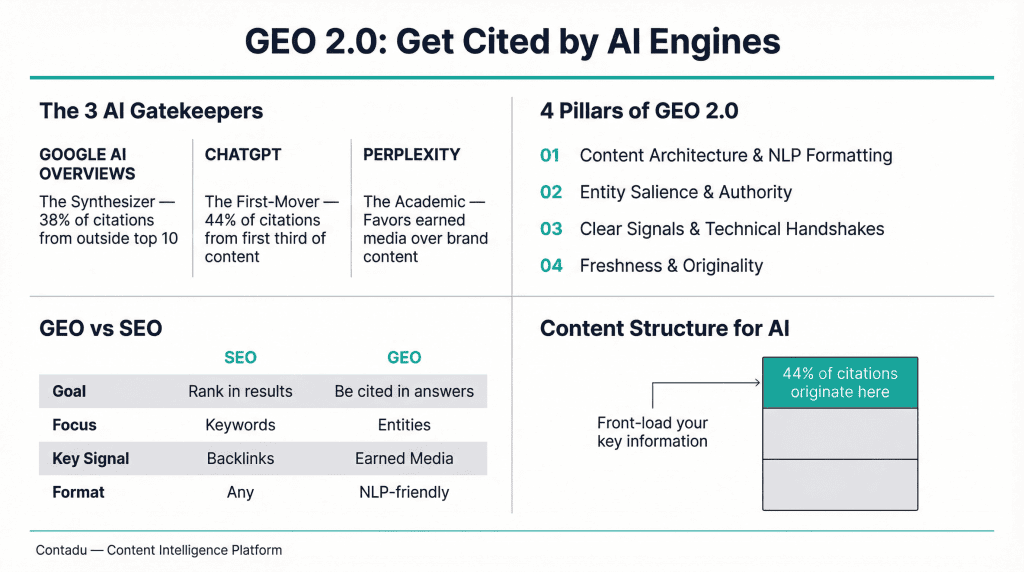
| Google AI Overviews | The Synthesizer. Leverages the entire Google index but shows a strong preference for content with high topical authority and clear E-E-A-T signals. A recent study found that only 38% of AI Overview citations come from pages ranking in the top 10, indicating it looks deeper for quality.
It prioritizes semantic completeness and will pull from multiple sources to construct a comprehensive answer. |
| ChatGPT | The First-Mover. Heavily biased towards the first turn of a conversation. A Profound study of ~700,000 conversations found that the first user query is 2.5x more likely to trigger a web search than the tenth.
It uses Wikipedia as a foundational knowledge layer and then triangulates with 4-6 other sources, often citing competitors side-by-side. |
| Perplexity | The Academic. Designed as a “conversation engine,” it structurally favors earned media and authoritative third-party sources over brand-owned content. It uses a multi-layer machine learning reranking system to evaluate sources, making it critical to build brand mentions and credibility on trusted domains. |
GEO 2.0: The 4-Pillar Framework for Getting Cited.
“Language models like ChatGPT and Claude don’t crawl the web like Google’s bot. They rely on pre-trained and real-time indexed information from high-quality, trusted, and well-structured content.” — Alex H., Lureon.ai
Winning in GEO requires a multi-faceted approach. The following four pillars form a comprehensive strategy for making your content citable.
Pillar 1: Content Architecture & NLP-Friendly Formatting
AI engines don’t read; they parse. They break content down into semantic chunks to be reassembled as answers. Your content must be structured for this process.
- Write in “Atomic Units”: Treat every H2/H3 section as a self-contained answer. Start with a direct, declarative statement (the “TL;DR”) and then expand with context. This makes your content easily extractable.
- Embrace NLP-Friendly Formatting: Use bullet points, numbered lists, and blockquotes. These formats are easy for AI to parse and are often lifted directly into generated answers.
- Structure for the “First Third”: Research shows that nearly 44% of ChatGPT’s citations originate from the first third of a document.
Front-load your most critical information, definitions, and data points.
- – Implement a Robust FAQ Section:* AI engines are fundamentally question-answering machines. A detailed FAQ section, optimized for natural language queries, is a direct line to getting cited.
Real-World Example:
- Before (Standard Paragraph): Our software integrates with various marketing automation platforms. It supports connections with HubSpot, Marketo, and Pardot, allowing for seamless data transfer between systems.
- After (Atomic Unit):
Does your software integrate with marketing automation platforms?
Yes, our software offers native integrations with HubSpot, Marketo, and Pardot. This allows for a seamless, bi-directional flow of lead data, campaign information, and analytics between our platform and your existing marketing stack.
Pillar 2: Entity Salience & Authority Building.
GEO is entity-first, not keyword-first. AI engines think in terms of people, brands, and products. Your goal is to make your core entities unambiguous and authoritative.
- Establish a Clear “Digital Fingerprint”: Ensure your brand name, executive names, and product names are used consistently across your website and third-party platforms.
- Build Your Knowledge Panel: Actively manage your Google Knowledge Panel. This is a direct signal to Google about your entity’s key attributes.
- Pursue Earned Media Relentlessly: AI engines, particularly Perplexity, are biased towards earned media. Guest posts, podcast appearances, industry awards, and mentions in reputable publications are no longer just for branding they are direct GEO ranking factors.
Become the Source After Wikipedia:** You won’t outrank Wikipedia for broad terms. The winning strategy is to be the expert source an AI turns to after consulting Wikipedia for the basic definition. Focus on original analysis, proprietary data, and expert commentary that Wikipedia cannot provide.
Real-World Example:
A financial planning software company, “Financify,” wants to be cited for queries about “401(k) contribution limits.” Instead of just stating the limit (which Wikipedia does), they publish an article titled “The 2026 Guide to Maximizing Your 401(k): Strategies Beyond the Contribution Limit.” It includes the limit but focuses on expert strategies for catch-up contributions, employer match optimization, and withdrawal tax planning—information an AI would cite for a deeper query..
Pillar 3: Clear Signals & Technical Handshakes.
Think of this as giving AI engines a clear, easy-to-read map of your content. While it sounds technical, the goal is simple: label your content so machines can understand its meaning and context without guesswork.
- Use “Digital Labels” (Schema Markup): Schema is like putting labels on your content. Instead of an AI just seeing a block of text, you can label it: “This is the author’s name,” “This is a recipe,” or “This is an answer to a frequently asked question.” This helps AI grab the right information with confidence. You don’t need to be a developer; many SEO tools and plugins can help you add these labels automatically.
- Check for “Do Not Enter” Signs (robots.txt): Your website has a file called robots.txt that tells bots which pages to ignore. It’s worth a quick check with your technical team to ensure you aren’t accidentally blocking important AI crawlers like GPTBot or PerplexityBot from reading your best content.
- Provide a “Welcome Guide” (llms.txt): A newer practice is creating a simple text file called llms.txt. This file acts as a friendly guide for AI, suggesting which parts of your site are best for factual information and which should be ignored.
Real-World Example:
Imagine you run a cooking blog. Using Schema Markup, you can label your recipe page so an AI understands:
- Recipe Name: “Classic Lasagna”
- Cook Time: “90 minutes”
- Ingredients: [List of ingredients]
- Steps: [Step-by-step instructions]
When someone asks an AI, “How long does it take to cook lasagna?”, the AI can confidently pull “90 minutes” from your page because it was clearly labeled, increasing your chances of being cited..
Pillar 4: Content Freshness & Originality Signals
AI models are designed to provide the most current and helpful information. Stale content is rarely cited.
- Implement a Content Refresh Cycle: Regularly update your cornerstone content with new data, insights, and a clearly visible “Last updated” date. This signals recency and relevance.
- Publish Original Research: This is the ultimate GEO moat. Proprietary data, surveys, and benchmark reports are highly citable because they represent unique, verifiable information that AI cannot generate on its own. A 2026 MarketingProfs report notes that 47% of B2B marketers plan to increase their use of original research.
- Focus on “Information Gain”:* Google holds a patent for an “Information Gain Score,” a system designed to reward content that provides new, non-obvious information compared to other documents ranking for the same query. To get cited, your content must add unique value to the conversation, not just summarize what’s already known.
Real-World Example:
For the query “best project management software,” most articles are simple listicles. A brand could achieve high Information Gain by publishing a data-driven report analyzing the average completion time for 5 common project types across the 10 leading software platforms. This is unique, verifiable data that AI engines are highly likely to cite.
How Contadu Powers Your GEO Strategy.
Contadu is built for the new era of content. Our platform provides the tools to execute and measure a sophisticated GEO strategy at scale.
- SERP-Informed Briefs: Contadu analyzes the top-ranking content for your target query, identifying the entities, topics, and questions you need to cover to achieve topical depth.
- Real-Time Content Scoring: Our Content Score evaluates your draft against dozens of NLP-driven factors, providing a live measure of quality and completeness before you publish.
- NLP-Powered Optimization: We identify missing entities and semantic terms, helping you write content that is optimized for both human readers and AI parsers.
- AI Visibility & Citation Tracking: Contadu upcoming AI Visibility module allows you to monitor how your brand and content appear across major AI engines. Track citation frequency, sentiment, and share of voice against your competitors to measure the direct impact of your GEO efforts.
- Automated AI Tracking: Move beyond manual checks. Our platform automates the process of querying AI engines and logs the results, giving you a historical view of your AI performance and alerting you to new citation opportunities or threats.
FAQ
What is the difference between GEO and SEO?
SEO (Search Engine Optimization) focuses on ranking web pages in a list of search results. GEO (Generative Engine Optimization) focuses on getting your content cited within the answers generated by AI engines like ChatGPT and Google AI Overviews
How long does it take to see results from a GEO strategy?
Initial signals, such as an increase in brand mentions within AI answers, can appear within 1-3 months. Earning consistent, high-value citations for competitive topics typically takes 6-9 months of sustained effort in content creation and authority building.
Is it better to focus on Google AI Overviews or standalone platforms like ChatGPT?
Focus on both, but with different tactics. For Google AI Overviews, building deep topical authority and strong E-E-A-T signals is paramount. For platforms like ChatGPT and Perplexity, a strong earned media presence and NLP-friendly content structure are often more critical.
Does website traffic still matter in the age of GEO?
Yes, but its role is changing. While zero-click searches are rising, high-quality traffic remains a strong signal of authority to both Google and other AI engines. Furthermore, traffic that comes from an AI citation is highly qualified, as the user has already been pre-sold on your expertise by the AI.
Can I just use AI to write content for GEO?
Using AI for drafting is effective, but relying on it solely is a losing strategy. AI-generated content often lacks the originality, experience, and proprietary data (Information Gain) that AI engines look for when selecting sources to cite. The winning formula is using AI to assist human experts, not replace them.
