
The Rise of Content AI Agents: Moving Beyond the Chatbot in 2026.
If you are still treating AI merely as a fast typist—pasting prompts into a chat window and copying the output into a Google Doc—you are already falling behind. In 2026, the competitive advantage in content marketing no longer belongs to those who write prompts the fastest. It belongs to teams that orchestrate AI agents.
The shift from conversational AI (chatbots) to agentic AI (autonomous agents) represents the most significant leap in content operations since the introduction of large language models. While chatbots wait for your instructions, AI agents execute multi-step workflows, interact with your tools, make decisions, and complete tasks with minimal human intervention.
This guide breaks down what content AI agents are, how they differ from traditional chatbots, and how you can deploy them to build a truly autonomous content engine.
Chatbots vs. AI Agents: The Architectural Shift.
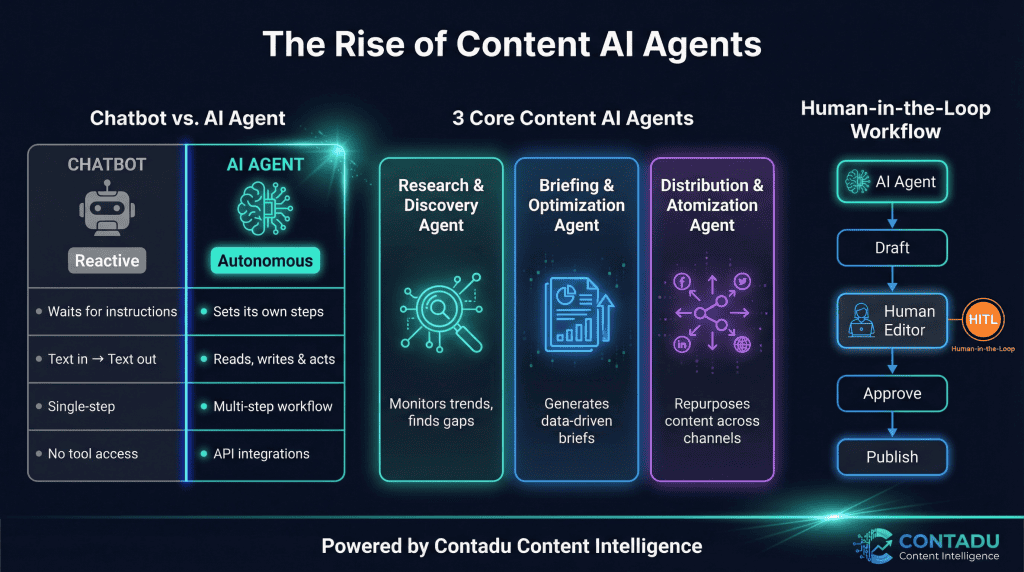
The fundamental difference between an AI chatbot (like ChatGPT in its basic form) and an AI agent lies in their architecture and autonomy. Chatbots are reactive and conversational; they require a human to steer every step of the process. AI agents are proactive and goal-oriented; you give them an objective, and they figure out the steps required to achieve it.
To understand this shift, consider how both handle a typical content marketing task: updating an underperforming blog post.
| Feature | The Chatbot Approach (Reactive) | The AI Agent Approach (Autonomous) |
| Trigger | You must manually identify the decaying post and paste its content into the chat. | The agent automatically detects traffic decay via Google Search Console API. |
| Context | You must manually feed it competitor data, keywords, and brand guidelines. | The agent independently crawls the top 3 SERP results and pulls your brand guidelines from its memory. |
| Execution | It generates text. You must manually copy, format, and paste it into your CMS. | It rewrites the necessary sections, updates internal links, and pushes a draft directly to WordPress. |
| Capabilities | Read and write (Text-in, text-out). | Read, write, and act (API integrations, tool usage, decision-making). |
As one industry expert noted, the difference is architectural: “Chatbots are read-only. AI agents read, write and act”
In a content operations environment, this means moving from assisted creation to delegated execution.
The 3 Types of Content AI Agents You Need in 2026.
You don’t need one omnipotent AI to run your entire marketing department. The most effective agentic workflows rely on specialized, narrow agents that communicate with each other—a concept known as multi-agent orchestration.
For a modern content team, there are three core agents that deliver immediate ROI:
1. The Research & Discovery Agent.
This agent’s goal is to identify what you should write about before your competitors do. It continuously monitors your niche, analyzes search trends, and identifies content gaps.
Typical Workflow:
1.Monitors industry news sites and social media for emerging trends.
2.Cross-references these trends against your existing topic clusters.
3.Analyzes search volume and SERP intent.
4.Automatically generates a prioritized list of topics and drops them into your content calendar.
2. The Briefing & Optimization Agent.
Once a topic is selected, this agent takes over to ensure the writer (human or AI) has a mathematically perfect roadmap. It replaces the hours SEO managers spend manually analyzing competitors.
Typical Workflow:
1.Crawls the top 10 ranking pages for the target keyword.
2.Extracts the semantic entities, heading structures, and word counts.
3.Identifies missing information to ensure high Information Gain.
4.Generates a comprehensive content brief and assigns it to a writer in your project management tool.
3. The Distribution & Atomization Agent.
Creating the content is only 20% of the work; distribution is the other 80%. This agent ensures your long-form content doesn’t just sit on your blog gathering dust.
Typical Workflow:
1.Takes a newly published long-form article.
2.Extracts key quotes, statistics, and actionable advice.
3.Formats these extractions into a LinkedIn thread, a Twitter thread, and a newsletter snippet (adhering to platform-specific character limits and styles).
4.Schedules them in your social media management tool.
Building Agentic Workflows: A Step-by-Step Guide.
Implementing AI agents doesn’t require a team of machine learning engineers. With modern no-code and low-code platforms, content marketers can build agentic workflows by connecting existing tools.
Here is how to start:
Step 1: Map Your Standard Operating Procedures (SOPs).
Agents need clear rules. Before you can automate a workflow, you must document it. Break down your content creation process into discrete, repeatable steps. If a human cannot follow your written SOP, an AI agent will fail completely.
Step 2: Define the Agent’s Persona and Tools.
Give your agent a specific role (e.g., “You are an expert technical SEO editor”) and provide it with the tools it needs to succeed. This means giving it API access to your CMS, your SEO software, and your project management platform.
Step 3: Implement Human-in-the-Loop (HITL)
Never let an AI agent publish directly to your live site without oversight. The most successful agentic workflows in 2026 employ a “Human-in-the-Loop” system. The agent does the heavy lifting—researching, drafting, formatting but a human editor must approve the final output before it goes live. This ensures brand safety and maintains E-E-A-T standards.
Putting It Into Practice: Orchestrating Agents with Contadu.
While you can build custom agents using platforms like Zapier or Make, the true power of agentic AI is unlocked when it is integrated directly into your Content Intelligence platform. Contadu is designed to serve as the central brain for your content operations, bridging the gap between strategy and autonomous execution.
Here is how Contadu empowers agent-driven workflows:
- Automated Semantic Research: Contadu Topic Discovery module acts as your Research Agent, continuously analyzing the SERP to identify semantic gaps and grouping them into logical clusters.
- One-Click Brief Generation: Instead of manually building guidelines, Contadu automatically generates data-driven briefs based on top-performing competitors, which can be instantly handed off to your writers or AI drafting tools.
- Real-Time Quality Control: Contadu Content Score acts as an automated editor, evaluating drafts against NLP algorithms to ensure semantic relevance and readability before a human editor even looks at the piece.
By centralizing your data and strategy in Contadu, you provide your AI agents with the exact context they need to produce content that actually ranks.
Conclusion
The era of using AI merely as a glorified autocomplete is ending. In 2026, content marketing success requires moving from single-prompt interactions to orchestrated, agentic workflows. By deploying specialized AI agents for research, briefing, and distribution, your team can scale output exponentially without sacrificing quality or burning out your human talent.
The question is no longer whether you are using AI to write content. The question is: are you managing an AI, or are you managing a team of AI agents?
FAQ.
Will AI agents replace human content marketers?
No. AI agents replace tasks, not roles. They handle data extraction, formatting, and initial drafting, freeing human marketers to focus on strategy, original research, and creative direction—the elements that actually build brand authority.
Do I need to know how to code to build an AI agent?
Not anymore. In 2026, many platforms offer no-code interfaces where you can build agents using natural language instructions and pre-built API integrations.
How do AI agents impact SEO?
Agents can drastically improve your SEO by automating the tedious parts of optimization, such as internal linking, semantic entity inclusion, and content refreshing. However, if agents are used to spam low-quality content, they will trigger search engine penalties. Quality control remains essential.
What is the difference between an AI agent and an automation tool like Zapier?
Traditional automation tools follow rigid “If This, Then That” logic. If a step breaks, the workflow stops. AI agents possess reasoning capabilities; if they encounter an obstacle, they can adapt, try an alternative tool, or ask a human for clarification.
How do I ensure my AI agent maintains my brand voice?
You must provide the agent with a comprehensive system prompt that includes your brand guidelines, tone of voice documentation, and examples of past successful content. This acts as the agent’s core memory.