

The Content Team Operating System: How to Run a High-Output Team.
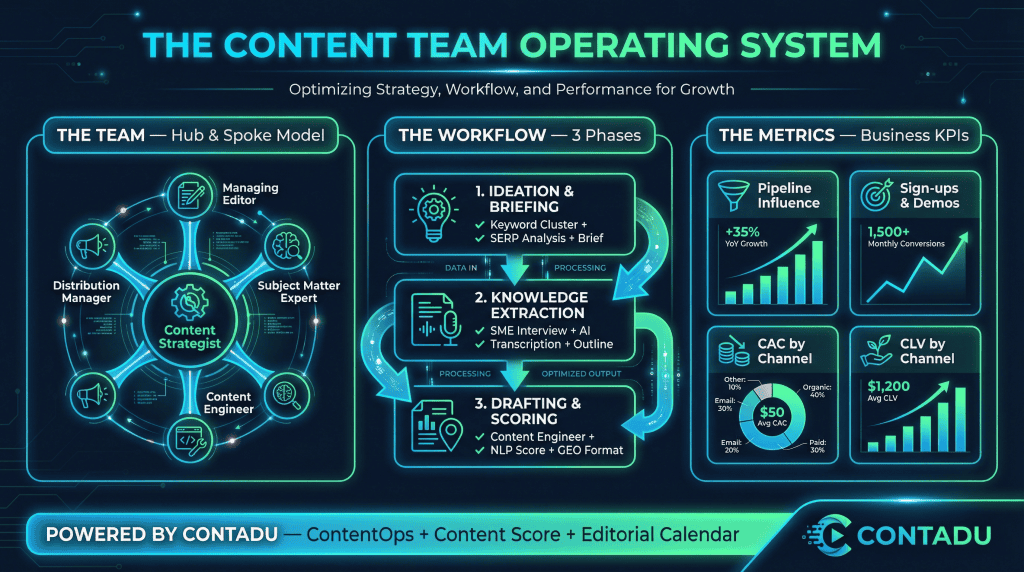
Content marketing has outgrown the spreadsheet. For years, marketing teams have tried to manage complex editorial calendars, SEO strategies, freelance writers, and distribution channels using a chaotic mix of Google Docs, Slack messages, and color-coded Excel rows.
This “duct-tape” approach worked when the goal was simply to publish one blog post a week. But in 2026, the demands on content teams have exploded. You are no longer just writing articles; you are managing a multi-channel media operation. You must produce high-quality, AI-assisted content at scale, optimize for generative search engines (GEO), atomize every piece across social platforms, and prove direct pipeline ROI to your CFO.
You cannot achieve this level of output with a disorganized team and a fragmented tool stack. You need a Content Team Operating System (ContentOS).
ContentOS is a unified framework of people, processes, and technology that enables your content marketing team to operate like a powerful machine. This guide will detail how to build this operating system, from structuring your team and defining roles to integrating AI into your workflow and measuring the metrics that actually matter.
Chapter 1: The Modern Content Team Structure.
The traditional “content writer” role is dead. In the age of AI, simply generating words is no longer a valuable skill. The modern content team requires a specialized mix of strategists, editors, and technical experts.
To build a high-output team, you must move away from the “lone wolf” model and adopt a “hub and spoke” structure.
The Core Roles of a 2026 Content Team.
| Role | Primary Responsibility | AI Augmentation |
| Content Strategist (The Hub) | Defines the editorial calendar, conducts SERP intent analysis, and builds the topical authority map. | Uses AI for keyword clustering and content gap analysis. |
| Managing Editor (The Filter) | Enforces brand voice, checks for Information Gain, and ensures E-E-A-T compliance. | Uses AI for structural editing and readability scoring. |
| Subject Matter Expert (The Brain) | Provides the proprietary data, unique opinions, and deep industry knowledge that AI cannot generate. | Uses AI to transcribe interviews and structure raw thoughts. |
| Content Engineer (The Builder) | Assembles the final piece, optimizing for semantic SEO, schema markup, and technical formatting. | Uses AI for entity extraction and HTML/Markdown generation. |
| Distribution Manager (The Amplifier) | Atomizes the core content into social posts, email sequences, and zero-click assets. | Uses AI to repurpose long-form text into multiple short-form formats. |
The Death of the “Generalist”.
If you hire a generalist and ask them to do keyword research, interview an expert, write a 3,000-word article, optimize it for SEO, and post it on LinkedIn, the result will be mediocre across the board.
By separating the strategy (Strategist), the knowledge (SME), the quality control (Editor), and the distribution (Amplifier), you create a highly efficient assembly line.
Read more: Content Operations (ContentOps): How to Build a Content Management System in the AI Era.
Chapter 2: The AI-Augmented Workflow.
The biggest mistake teams make in 2026 is trying to use AI to replace the writer. This results in generic, soulless content that fails Google’s quality guidelines and alienates readers.
The correct approach is to use AI to augment the workflow, removing friction and accelerating the operational steps, while leaving the critical thinking to humans.
Phase 1: Ideation and Briefing.
The foundation of a great article is a great brief. A weak brief guarantees a weak outcome, regardless of whether a human or an AI writes the draft.
The Augmented Briefing Process:
1.The Content Strategist identifies a target keyword cluster based on the company’s Topical Authority map.
2.The Strategist uses a Content Intelligence tool to analyze the top 10 SERP results, extracting the required semantic entities and identifying the search intent.
3.The Strategist creates a highly detailed brief that includes the target audience, the unique angle (Information Gain), and the required structure.
Read more: How to Create the Perfect Brief for a Copywriter
Phase 2: Knowledge Extraction.
The most valuable content comes from the minds of your internal experts (Founders, Product Managers, Sales Reps). But experts are busy and hate writing.
The Augmented Extraction Process:
1.The Managing Editor conducts a 15-minute recorded interview with the Subject Matter Expert (SME), asking highly specific, contrarian questions based on the brief.
2.The audio is transcribed using an AI tool.
3.The Editor uses advanced AI Prompting Techniques to synthesize the raw transcript into a structured outline that captures the SME’s unique voice and proprietary insights.
Phase 3: Drafting and Optimization.
This is where the Content Engineer takes over, turning the structured outline and the SME’s insights into a polished, SEO-optimized asset.
The Augmented Drafting Process:
1.The Engineer drafts the content, focusing on narrative flow and readability.
2.The Engineer uses a real-time Content Scoring tool to ensure the draft includes all necessary semantic entities and meets the required readability standards.
3.The Engineer formats the content for both human scanners and Generative AI engines (GEO), using clear headings, bolded quotable statements, and inverted pyramid structures.
Read more: The AI-First Content Workflow
Chapter 3: Distribution and Atomization.
The “publish and pray” era is over. A high-output team spends as much time distributing content as they do creating it. If you spend 20 hours writing a pillar page and 5 minutes sharing it on LinkedIn, you have failed your operating system.
The Atomization Framework
Atomization is the process of breaking down a large, core piece of content (like this pillar page) into dozens of smaller, platform-specific assets.
How to execute Content Atomization:
1.The Core Asset: Publish a comprehensive, 5,000-word Long-Form Content guide on your blog.
2.The Email Sequence: Break the guide into a 5-part educational email course for your newsletter subscribers.
3.The Social Carousel: Extract the 5 most contrarian opinions from the guide and turn them into a visual LinkedIn carousel.
4.The Short-Form Video: Record a 60-second summary of the core concept for YouTube Shorts and TikTok.
5.The Community Post: Share a “zero-click” summary in relevant Slack communities, focusing on the value, not the link.
Read more: Content Atomization: How to Create 20 Pieces from One Article
Penetrating “Dark Social”.
In B2B marketing, the most important conversations happen in private channels: Slack groups, Discord servers, WhatsApp chats, and direct messages. This is known as “Dark Social.”
You cannot track Dark Social with Google Analytics, but you can influence it by creating highly shareable, “zero-click” content.
The Zero-Click Strategy:
Instead of posting a link with the caption “Read our new blog post,” post the entire value proposition directly in the social feed. If the post is valuable enough, users will share it within their private networks, establishing your brand’s authority.
Read more: Content Distribution Strategy: Beyond “Publish and Pray”
Chapter 4: Measuring the Metrics That Matter.
A ContentOS is only as good as its feedback loop. If you are tracking the wrong metrics, you will optimize for the wrong outcomes.
Vanity Metrics vs. Business Metrics.
The biggest trap for content teams is optimizing for “Vanity Metrics”—numbers that look impressive on a dashboard but do not correlate with business growth.
| Vanity Metrics (Ignore) | Business Metrics (Optimize For) |
| Total Page Views | Pipeline Influence |
| Bounce Rate | Sign-ups / Demos / Trials |
| Social Media Likes | Customer Acquisition Cost (CAC) by Channel |
| Time on Page | Customer Lifetime Value (CLV) by Channel |
If your goal is to drive revenue, you must connect your content directly to the pipeline.
Implementing Multi-Touch Attribution.
A B2B buyer’s journey is complex. They might read a blog post, attend a webinar, click a retargeting ad, and then request a demo. If you only track the “Last Touch” (the demo request), you are ignoring the content that initiated the journey.
To accurately measure the ROI of your ContentOS, you must implement a multi-touch attribution model (like W-Shaped Attribution) that assigns credit to every touchpoint in the buyer’s journey.
Read more: Content ROI: How to Measure What Actually Matters
Chapter 5: The Contadu Operating System.
Building a high-output ContentOS requires the right technology stack. You cannot manage a team of specialists, track semantic entities, and measure ROI across 50 simultaneous projects using a spreadsheet.
This is why top-performing marketing teams rely on Contadu as their centralized Content Intelligence platform.
1. Centralized Content Operations.
Contadu acts as the command center for your entire ContentOS. The Team Management panel allows the Content Strategist to assign specific tasks (Briefing, Drafting, Editing, Publishing) to different specialists, tracking the progress of every piece of content in real-time.
Read more: How to Manage 50 Content Projects Simultaneously in Contadu
2. Data-Driven Briefs and Semantic Scoring.
Stop guessing what to write. Contadu analyzes the top-ranking pages for your target keywords and generates comprehensive content briefs for your Subject Matter Experts and Content Engineers.
As the Engineer drafts the content, Contadu provides real-time NLP feedback. The proprietary Content Score evaluates semantic relevance, readability, and structure, ensuring every piece of content meets the required quality standards before it reaches the Managing Editor.
Read more: Content Scoring: How to Measure Quality Before Publishing
3. Maintaining the Editorial Calendar.
A high-output team requires a centralized, transparent editorial calendar. Contadu integrates your keyword strategy directly with your publishing schedule, allowing the entire team to see what is being published, when, and by whom.
Read more: Content Calendar: From Chaos to System
Conclusion: The Era of High-Output Content.
The era of the “lone wolf” content writer is over. In 2026, content marketing is a complex, multi-disciplinary operation that requires a highly specialized team and a robust technological foundation.
To build a high-output Content Team Operating System (ContentOS), you must:
1.Restructure Your Team: Move away from generalists and adopt a “hub and spoke” model of Strategists, Editors, SMEs, Engineers, and Amplifiers.
2.Augment, Don’t Replace: Use AI to accelerate the ideation, extraction, and formatting phases of your workflow, but rely on human Subject Matter Experts for the core insights and Information Gain.
3.Atomize Relentlessly: Spend as much time distributing and repurposing your content as you do creating it, focusing on “zero-click” assets for Dark Social.
4.Measure Pipeline ROI: Stop tracking vanity metrics and start measuring the direct impact of your content on pipeline, CAC, and CLV.
5.Centralize Your Operations: Use a Content Intelligence platform like Contadu to manage your team, track your semantic scoring, and maintain your editorial calendar.
By implementing this operating system, you will transform your content team from a chaotic, reactive group into a proactive, revenue-generating machine.
FAQ
How large does a content team need to be to implement this operating system?
You do not need a massive team to implement a ContentOS. Even a two-person team can adopt the “hub and spoke” model by clearly defining who acts as the Strategist/Editor and who acts as the Engineer/Amplifier, while leveraging internal SMEs for insights. The key is the process, not the headcount.
What is the most important role in the modern content team?
The Subject Matter Expert (SME). In an era where AI can generate infinite amounts of generic text, the proprietary data, unique experiences, and contrarian opinions of your internal experts are your only true competitive advantage.
How do we convince our internal SMEs to participate in content creation?
Do not ask them to write. SMEs are busy and often dislike writing. Instead, use the Augmented Extraction Process: have the Managing Editor conduct a 15-minute recorded interview, transcribe it with AI, and have the Content Engineer draft the article based on their insights.
Can we use AI to write the final draft?
No. While AI is excellent for outlining, summarizing transcripts, and checking semantic relevance, the final draft must be written and polished by a human Content Engineer. Purely AI-generated content lacks the necessary voice, narrative flow, and Information Gain required to rank and convert in 2026.
How long does it take to build a fully functional ContentOS?
Transitioning from a traditional “spreadsheet” model to a high-output ContentOS typically takes 3 to 6 months. It requires a fundamental shift in team culture, the adoption of new technologies like Contadu, and the establishment of new, AI-augmented workflows.
