

Long-Form Content: How to Write 3000+ Word Articles That Rank and Convert
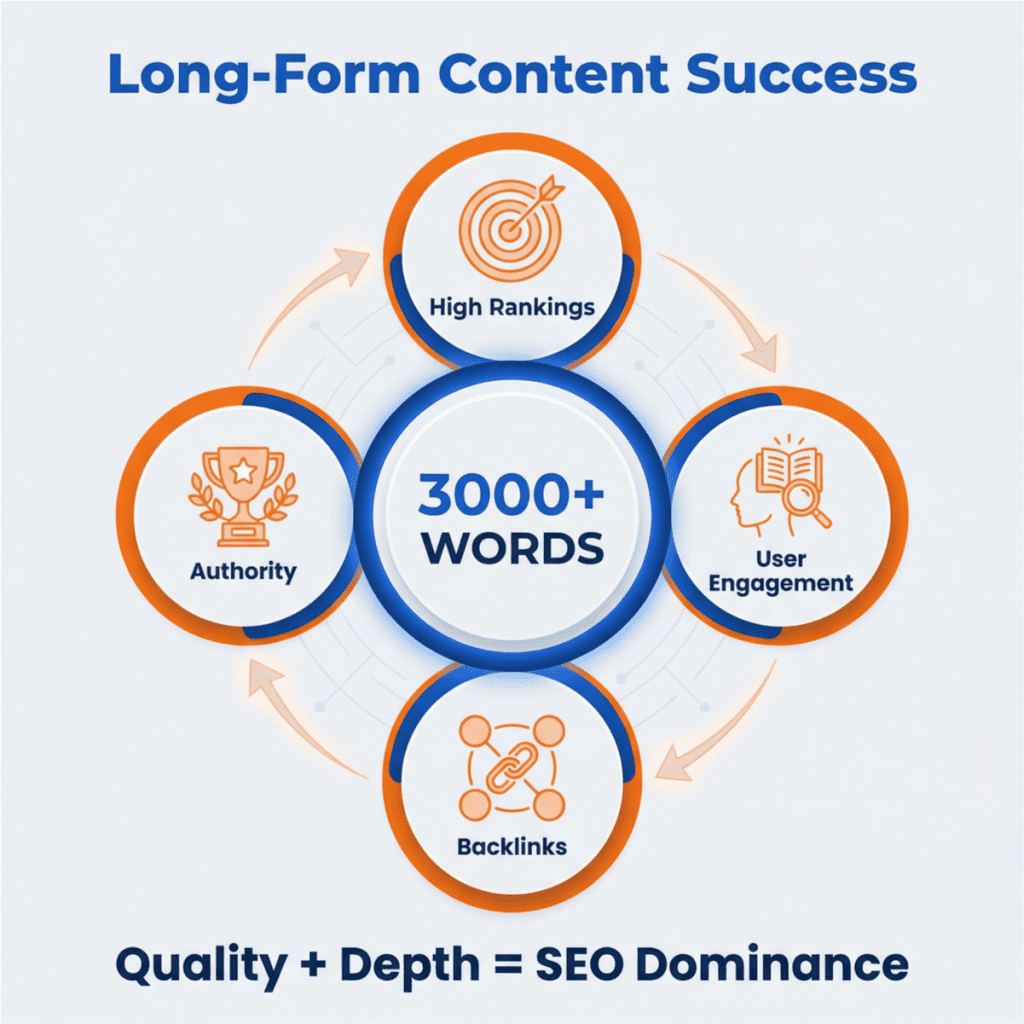
You will discover how to create comprehensive, substantive articles that not only achieve top positions in Google but also engage readers and effectively accomplish business goals. This guide is a complete strategy for creating long-form content in 2026. You will learn how to maintain reader attention across 3000 words, how to structure content for maximum readability, and how to use tools to make this process efficient and repeatable.
Why Long-Form Content Dominates in 2026 (The Theory of Success)
Creating long-form content is not art for art’s sake. It’s a strategic decision based on hard data and an understanding of how modern search engine algorithms and user psychology work.
- Demonstrating E-E-A-T (Expertise, Experience, Authoritativeness, Trustworthiness): A long, comprehensive article is the strongest possible signal to Google that you are an expert in a given field. Covering a topic comprehensively, including nuances and different perspectives, builds authority that cannot be achieved in 500 words.
- Comprehensive Semantic Coverage: Longer content allows for the natural incorporation of hundreds of semantic terms (NLP), synonyms, and related phrases. This allows Google to understand the context and depth of your knowledge, which is crucial in the era of entity-based search. You build a solid foundation for your topic clusters in this way.
- Extended Dwell Time: An engaging, well-written long-form article keeps users on the page longer. Longer time spent on a page is a strong signal to Google that the content is valuable and relevant, which directly impacts higher rankings.
- Backlink Potential: Studies consistently show that long-form content generates significantly more backlinks than short-form content. Other creators and experts are more likely to link to comprehensive, definitive guides than to superficial articles.
Anatomy of an Effective Long-Form Article (Structure and Elements)
How do you write 3000 words that people will actually read? The key is text architecture that guides the reader by the hand.
- Inverted Pyramid Model: Place the most important information, definitions, and answers at the very beginning of the article. Give the reader what they came for right away, then invite them to explore the topic further in subsequent sections.
- Attention-Holding Hooks: Regularly weave elements into the text that capture attention: intriguing questions, surprising statistics, short anecdotes, controversial theses.
- Navigational Heading Structure: Use a logical hierarchy of headings (H1, H2, H3, H4) as a roadmap for your article. The reader should be able to scan the headings and immediately know what they’ll find in each section. This is a crucial element of effective on-page optimization.
- Visual “Rest Stops”: No one wants to read a wall of text. Regularly (every 200-300 words) break up the text with visual elements: graphics, infographics, tables, blockquote citations, embedded videos.
- Internal Calls to Action (Internal CTAs): Don’t wait until the very end to include a call to action. Weave contextual CTAs into the content, such as links to download an e-book, sign up for a webinar, or try a feature that solves the problem being discussed.
The Process of Creating Long-Form Content (Step by Step)
Step 1: Research and Planning (50% of Success). Before you write the first sentence, you need to know everything. Conduct in-depth content gap analysis and keyword research. Create an extremely detailed article outline, breaking down each H2 and H3 heading along with the key points you want to address in it. All of this should be included in your perfect brief.
2.Step 2: Writing the First Draft (Drafting). At this stage, focus solely on getting your thoughts onto paper (or screen). Don’t worry about perfect sentences or typos. Your goal is to create a complete, substantive skeleton while sticking to the planned structure.
3.Step 3: Optimization and Enrichment. Now it’s time for magic. Import your text into the Contadu editor. Focus on NLP term suggestions to semantically enrich the content. Analyze the heading structure of competitors and supplement your article with missing sections. Aim for the highest possible Content Score.
4.Step 4: Editing and Improving Readability. This is the stage where you turn good text into outstanding text. Shorten long sentences, simplify complex language, use bullet points and bold text to highlight key information. Read the text aloud to catch unnatural phrasing.
How Contadu Simplifies Long-Form Content Creation
Creating long-form content without the right tools is extremely difficult. Contadu was designed to support this process at every stage.
- Planning: The Content Strategy module allows you to plan an entire topic cluster of which your long-form article is a part.
- Analysis: SERP analysis and content gap tools provide the data needed to create a comprehensive article outline.
- Writing and Optimization: The Content Editor with Content Score metric and NLP term suggestions is your command center. It ensures that your article is not only long but also substantively complete and perfectly optimized.
- Management: The entire multi-stage process of creating a long-form article can be enclosed within a structured Content Operations system, which guarantees repeatability and high quality.
FAQ
Should every article be long-form?
No. Content length should be dictated by user intent and topic complexity. Sometimes the best answer is a short, concise paragraph. Reserve long-form content for topics that require in-depth explanation (e.g., pillar pages, ultimate guides).
How long does it take to write a 3000+ word article?
Professionally writing, optimizing, and editing such extensive material can take 8 to 20 hours of work. That’s why it’s so important to create them as part of a thoughtful strategy, not haphazardly.
Can I use AI to write a long-form article?
You can and should use AI as an assistant in the process – for research, generating ideas for sections, or paraphrasing sentences. However, relying 100% on AI to write an entire long-form article is a direct path to creating generic content devoid of unique perspective that won’t build authority.
How do you maintain consistency in such a long text?
The key is a detailed outline created during the planning stage. It acts as a map that ensures you don’t lose the thread and that all sections logically connect with each other.
How do you measure the success of a long-form article?
Beyond Google rankings, measure metrics such as: time on page (should be high), number of backlinks generated, conversion rate on internal CTAs, and number of social media shares.
Summary and Next Step
Creating long-form content is an investment that pays off. It’s a strategy for those who want to build lasting authority and dominate their niche, not just fight for scraps of traffic from short, superficial articles. It requires planning, discipline, and the right tools, but the return on this investment is invaluable.
Suggested next step: Choose one of the key topics for your business that is currently described in a short, superficial article. Treat it as a candidate for expansion. Use Contadu to analyze the competition and identify missing sections and terms, then expand it into a comprehensive guide. This will be your first practical lesson in creating effective long-form content.
