
Keyword Research in 2026: Beyond Search Volume.
You will understand why traditional keyword research based solely on search volume is outdated. This guide is your roadmap to modern keyword research for 2026. You will learn how to decode user intent, discover semantic opportunities, and analyze the SERP landscape to find phrases that not only generate traffic but, above all, attract valuable, converting customers.
The Paradigm Shift: From Keywords to Problems
For years, keyword research was simple find a phrase with high volume and low competition. In 2026, in the era of AI Search and semantic understanding, this approach is doomed to fail. The new paradigm involves a shift in thinking:
You’re no longer searching for keywords. You’re searching for problems, questions, and needs of your customers.
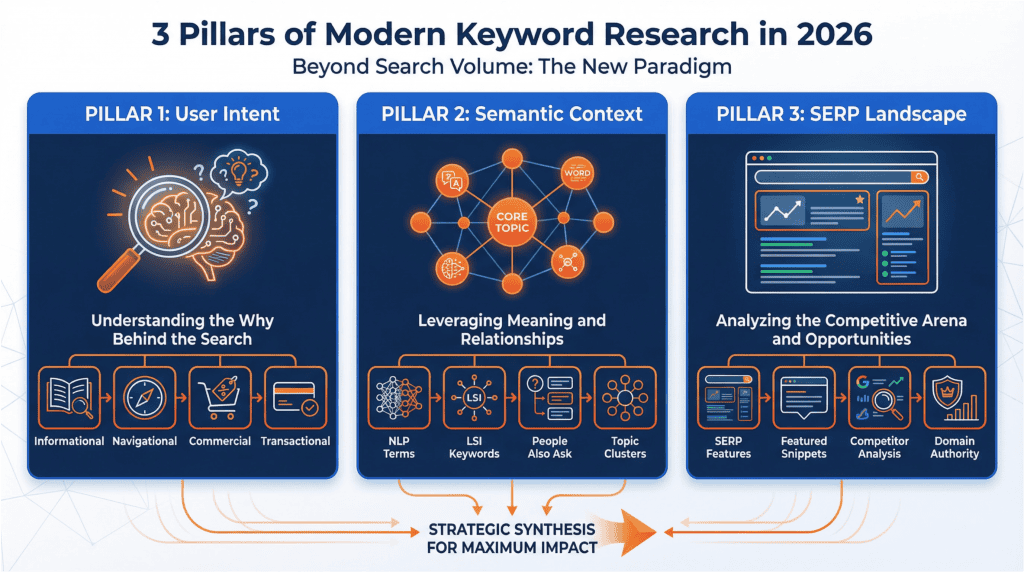
Keywords are just the way people articulate these problems. Your task is to understand what lies behind the query. This is a fundamental shift that requires moving away from spreadsheets filled with volume and focusing on three key pillars.
Three Pillars of Modern Keyword Research
Pillar 1: User Intent (Search Intent)
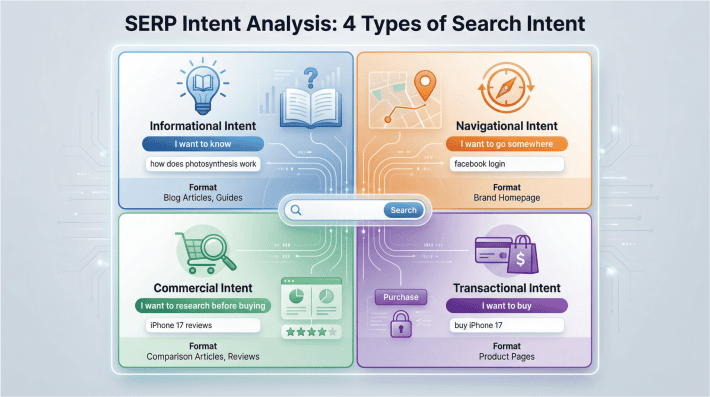
This is the absolute foundation. Before you look at volume, you must understand why someone is typing a given phrase. We distinguish four main types of intent:
- Informational: The user is looking for an answer to a question (e.g., “how does SEO work?”).
- Navigational: The user wants to reach a specific page (e.g., “Contadu login”).
- Commercial: The user is considering a purchase and comparing options
- Transactional: The user is ready to buy (e.g., “Contadu pricing”).
How to use this? Analyze the SERP (search engine results page) for each phrase. What type of content does Google show in the top 10? Are they blog posts (informational), product pages (transactional), or comparisons (commercial)? Matching your content format to the dominant intent is a prerequisite for achieving high rankings.
Pillar 2: Semantic Context.
Google no longer thinks in terms of individual words. It thinks in terms of topic clusters and entities. That’s why your research must be broader.
- NLP and LSI Keywords: These aren’t just synonyms. They are terms and phrases that naturally co-occur in conversation about a given topic. If you’re writing about “electric cars,” Google expects you to mention “batteries,” “charging stations,” “range,” and “Tesla.”
- “People Also Ask” (PAA) Analysis: This is a goldmine. The PAA section in Google results shows you real, related questions that users are asking. Each of these questions is a potential H2 or H3 heading in your article.
How to use this? Use tools like Contadu to automatically extract NLP terms and PAA questions. Your goal is to create content that covers the topic holistically, not just repeats the main phrase.
Pillar 3: SERP Landscape Analysis
Volume and difficulty are only part of the picture. You need to understand who and what you’re competing against.
- SERP Features: Do videos, images, featured snippets, or “Top Stories” carousels dominate the results? This suggests what content format has the best chance of success.
- Competitor Authority: Who occupies the top 10? Are they global brands with huge domain authority, or perhaps smaller, niche blogs? Fighting Wikipedia requires a different strategy than competing with a blog from your city.
How to use this? Before you commit to a given phrase, manually analyze the SERP. See if you have a realistic chance of creating content 10x better than what’s already there.Sometimes it’s better to find a phrase with lower volume but less competition and better alignment with your business. This is the essence of content gap analysis.
How Contadu Automates Modern Keyword Research
Contadu was built around the new keyword research paradigm, automating tasks that would manually take dozens of hours.
- Keyword Discovery: Discover new opportunities, but with full context. Contadu not only shows volume but also groups phrases thematically, making it easier to plan topic clusters.
- SERP and Intent Analysis: The platform automatically analyzes top results, showing you the dominant intent, most commonly used content formats, and key SERP features.
- NLP and PAA Term Extraction: Instead of manually copying questions from Google, Contadu provides you with a complete list of semantic terms and “People Also Ask” questions that are essential for creating comprehensive content.
- Content Strategy Module: All found phrases and problems can be visually mapped, creating a strategic content architecture, not just a flat list of keywords.
FAQ
Is search volume now completely useless?
No, but its role has changed. It’s an indicator of potential reach, but it shouldn’t be the only or most important criterion. A phrase with a volume of 50 but perfect alignment with your product and high transactional intent is often more valuable than a phrase with a volume of 5000 and general informational intent.
How important is keyword difficulty?
It’s a useful metric, but often misleading. Many tools calculate it primarily based on competitors’ backlink profiles. It doesn’t account for content quality, topical authority, or intent matching. Treat it as a guideline, but always verify it with manual SERP analysis.
What is “Zero-Click Search” and how does it affect keyword research?
This is a situation where the user finds the answer to their question directly on the Google results page (e.g., in a featured snippet) and doesn’t click on any link. This means you need to optimize your content to appear in these snippets by providing concise, direct answers at the very beginning of the article.
Should I target keywords with zero volume?
Yes, if they are very specific, long-tail phrases that indicate strong purchase intent or solve a specific problem for your ideal customer. A few valuable customers from such a phrase are more valuable than hundreds of random visitors.
How does AI Search (e.g., Google SGE) change keyword research?
AI Search further strengthens the importance of intent and context. People will ask more complex, conversational questions. Your research must focus on anticipating these questions and creating content that provides comprehensive, authoritative answers, not just matching keywords.