
E-E-A-T in 2026: How to Demonstrate Expertise, Experience, Authority, and Trust
You will understand why E-E-A-T (Expertise, Experience, Authoritativeness, Trustworthiness) is not just another SEO acronym, but a fundamental philosophy that determines success or failure in Google search results in 2026. This guide is your strategy for building and communicating trust signals that are crucial for algorithms and, more importantly, for your readers. You will learn how to transform your site from an anonymous source into a recognized and valued authority in your niche.
The Genesis of E-E-A-T: From Algorithm to Philosophy.
Fun Fact: The concept of E-A-T (without ‘Experience’) first appeared in Google official Search Quality Rater Guidelines as early as 2014. However, it wasn’t until after the famous algorithm update, dubbed the “Medic Update” by the SEO industry in August 2018, that the marketing world began to take it deadly seriously. This update devastated the visibility of many health and finance websites that couldn’t prove their authority.
Another breakthrough came in December 2022, when Google officially added the second ‘E’ for Experience. This was a clear signal: Google wants to promote content created by people who have actually lived what they’re writing about.
Deconstructing E-E-A-T: What Each Element Means in Practice.
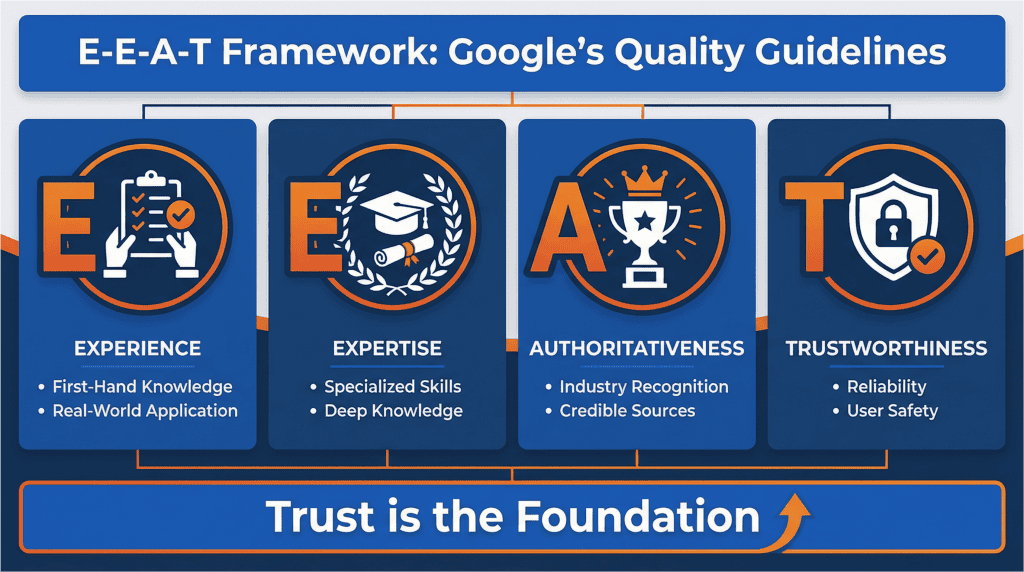
E-E-A-T is a set of criteria that Google uses to evaluate the quality and credibility of content, especially in YMYL (Your Money or Your Life) topics. Here’s how to understand each pillar:
Experience: Does the content creator have direct, lived experience with the topic being discussed?
From Google’s guidelines: “Consider the extent to which the content creator has the necessary first-hand or life experience for the topic. For example, a product review written by someone who personally used the product.”
Analogy: Would you rather learn to climb from someone who read 10 books about mountains, or from someone who summited Mount Everest?
Expertise: Does the author possess the necessary knowledge and skills in the given field?
From Google’s guidelines: “Consider the extent to which the content creator has the necessary expertise for the topic. Different topics require different levels and types of expertise in order to be trustworthy.”
From Google’s guidelines: “Consider the reputation of the content creator or website for the topic. […] Signals of authoritativeness, such as recommendations from experts and other reputable sources, can help with evaluation.”
Analogy: When buying a book on business strategy, would you reach for a title by an unknown author, or one recommended by Harvard Business Review?
Trustworthiness: Can users trust your site? This is the most important element, a foundation for all others.
From Google’s guidelines: “Trust is the most important member of the E-E-A-T family because untrustworthy pages have low E-E-A-T, no matter how Experienced, Expert, or Authoritative they may seem.”
Analogy: Would you enter a beautiful-looking bank that everyone says is insolvent?
Strategic Checklist for Building E-E-A-T Signals.
Building E-E-A-T is a marathon, not a sprint. Here’s a checklist of actions you must implement on your site and beyond.
On-Page Signals:
- Author Bio Pages: Every article should be signed by a real person. Create detailed author bios containing their qualifications, experience, links to social profiles (LinkedIn), and publications elsewhere.
- About Us Page: This is one of the most important pages on your website. Tell your brand’s story, introduce your team, mission, and values. Show the human face of your company.
- Citing Sources: Always link to original research, reports, and data you reference. This shows that your content is well-researched and fact-based.
- Structured Data (Schema Markup): Use structured data (e.g., Person, Organization, Article) to help Google understand who your authors are and what your organization is.
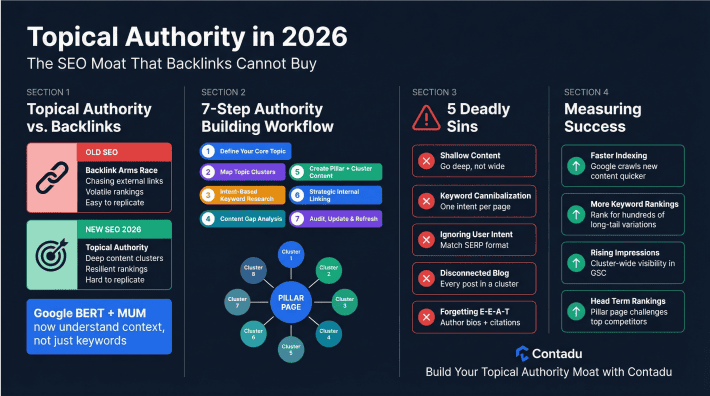
- Content Comprehensiveness: Invest in topic clusters. Covering an entire topic, not just individual keywords, is the strongest proof of your expertise.
Off-Page Signals:
- Brand Mentions: Actively build your brand’s presence online. Speak on industry forums, participate in podcasts, publish guest articles.
- Backlink Profile: Earn links from authoritative, topically related sites. One link from a reputable industry portal is worth more than a hundred links from business directories.
- Reviews and Testimonials: Encourage satisfied customers to leave reviews on Google, industry portals, and social media. Actively manage your online reputation.
- Social Media Consistency: Maintain active and consistent profiles on key social media platforms for your industry. This builds brand recognition and authority.
How Contadu Supports Building E-E-A-T.
Contadu won’t build authority for you, but it provides tools that are essential in this process.
- Expertise Guarantee: The Content Editor, through NLP term analysis and suggestions based on top competitors, helps create content that is substantively complete and comprehensive. This directly supports the “Expertise” pillar.
- Authority Planning: The Content Strategy module allows for visual planning of topic clusters. Building topical authority becomes a deliberate process, not a matter of chance.
- Quality Management: Implementing a Content Operations system in Contadu ensures that every published material goes through the same verification and optimization stages, guaranteeing a consistently high level of quality and expertise.
Summary and Next Step.
Stop thinking about E-E-A-T as a technical SEO task. Start thinking about it as building your brand’s reputation in the digital world. Every article, every author bio, every mention online is a brick that builds trust and perception of your company as a leader. This is not the fastest path, but the only one that leads to lasting success in Google in 2026.
Suggested next step: Conduct an audit of your site for E-E-A-T. Start with simple things: do you have an “About Us” page? Do your articles have authors with bios? Is it easy to find your company’s contact information? Fixing these basics is your first, most important step.
FAQ (Frequently Asked Questions)
Is E-E-A-T a direct ranking factor?
Not in a technical sense, like page speed. Google doesn’t have an “E-E-A-T score.” It’s rather a concept that is realized through hundreds of smaller signals that algorithms can measure (link quality, brand mentions, user behavior on the site).
Is E-E-A-T important for every site?
Yes, but its weight is greatest for YMYL (Your Money or Your Life) pages – finance, health, law, news. For a cooking blog, the weight of “Experience” (whether the author actually cooks these dishes) will be greater than formal qualifications.
Can I be anonymous and still have high E-E-A-T?
In 2026, this is practically impossible, especially in competitive niches. Anonymity is the opposite of trust and authority. Users and Google want to know who is behind the content.
How quickly will I see the effects of building E-E-A-T?
This is a long-term strategy. You can see the first effects in terms of better brand perception and greater engagement after 3-6 months. Significant impact on Google rankings is often a matter of 6-12 months of consistent work.
What’s more important: links or great content?
This is a false dichotomy. In 2026, you need both. Great, expert content is the foundation that naturally attracts links and builds authority. Links to poor content won’t bring long-term results.