
Content Calendar 2.0: Your Content Marketing Command Center.
Does your content marketing feel like putting out fires? Do you publish whenever you have time, choose topics based on gut feelings, and only think about consistency and strategy once a quarter? If so, this guide is for you. We’ll show you how to transform a simple list of topics into a strategic command center that drives growth, builds authority, and helps you regain control over the chaos. You’ll understand that a mature content calendar isn’t about bureaucracy, but about building a foundation for scalable and predictable marketing.
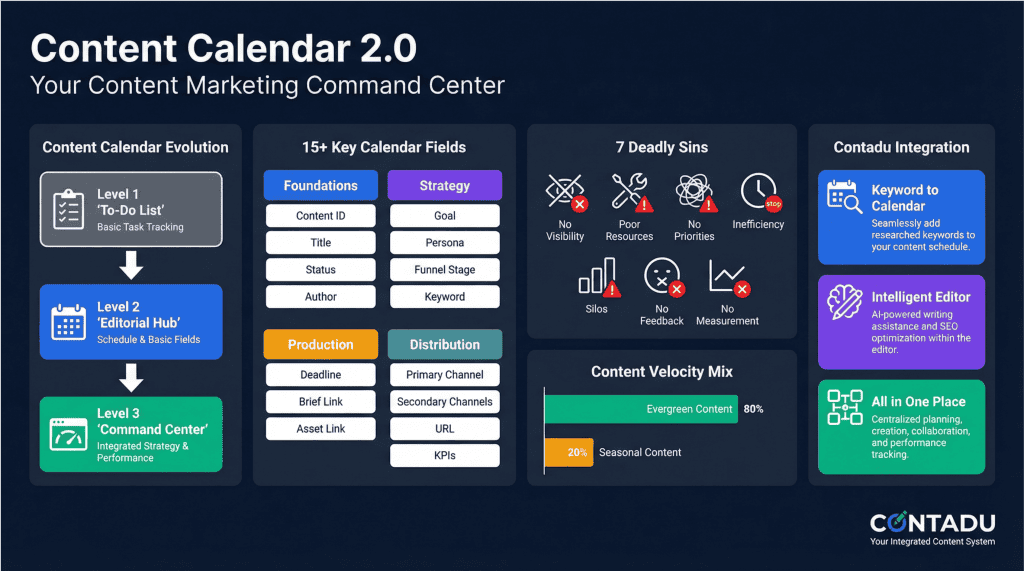
The Evolution of the Content Calendar: From Spreadsheet to System.
Initially, a content calendar is often a simple Google Sheets file. That’s a good start, but its true power lies in its evolution. Let’s see how to reach the next level of maturity.
Level 1: The To-Do List
- Characteristics: A simple spreadsheet with columns: Topic, Publication Date, Status.
- Problem: Reactivity. Such a calendar doesn’t answer the “why?”, doesn’t connect content to business goals, and doesn’t manage the entire content lifecycle.
Level 2: The Editorial Hub
- Characteristics: Enriched with Author, Persona, Distribution Channels, Content Pillar.
- Problem: It’s still a silo. Planning is separate from creation, optimization, and analysis. Teams (SEO, social media, writers) work in separate tools, leading to inconsistencies.
Level 3: The Integrated Command Center
- Characteristics: This is no longer just a calendar; it’s a content operating system. It combines strategic planning, production management, SEO optimization, and analytics in one place. Each piece of content is an asset with assigned metadata, goals, and a measurable ROI.
- Solution: Platforms like Contadu allow you to create such a center, integrating a data-driven content strategy with daily editorial work.
Anatomy of a Strategic Content Calendar: 15+ Key Fields
Forget about 3 columns. A professional calendar is a database. Here is a comprehensive structure you can adapt:
| Category | Field | Description & Importance | Example |
| Foundations | Content ID | A unique identifier. | ART-014 |
| Working Title | A preliminary but clear title. | Content Calendar 2.0 Guide | |
| Status | A precise workflow stage (e.g., Idea, Brief Ready, Writing, SEO Review, Pending Approval, Scheduled, Published, In Promotion, To Be Updated). | SEO Review | |
| Strategic Context | Primary Goal | What is this content meant to achieve? (e.g., Organic Traffic, Lead Generation, Authority Building, Sales Support). | Authority Building |
| Persona | The main target audience for the content. | Martha, Content Manager | |
| Funnel Stage | At what stage of the customer journey is the persona? (TOFU, MOFU, BOFU). | MOFU (Middle of the Funnel) | |
| Pillar / Cluster | Belonging to a strategic topic cluster. Link to the cluster map. | Pillar 2: Scalable Content Creation | |
| Keyword | The main keyword and its monthly search volume. | content calendar (880/mo) | |
| Production & Resources | Author | The person responsible for creation. | Anna Nowak |
| Deadline | The final publication date. | 2026-03-20 | |
| Brief Link | A link to a detailed brief in Contadu or Notion. | [Link to brief] | |
| Asset Link | A folder with graphics, data, and quotes. | [Link to folder] | |
| Distribution | Primary Channel | Where will the content be published originally? | Blog |
| Secondary Channels | Where will the content be repurposed? (atomization). Link to the atomization guide. | Newsletter, LinkedIn, Twitter, Infographic on Pinterest | |
| Analytics | URL | The final URL after publication. | /blog/content-calendar-guide-enhanced |
| KPIs to Track | Specific success metrics (e.g., SERP Positions, Number of Leads, Conversion Rate). | Positions for ‘editorial calendar’, ‘publication plan’ | |
| Update Date | When should the content be refreshed? | 2027-03-20 |
The 7 Deadly Sins of Calendar Management (and How to Avoid Them)
Even the best tool will fail if the process is flawed. Here are the most common problems identified by Asana and our solutions:
Lack of Visibility: Teams don’t know what’s being published and what’s in the pipeline. This leads to duplicated topics and a loss of synergy.
- Solution: Use a tool with a calendar view (e.g., Contadu, Asana, Notion Calendar) that will become the single source of truth (SSoT) for all content activities.
Poor Resource Management: It’s hard to assess who is overloaded with work and who has free capacity.
- Solution: Introduce time estimates for each task and use “Workload” views to visualize team capacity.
Prioritization Problems: Creating content for the sake of creating it, without linking it to company goals.
- Solution: Implement an idea scoring system (e.g., RICE, ICE) and map every piece of content to a specific business goal and funnel stage.
Inefficient Processes: Lack of standards, chaotic workflows, unclear approval processes.
- Solution: Create task templates for different content types (article, case study, webinar) with predefined steps and checklists. Automate repetitive tasks.
Difficult Cross-Team Collaboration: Silos between the SEO department, social media, and content creators.
- Solution: Integrate tools (e.g., Asana + Slack + Google Drive) or work on a single platform (Contadu) where all communication and feedback happen in the context of a given task.
Problems with Gathering Feedback: Comments and corrections get lost in emails and on Slack.
- Solution: Use commenting and tagging functions directly in the document or task. This centralizes the discussion and ensures that nothing is missed.
Lack of Performance Measurement: You publish and forget. You don’t know what works and what is a waste of time and money.
- Solution: Define KPIs for each piece of content in the calendar. Regularly (e.g., monthly) analyze the results and use this data to plan future activities. This is the essence of a data-driven strategy.
Advanced Concepts: Content Velocity and Publishing Cadence.
Content Velocity is a metric that measures how quickly and efficiently your team can produce valuable content. It’s not about publishing more, but about shortening the cycle from idea to customer value.
- Why is it important? High velocity allows you to react faster to trends, dominate topic niches, and build authority in the eyes of Google, which values regularly updated and valuable services.
- How to achieve it?
- Workflow Optimization: Eliminate bottlenecks in the process (e.g., long waits for approval).
- Standardization and Templates: Use briefs, checklists, and templates to minimize conceptual work on repetitive tasks.
- Content Atomization: Plan for redistribution at the creation stage. One large article can become a series of social media posts, an infographic, and a newsletter snippet. See our atomization guide.
Evergreen vs. Seasonal/Reactive Content
Your calendar must balance both types of content:
- Evergreen Content (80%): The foundation of your strategy. How-to articles, guides, definitions that remain relevant for a long time (like this one!). They generate steady, predictable traffic.
- Seasonal/Reactive Content (20%): Content related to events, holidays, trends (e.g., “How to use AI in marketing in 2026”). They generate traffic spikes and engagement but have a shorter lifecycle.
The Role of Contadu: Your Integrated Content Nervous System
Using Contadu to manage your calendar is like switching from a kayak to a speedboat. The platform combines all elements into one cohesive ecosystem:
- From Keyword to Calendar: You start with SERP intent analysis and building a strategy in the Content Strategy module. You can add found topics and keywords to the Calendar with one click, immediately creating a draft article with an assigned author and date.
- Intelligent Editor: You write in an editor that provides real-time suggestions on which keywords to use, what headline structure to apply, and which user questions to include to maximize SEO potential.
- Everything in One Place: No more switching between 10 tabs. Briefing, writing, optimization, feedback, and status tracking – everything happens in one place. This is true Content Operations in practice.
FAQ
How often should I plan content?
Use a 3-tier method: Annual/Quarterly Planning (you set the main pillars and campaigns), Monthly Planning (you schedule specific topics for dates), and Weekly Planning/Sprints (daily task management).
What is more important: sticking to the plan or being flexible?
The plan is a map, not a straitjacket. Leave “buffers” in your calendar for unplanned, reactive content. A good practice is the 80/20 rule – 80% planned evergreen content, 20% room for flexibility.
How do I convince my boss that we need time/tools for this?
Show them the costs of chaos: a burned budget on ineffective content, wasted time searching for information, the cost of missed opportunities (low Google rankings). Present the calendar as an investment in predictability and measurable ROI.
Our team is small. Isn’t this overkill?
Quite the opposite! For small teams and freelancers, a systematic calendar is a tool for maximizing efficiency. It allows you to focus limited resources on activities that bring the greatest return.
Google Sheets or a dedicated tool?
Start with Google Sheets or Airtable to build the habit. When you feel that the spreadsheet is limiting you (no automation, difficult collaboration, no integration with analytics), it’s a sign that you’re ready for a dedicated tool like Contadu, Asana, or Notion.
Conclusion: Build Your System
A strategic content calendar is not another chore, but your greatest competitive advantage. It determines whether your content marketing is just a cost or an investment that generates a return. Start with small steps – implement the extended structure from Section 2 in your favorite tool. Define a clear workflow. And then watch as chaos turns into a predictable, scalable system for winning at content marketing.