

Zero-Click Search Strategy: How to Gain Visibility When No One Clicks?
Online search is undergoing a transformation. The era in which SEO success was measured solely by clicks and rankings is finally fading away. The phenomenon of “zero-click searches”—searches that end without reaching any website—is becoming a dominant force. This isn’t a passing trend, but a new reality that requires marketers and SEO specialists to completely redefine their strategies. Understanding and adapting to this phenomenon is key to maintaining and building online visibility today.
Why is This Area Crucial in Modern SEO?
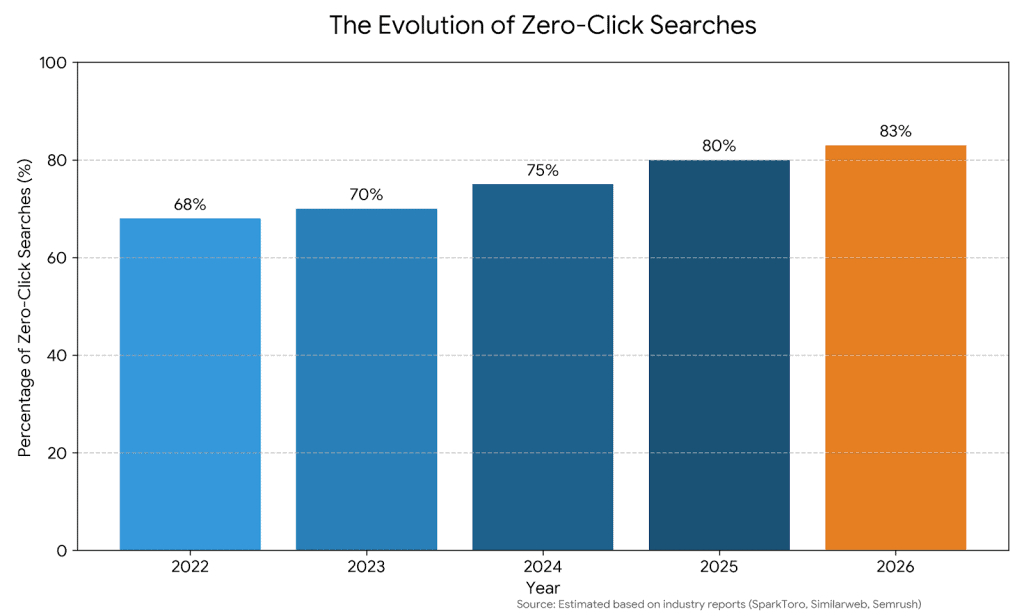
The answer is simple: because traditional metrics and attribution models no longer reflect reality. In a world where, according to estimates, up to 60% of mobile searches do not result in a click, relying solely on organic traffic as a measure of success is a strategic mistake.
Statistics are even more alarming: organic click-through rates for queries with AI Overviews have plummeted by 61% since mid-2024—from 1.76% to just 0.61%. For paid ads, the situation is even worse, with a CTR drop of 68%. AI Overviews, featured snippets, knowledge panels, and other SERP (Search Engine Results Pages) features provide users with answers directly on the results page, eliminating the need for further exploration.
This phenomenon, known as the “attribution crisis,” makes many valuable brand interactions invisible to standard analytical tools. Your brand might be a source of information for thousands of users, building authority and awareness, yet you may not even notice it while looking at declining CTRs.
For content publishers, the situation is particularly dramatic: organic traffic fell from over 2.3 billion visits in mid-2024 to under 1.7 billion in May 2025, while the percentage of zero-click searches for news increased from 56% to 69%. Therefore, in 2026, you must stop thinking in terms of “how to drive traffic” and start thinking “how to dominate visibility” on every possible level—from traditional results, through AI, to voice search.
What Are Zero-Click Searches? Mechanisms and Challenges
A zero-click search occurs when a user’s query is fully satisfied on the search results page. The user gets the answer they were looking for and doesn’t need to click on any links. This phenomenon is driven by the growing number of advanced SERP features that Google and other search engines are introducing to improve the user experience.
The scale of this phenomenon is impressive: in March 2025, only 40.3% of Google users clicked on an organic result, meaning that almost 60% of searches ended without a click. AI Overviews now appear in about 29% of non-logged-in Google user sessions, and for some keyword categories, this rate exceeds 50%. This is not a marginal trend—it’s a fundamental change in how people search for and consume information online.
Main Mechanisms Generating Zero-Click Searches:
| SERP Feature | Description | Impact on SEO |
| AI Overviews | AI-generated summaries that synthesize information from multiple sources. They appear at the top of the results for informational queries. | The biggest challenge. Poor attribution and a drastic drop in CTR for traditional results. |
| Featured Snippets (“Position Zero”) | Direct answers to questions, often in the form of a definition, a step-by-step list, or a table. Extracted from a single, specific page. | Crucial for voice search. An opportunity for high visibility, but at the cost of a click. |
| Knowledge Panels | Information panels about entities (companies, people, places) that gather data from various sources, including Google’s Knowledge Graph. | Builds entity authority. Brand visibility without needing a site visit. |
| People Also Ask (PAA) | Expandable sections with related questions and answers that appear for a very wide range of queries. | Opportunity to appear multiple times in the SERP. Answers must be concise and precise. |
| Local Packs | Local results with a map, opening hours, reviews, and contact information. Essential for local businesses. | Dominance in local queries. Users often call or navigate without visiting the website. |
The AI Search Ecosystem in 2026
Zero-click searches are not just a Google problem. The entire search ecosystem is evolving towards an AI-first approach. In 2026, you need to think about visibility across multiple platforms simultaneously:
- Google AI Overviews and Gemini – Dominate informational queries by synthesizing answers from multiple sources.
- Microsoft Copilot – Integration with Windows, Edge, and Office creates new user touchpoints.
- ChatGPT and SearchGPT – Normalize conversational, assistant-driven search with real-time web access.
- Perplexity AI – Rapid user base growth, with a citation-heavy approach creating new visibility opportunities.
- Apple Siri (2026) – A planned overhaul with the integration of large language models.
- Reddit, Quora, and forums – Increasingly cited as authoritative sources by LLMs.
This fragmentation means that traditional metrics like rankings and CTR only tell part of the story. Success in 2026 requires measuring visibility across all these platforms at once.
How to Implement a Zero-Click Strategy Step-by-Step
Adapting to the new reality isn’t about abandoning your current efforts but strategically expanding them. You need to start creating content that is valuable for both AI algorithms and the users who decide to click. Here are the four key pillars of such a strategy:
Step 1: Optimize Content Structure for Extraction
AI algorithms and snippet-generating mechanisms love well-organized, easy-to-process information. Your goal is to serve them the answer on a silver platter.
- Create concise definitions: Answer “what is X?” questions in short, 40-60 word paragraphs.
- Use lists and step-by-step instructions: Format processes as numbered or bulleted lists.
- Use comparison tables: They make it easy to compare features, prices, or parameters.
- Use H2 and H3 headings with questions: Structure your article around the questions your users are asking.
Step 2: Implement Advanced Structured Data (Schema Markup)
Schema markup is the language you use to “explain” to the search engine what your content is about. In the age of AI, this is more important than ever. It allows for the precise definition of relationships between entities and increases the chances of appearing in advanced search results.
- Implement key schema types: Organization, Person, Product, Article.
- Use FAQPage schema for pages with frequently asked questions.
- Use HowTo schema for instructional content.
- Define sameAs relationships to connect your entity with profiles on other services (e.g., Wikipedia, LinkedIn).
Step 3: Build Topical Authority
AI search engines don’t trust random sources. They promote domains that demonstrate in-depth knowledge in a given field. Instead of creating single articles on loosely related topics, focus on building comprehensive topic clusters.
- Cover the topic comprehensively: Create content that answers all possible user questions within your niche.
- Use strong internal linking: Connect related articles to create a logical knowledge network.
- Adhere to E-E-A-T (Experience, Expertise, Authoritativeness, Trustworthiness): Showcase the experience and expertise of your authors, cite credible sources, and keep your content updated.
Step 4: Focus on Entity Optimization
AI search engines think in terms of entities (things, concepts, people, places), not just keywords. Your brand, products, and key employees are entities. Your job is to build a strong, unambiguous, and authoritative presence for these entities online.
- Create dedicated pages for key entities: e.g., an “About Us” page with a clearly defined history and mission.
- Earn mentions on authoritative platforms: Mentions on Wikipedia, industry portals, or in interviews build the strength of your entity.
- Maintain data consistency (NAP): Name, Address, Phone—consistency of this data across the internet is crucial, especially for local SEO.
How Does CONTADU Support a Zero-Click Search Strategy?
Adapting to the zero-click era requires not only a new strategy but also the right tools to automate analysis and accelerate the production of optimized content. A Content Intelligence platform like CONTADU becomes an indispensable partner in this context, allowing you to make data-driven decisions.
Solved Problems and Time Savings
CONTADU addresses the key challenges of a zero-click strategy by automating processes that would manually take dozens of hours:
- Identifying Gaps and Topics: The Content Strategy module analyzes your domain and your competitors’ domains, pointing out gaps in topic coverage and suggesting new, promising topics to build authority. Instead of guessing what to write, you get a ready-made action plan.
- Quick Creation of Optimized Content: The Content Designer, powered by AI (including Neuro AI), allows you to create an article outline in minutes that is already pre-optimized for semantics and structure. The tool suggests which terms and user questions to include in the content to increase its chances of appearing in featured snippets and AI Overviews.
- Semantic Optimization: Thanks to advanced NLP models, CONTADU analyzes top Google results and recommends the use of specific terms and entities. This allows you to create content that is not only rich in keywords but, above all, thematically deep, which is crucial for AI algorithms.
Data-Driven Decisions
The platform provides hard data that guides your strategy:
- SERP and Competitor Analysis: CONTADU shows you who dominates the search results for given phrases, which content formats are most effective, and what questions users are asking. This allows you to create content that precisely targets market intent and needs.
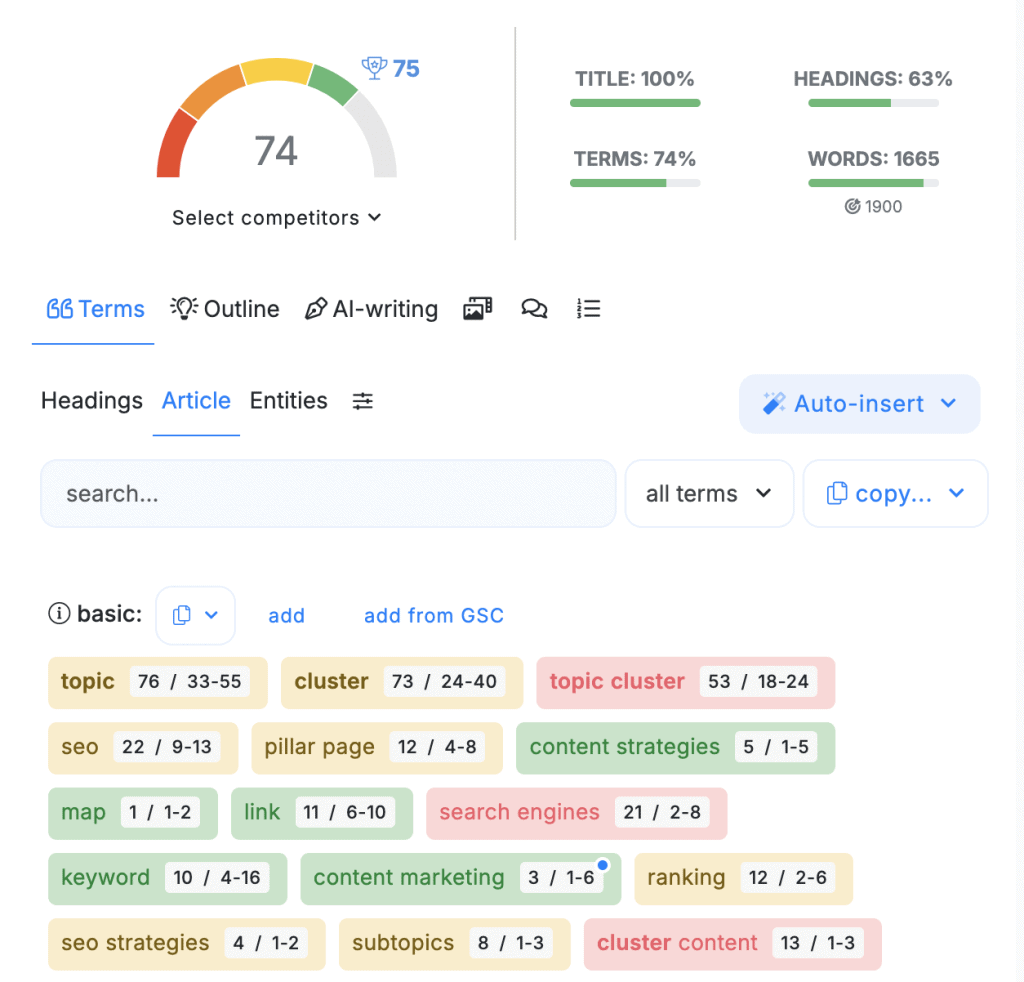
- Measurable Optimization: The real-time Content Score evaluates the quality of your content compared to the competition, giving you a clear signal of what you can still improve to achieve top positions.
Use Case Scenarios in Practice
Imagine you run a company that offers project management software. Your goal is to gain visibility in queries related to remote work.
Scenario 1: Winning a Featured Snippet for the query “how to manage a remote team effectively?”
- In CONTADU, you analyze this query. The tool shows that the SERP is dominated by a featured snippet in the form of a step-by-step list.
- You use the Content Designer to create an article with a structure based on H2/H3 headings that answer related questions (e.g., “What remote work tools should I choose?”).
- In the content, you create a concise, numbered list of “10 steps to effectively manage a remote team,” optimizing it based on CONTADU’s NLP recommendations.
Scenario 2: Appearing in an AI Overview for the query “best remote work software”
- You know that AI Overviews synthesize information from multiple sources. Your goal is to become one of them.
- In the Content Strategy module, you build a topic cluster around “remote work,” creating articles about methodologies, challenges, tools, and trends.
- In each article, you ensure semantic enrichment and link to your software’s product page, building strong associations between the “Your Brand” entity and the concept of “remote work.”
Summary: The Synergy of SEO, AI, and Content Intelligence
The era of zero-click searches does not mean the end of SEO. It means its evolution towards a more strategic, holistic, and data-driven approach. Success in 2026 depends on the synergy of three pillars:
- A deep understanding of SEO principles
- The intelligent use of AI tools for automation and optimization
- Advanced analytics (Content Intelligence) that allow you to measure what really matters—overall visibility and brand authority
Stop fighting for every single click. Start building a strategy that will give your brand a dominant presence where your customers are looking for answers—even if they never click your link. This is the long-term investment in the future of your business in the digital world.
FAQ
- Do zero-click searches mean that traffic to my site will drop to zero?
No. It means that some queries, especially simple and informational ones, will be satisfied on the SERP. However, more complex, commercial, and navigational queries will still generate traffic. Moreover, users who do click after seeing an AI Overview are often better informed and have a higher conversion intent. - How do I measure success in the zero-click era?
Traditional metrics like position and CTR should be supplemented with new indicators. These include “Share of SERP Presence” (your share of all visible SERP elements), “Entity Coverage,” and tracking brand mentions in AI responses. Tools like CONTADU help in monitoring these advanced metrics. - Do small businesses have a chance to compete for visibility with large brands?
Yes. Building topical authority in a narrow niche is a strategy that allows small businesses to compete with giants. Focusing on precisely answering the needs of a specific audience and providing comprehensive topic coverage can give you an edge even over large but more general portals. - Should I stop optimizing for keywords?
No, but optimization must evolve. Instead of focusing on single keywords, think about entire topic clusters and user intents. Keywords are still important, but they are part of a larger semantic puzzle where the relationships between concepts are key. - How quickly do I need to implement these changes?
The sooner, the better. The AI revolution in search engines is already happening, and its pace is accelerating. Companies that start adapting their strategies today will build a competitive advantage that will be difficult to catch up with in the future. It’s not a question of “if,” but “when” these changes will become an absolute necessity.
