

The Content Refresh Playbook: When to Update, Rewrite, or Delete
Not all content is created equal, and not all content ages gracefully. A significant portion of your website’s content likely isn’t delivering the expected results, depreciates, or actively harms your SEO efforts. The conventional wisdom that “more content is better” is fading. Effective content marketing strategies today prioritize quality over quantity, which means strategically managing existing assets.
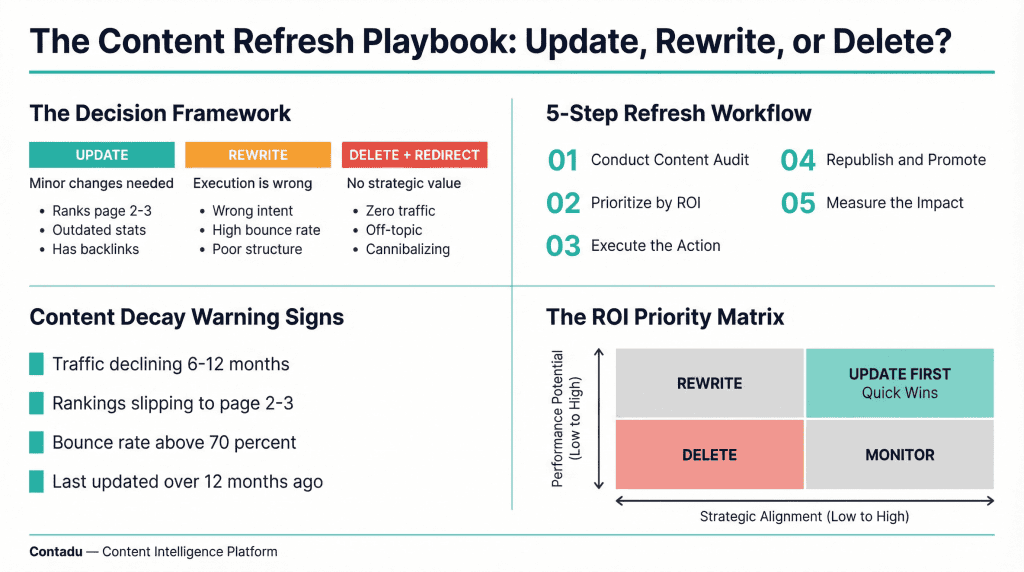
This is where a Content Refresh Playbook becomes essential. It’s a data-driven framework for deciding whether to update (minor changes), rewrite (major overhaul), or delete (and redirect) underperforming content. Making the right choice can unlock significant organic growth, while the wrong one wastes resources and leaves rankings on the table.
This guide provides a clear, actionable playbook for auditing your content and making strategic decisions that drive long-term results.
“Your old content is not a liability; it’s an asset. But only if you manage it. A content refresh strategy is the single most effective way to get more results from the content you’ve already created.” — Andy Crestodina, Orbit Media
The Decision Framework: Update vs. Rewrite vs. Delete.
The core of the playbook is a decision framework based on two key axes: Strategic Alignment (how relevant is this topic to your business today?) and Performance Potential (does this page have a realistic chance to rank and drive traffic?).
| Action | When to Use This | Key Signals & Data Points |
| Update (Refresh) | The content is strategically aligned and has good performance potential, but is slightly outdated or incomplete. This is for your “almost great” content. | – Ranks on page 2-3 for target keywords. – Declining traffic over the last 6-12 months. – High-quality backlinks exist. – Outdated stats, examples, or screenshots. – Competitors have more comprehensive content. |
| Rewrite | The content is strategically aligned, but the current version is fundamentally flawed. The core topic is right, but the execution is wrong. | – High bounce rate, low time on page. – Wrong search intent (e.g., you have a blog post, but Google ranks landing pages). – Poor structure, readability, or user experience. – The topic has evolved significantly. |
| Delete (and Redirect) | The content is no longer strategically aligned with your business, or it has zero performance potential. This content is a liability. | – Irrelevant topic (e.g., about a discontinued product). – Zero traffic, zero backlinks, zero keyword rankings. – Duplicate or cannibalizing another, better page on your site. – Very low-quality, thin content. |
The 5-Step Content Refresh Workflow.
Follow this systematic process to implement your content refresh strategy at scale.
Step 1: Conduct a Content Audit to Identify Candidates
You can’t improve what you don’t measure. Start by creating a content inventory of your entire site. For each URL, pull the following data:
- Performance Metrics: Organic traffic, keyword rankings, backlinks (from Google Search Console or any keyword research platform).
- Engagement Metrics: Bounce rate, time on page (from Google Analytics).
- Content Details: Publication date, last update date, word count.
Use this data to segment your content into the three buckets: Update, Rewrite, or Delete.
Step 2: Prioritize Your Efforts Based on ROI
Don’t start with the worst-performing content. Start with the content that has the highest potential for a quick win. Prioritize pages that are already ranking on page 2 or 3 for high-value keywords. A small update to these pages can often push them onto page 1, delivering a significant traffic boost with minimal effort.
Step 3: Execute the Update, Rewrite, or Deletion
- For Updates: Add new statistics, examples, and expert quotes. Expand sections to add more depth. Update screenshots and internal links. Improve readability and formatting.
- For Rewrites: Go back to the drawing board. Analyze the current top-ranking content for your target keyword. Create a new, comprehensive outline that matches search intent and provides more value than the competition.
- For Deletions: This is critical. Never just delete a page. This creates a 404 error and loses any link equity the page may have had. Always implement a 301 redirect to the most relevant alternative page on your site (e.g., a parent category page or a similar blog post).
Step 4: Republish and Promote
When you make a significant update or rewrite, change the publication date to the current date. This signals freshness to Google. After republishing, promote the updated content as if it were a brand new piece. Share it on social media, send it to your email list, and build new internal links to it.
Step 5: Measure the Impact
Track the performance of your updated content closely for the next 30-90 days. Monitor organic traffic, keyword rankings, and engagement metrics. A successful content refresh should result in a measurable uplift in performance. For Generative Engine Optimization (GEO), this also means tracking your visibility and citations within AI Overviews and chatbots, a feature now integrated into platforms like Contadu AI Tracking module.
How Contadu Powers Your Content Refresh Strategy.
Contadu is designed to streamline this entire process.
- Content Audit & Planning: Use the Content Calendar and planning features to manage your audit, categorize your content, and schedule your refresh workflow.
- Content Scoring: Before you even start an update, use Contadu Content Score to benchmark your existing page against the current top-ranking competitors. This instantly shows you the gaps in topical coverage and quality.
- AI-Powered Rewrites: Leverage Contadu AI to help you rewrite sections, generate new ideas, and ensure your updated content is optimized for both users and search engines.
FAQ
How often should I conduct a content audit?
For most businesses, a full content audit should be performed annually. However, you should be monitoring your content performance on a quarterly basis to spot decay early.
Will deleting content hurt my SEO?
If done correctly (with a 301 redirect), deleting low-quality, irrelevant content will help your SEO. It consolidates your site’s authority on your most important pages and improves your overall site quality signals.
What’s the difference between a content refresh and a content update?
The terms are often used interchangeably. A “refresh” or “update” typically refers to minor-to-moderate changes, while a “rewrite” is a complete overhaul from scratch.
Should I change the URL when I rewrite a page?
No. Unless the topic is changing completely, you should always keep the original URL to preserve its age, authority, and existing backlinks.
What is the biggest mistake to avoid?
Deleting a page without implementing a 301 redirect. This is a missed opportunity to pass on link equity and creates a poor user experience.
