

Original Research: The Ultimate Guide to Building Authority and Backlinks
In a world saturated with AI-generated, rehashed content, original research is the ultimate moat. It is the single most effective way to build authority, earn high-quality backlinks, and create content that cannot be easily replicated. While other forms of content marketing are about commenting on the conversation, original research is the conversation.
This guide provides a step-by-step playbook for creating and promoting original research, transforming your brand from a commentator into a primary source.
“When your website becomes the primary source for new information, you enter a completely different category of content.” — Stefan Maritz, CXL
Why Original Research is a Content Marketing Superpower.
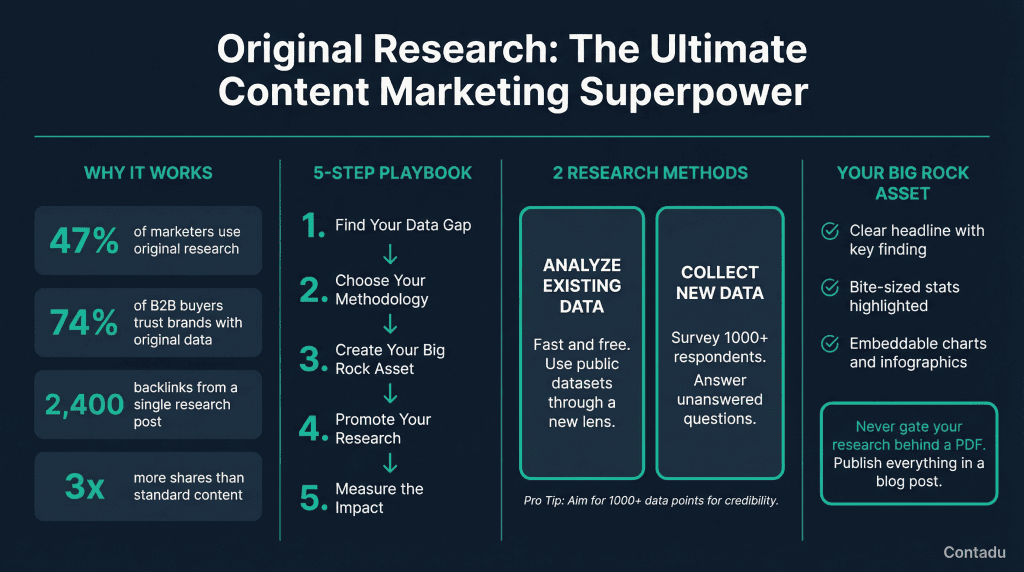
According to a study by BuzzSumo, 47% of marketers are using original research, and for good reason. It delivers unparalleled results across multiple marketing disciplines.
| Benefit | Why It Matters | Key Statistic |
| 1. High-Quality Backlinks | Journalists and bloggers need data to back up their claims. Your research becomes their source. | Data and research are the most effective content format for link building. |
| 2. Brand Authority & Trust | Publishing unique data positions your brand as an expert and a trusted source of information. | 74% of B2B buyers say they are more likely to trust a brand that publishes original research. |
| 3. Unique, Defensible Content | Original research cannot be easily replicated by competitors or AI, giving you a sustainable competitive advantage. | Original research is one of the three pillars of a top 1% content strategy. |
| 4. PR & Media Coverage | A compelling study is a ready-made story for journalists, leading to media mentions and increased brand awareness. | A single study can generate hundreds of media mentions and go viral on social media. |
The 5-Step Original Research Playbook
This workflow provides a repeatable system for creating and promoting original research that gets results.
Step 1: Find Your Angle (The Data Gap)
The best research fills a gap in the existing data. Look for questions that your industry is asking but no one has answered with data. Good places to find data gaps include:
- Industry Reports: Look for what they didn’t cover.
- Customer Conversations: What questions do your customers ask that have no clear answer?
- Google Trends & BuzzSumo: Identify trending topics that lack hard data.
Step 2: Choose Your Methodology
There are two main ways to conduct original research:
- Analyze Existing Data: Take a large, publicly available dataset (e.g., from a government agency or a platform like Google Trends) and analyze it through a new lens. This is the fastest and most cost-effective method.
2.Collect New Data: Conduct a survey of a large, relevant audience. This is more time-consuming and expensive, but it allows you to answer questions that have never been answered before.
Pro Tip: Your sample size matters. The larger the sample, the more credible your findings. Aim for at least 1,000 data points (e.g., 1,000 survey respondents or 1,000 websites analyzed).
Step 3: Create Your “Big Rock” Asset
Publish your findings as a comprehensive, well-designed blog post. Do not gate your research behind a PDF download. The goal is to make it as easy as possible for people to find, read, share, and link to your study. Your post should include:
- A Clear Headline: Announce your most compelling finding.
- Bite-Sized Stats: Pull out the most interesting data points and highlight them.
- Embeddable Visuals: Create charts, graphs, and infographics that others can easily embed in their own content (with a link back to you).
Step 4: Promote Your Research
“Publish and pray” doesn’t work. You need a proactive distribution strategy:
- Email Outreach: Reach out to journalists, bloggers, and influencers who have covered similar topics and offer them your new data.
- Content Atomization: Break your study down into dozens of smaller pieces of content (e.g., social media posts, infographics, video clips) to promote across all your channels.
- Guest Blogging: Write guest posts for other publications that reference your study.
Step 5: Measure the Impact
Track the success of your research by monitoring:
- Backlinks: Use a tool like Google Search Console to see who is linking to your study.
- Media Mentions: Set up Google Alerts to track mentions of your brand and study.
- Organic Traffic & Rankings: Monitor the organic traffic and keyword rankings of your research post.
How Contadu Supports Original Research
- Content Strategy Module: Identify data gaps and trending topics.
- Content Calendar: Plan your research, creation, and promotion workflow.
- Content Atomization Hub: Break your research down into smaller pieces for distribution.
- AI Tracking: Monitor mentions of your research in AI-generated content.
FAQ
How much does it cost to produce original research?
Analyzing existing data can be done for free. Conducting a survey can cost anywhere from a few hundred to several thousand dollars, depending on the sample size and audience.
How long does it take?
Analyzing existing data can take as little as a week. A full survey-based study can take 1-3 months from start to finish.
What is the biggest mistake to avoid?
The biggest mistake is not having a promotion plan. The world’s best research is useless if no one knows it exists.
Can I use AI to help with original research?
Yes. AI can be used to analyze large datasets, identify trends, and even write the first draft of your research report.
How do I get journalists to cover my study?
Make their job as easy as possible. Provide them with a clear, compelling story, bite-sized stats, and embeddable visuals.
