

Information Gain Score: What Google’s Patent Means for Your Content Strategy.
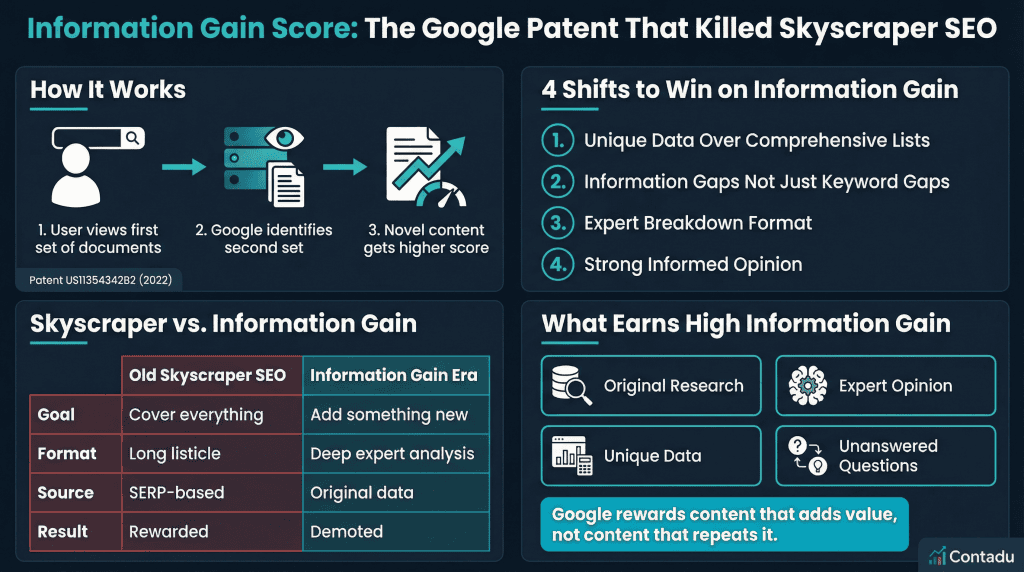
For years, the dominant SEO strategy was simple: find what ranks, do more of it, and make it longer. That era is over. Google’s patent on “Information Gain Score” signals a fundamental shift from rewarding comprehensive content to rewarding original and valuable content. If your content strategy still revolves around creating longer listicles of rehashed information, you’re optimizing for a search engine that no longer exists.
This guide breaks down what the Information Gain patent actually means, how it works “under the hood,” and provides a practical framework for creating content that wins in the new era of search.
“Boosting some pages in rankings based on how much information they would add to a searcher and demoting them if they don’t add much information to a searcher.” — The late Bill Slawski, Go Fish Digital
The Mechanism: How Information Gain Score Actually Works.
At its core, the Information Gain Score is a metric Google can use to determine if a piece of content offers new, additional information beyond what a user has already seen on a given topic. It’s a system designed to combat the “sea of sameness” in search results.
The patent (US-11354342-B2) describes a process that works roughly like this:
1.Initial Search & View: A user searches for a topic (e.g., “how to fix a slow computer”) and views a first set of documents.
2.Second Set Identification: Google identifies a second set of relevant documents that the user has not yet seen.
3.Scoring for Novelty: A machine learning model compares the information in the second set of documents to the information in the first (viewed) set. Documents in the second set that contain unique, novel information receive a higher “information gain score.”
4.Re-ranking: These high-scoring documents are then ranked higher for that user, or for subsequent users with similar information needs.
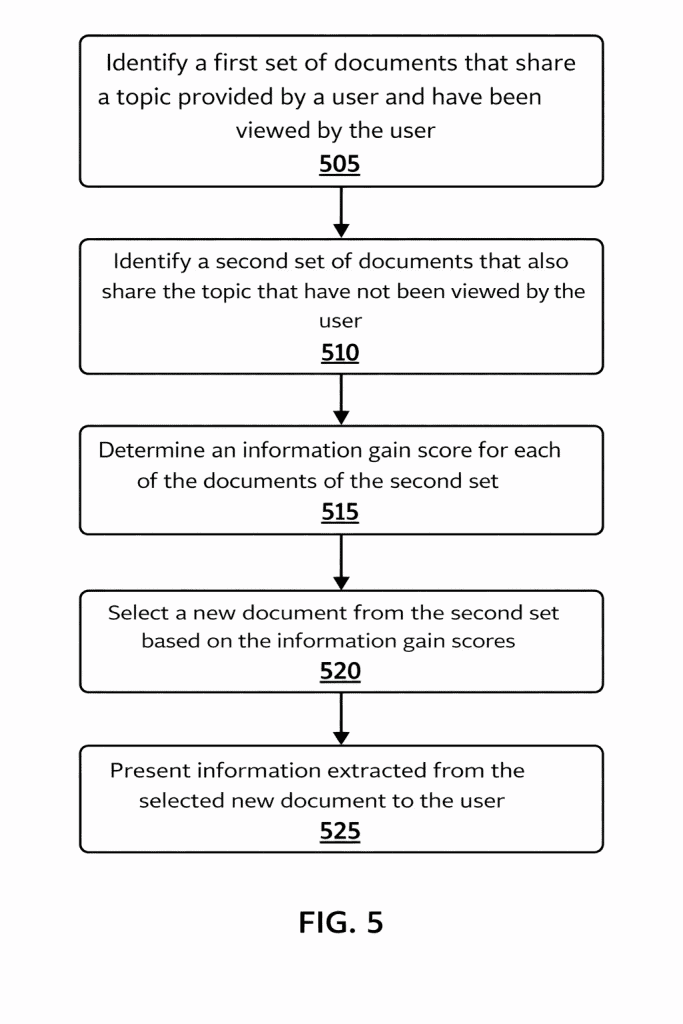 Source: Google Patent US20200349181A1 / US1135434
This means Google is actively looking for and rewarding content that doesn’t just repeat what’s already ranking. It’s a direct assault on the “Skyscraper” technique, which often results in long, comprehensive, but ultimately unoriginal articles.
What This Means For Your Content Strategy: 4 Actionable Shifts.
Optimizing for Information Gain requires a mental shift from “how can I cover this topic?” to “what new value can I add to this topic?”
1. Prioritize Unique Data Over Comprehensive Lists
Instead of writing “25 Ways to Improve SEO,” publish a study on “We Analyzed 500 SaaS Blogs: Here Are the 3 On-Page SEO Factors That Correlate With High Rankings.” The first is rehashed; the second is a primary source.
Actionable Tactic: Use your company’s internal data—customer service logs, sales call transcripts, product usage data—to find unique insights that no competitor can replicate.
2. Target Information Gaps, Not Just Keyword Gaps
A keyword gap tells you what your competitors rank for that you don’t. An information gap tells you what questions users are asking that no one is answering well.
Actionable Tactic: Spend more time analyzing the “People Also Ask” section and forum discussions (Reddit, Quora) than you do in traditional keyword research tools. Look for the follow-up questions that indicate an unmet information need.
3. Adopt the “Expert Breakdown” Format
Don’t just explain what something is; explain how it works, why it matters, and what the common mistakes are. Go deeper than the surface-level definitions that AI can easily generate.
Actionable Tactic: For your next article, add a “What Most Guides Won’t Tell You” section. This forces you to think beyond the obvious and add unique value.
4. Embrace a Strong, Informed Opinion
In a world of generic AI content, a well-argued, data-backed opinion is a powerful differentiator. Don’t just present facts; interpret them and guide the reader to a conclusion.
Actionable Tactic: Before writing, formulate a strong thesis. Instead of “A Guide to Topical Authority,” try “Topical Authority is More Important Than Backlinks in 2026. Here’s the Data.”
How Contadu Helps You Win on Information Gain
Contadu’s platform is built to create content that scores high on Information Gain.
- Content Strategy & SERP Analysis: Identify information gaps by analyzing the SERPs for what’s missing, not just what’s present. See the dominant formats and angles, and find your unique opening.
- NLP-Powered Content Scoring: Contadu’s Content Score doesn’t just reward keyword density. It analyzes topical coverage and semantic depth, pushing you to cover topics more comprehensively and originally than the competition.
- AI-Powered Briefs: Generate briefs that are based on a deep analysis of the SERPs, allowing you to build on what exists rather than just repeating it.
FAQ
Is the Skyscraper technique completely useless now?
Not completely, but its effectiveness is drastically reduced. It can still be a starting point for research, but the final product must add significant new information or a unique angle to succeed.
Does this mean shorter content can now outrank longer content?
Yes. A 1,500-word article with a unique data study and expert analysis will likely outrank a 4,000-word rehashed listicle, assuming all other factors are equal.
How does Information Gain relate to E-E-A-T?
They are deeply connected. Creating content with high information gain (e.g., original research, expert insights) is one of the most powerful ways to demonstrate Expertise, Experience, Authoritativeness, and Trustworthiness.
Is this just a theory, or is Google actually using this?
While Google rarely confirms specific ranking factors, the patent exists, and its principles align perfectly with the stated goals of the Helpful Content Update and other recent algorithm changes. It is actively being used to shape search results.
How can I measure the “Information Gain Score” of my content?
You can’t directly. It’s an internal Google metric. However, you can use proxy metrics: Does your content get cited by others? Does it earn backlinks from authoritative sources? Does it rank for long-tail informational queries? These are all signs that you are providing unique value.
