

How to Automate Your Content Strategy ? A Complete Guide to Content Intelligence.
Stop wasting hours manually digging through keyword planners. The winners today aren’t just “writing articles”; they are architecting entire knowledge ecosystems.
If your Excel sheets are overflowing with random keywords, yet you’re still wondering why your competitors are dominating AI Overviews, you’re in the right place. It’s time to stop guessing what search engines want. Welcome to the era of Content Intelligence—where every piece of content is driven by hard data and actual market demand, not just a copywriter’s hunch.
What is Content Strategy Automation in 2026?
In 2026, automating a content strategy isn’t just about “AI-generated text.” It is a sophisticated process using Content Intelligence platforms like CONTADU to:
- Perform Content Gap Analysis: Automatically identifying topics your competitors cover that you are missing.
- Execute Topic Clustering: Grouping hundreds of keywords into logical structures that build domain authority.
- Forecast Trends: Predicting which topics will gain traction before the competition does.
Why the Traditional Approach No Longer Works.
Search engines, such as Google (powered by SGE – Search Generative Experience), no longer look for pages that simply match a phrase. They look for answers. To become the source of that answer, your website must stop publishing random posts and start building a cohesive knowledge network.
The Architecture of Topical Authority: From Keywords to Clusters.
The biggest mistake in 2026 is attempting to rank a single article for a difficult keyword without the necessary topical support. To dominate search results, you must implement the Pillar-Cluster model.
The Pillar-Cluster Model in Practice:
- Pillar Page: A comprehensive resource on a broad topic (e.g., “The Ultimate Guide to Content Marketing”).
- Topic Clusters: A series of shorter, specialized articles answering specific questions (e.g., “SEO for E-commerce,” “How to Measure Content ROI”).
- Internal Linking: Intelligent connections that signal search engine bots: “We are experts in this field.”
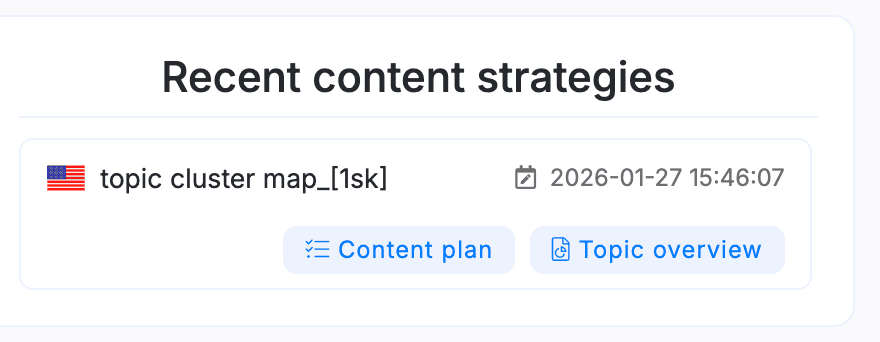
Pro tip for AI Overviews: AI algorithms most frequently cite sites that demonstrate the deepest understanding of a topic through interconnected content. Automating this in CONTADU allows you to create a cluster map in minutes, rather than weeks of manual labor.
Workflow: Step-by-Step Automation
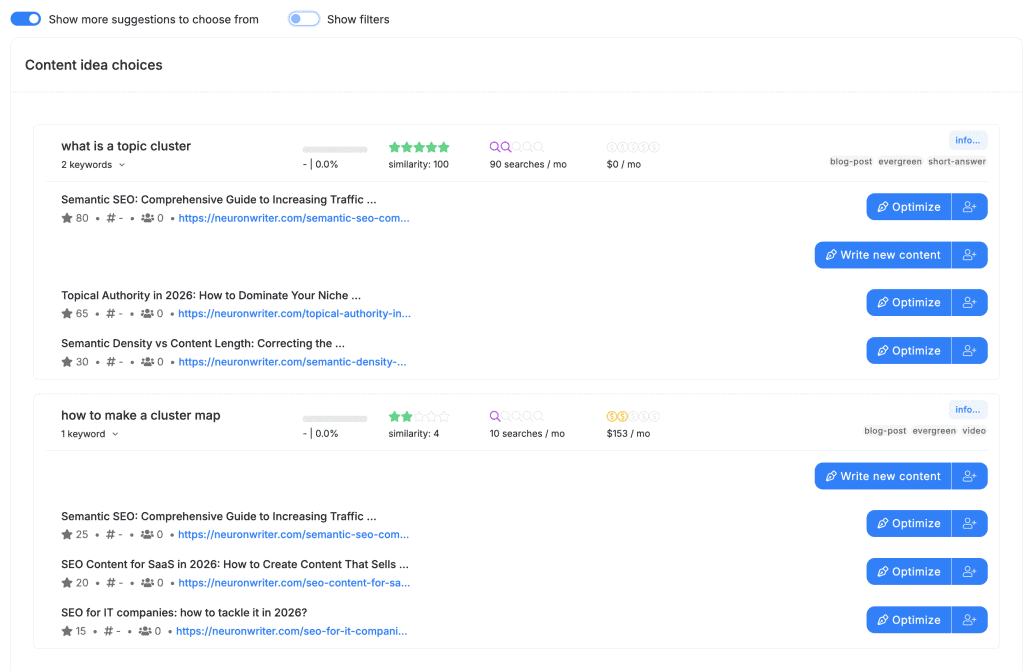
Here is how a modern strategy process should look to save time and maximize results:
Step 1: Semantic Audit and Competitor Analysis
Instead of manually browsing SERPs, use the Content Strategy module. The tool analyzes the TOP 20 results for your industry and identifies the semantic correlations (NLP) present in the leaders’ content.
Step 2: Automatic Topic Map Generation
Based on the gathered data, the system generates a topic list for the next 30–90 days. It is crucial that each topic is assigned a User Intent:
- Informational (I want to know),
- Navigational (I want to find),
- Transactional (I want to buy).
Step 3: AI-Powered Briefing
Writing briefs for copywriters manually is a waste of time. In 2026, automation allows you to generate a complete brief with a ready-made heading structure (H1-H3), a list of NLP keywords, and a suggested word count based on statistical competitor analysis.
The Role of E-E-A-T in Content Automation.
In an age of mass AI-generated content, Google places immense weight on E-E-A-T (Experience, Expertise, Authoritativeness, Trustworthiness). Can automation and trust go hand in hand?
Yes, provided you maintain a “Human-in-the-loop” approach.
- Experience: Use automation for research, but add your own case studies and unique insights.
- Expertise: Use tools like Neuro (AI Assistant) to refine your tone, ensuring it sounds professional and substantive.
- Authoritativeness: Build it through the aforementioned topic clusters. The more valuable content you have on a subject, the higher your domain authority.
Optimizing Content for AI Overviews (SGE).
AI-driven search engines prefer specific data formats. To ensure your article is chosen as a source for an AI response, it must meet three conditions:
- Direct Answers: Place concise definitions (40–60 words) under headings like “What is…” or “How to…”.
- Lists and Tables: Structured data is easier for Large Language Models (LLMs) to process.
- Unique Point of View: AI rarely cites content that is merely a copy of others. Add an original opinion or a forecast
Measuring Success: KPIs in the Era of Content Intelligence.
Automation doesn’t end with publication.
- AI Overview Share of Voice: What percentage of generative queries display your brand as a source?
- Topical Coverage: How much of a topic have you covered compared to the market leader?
- Content Decay: Automated systems should alert you when your content starts losing relevance (e.g., due to changes in technology or trends
Summary: Are You Ready for the Future?
Automating your content strategy in 2026 is not an option—it is a necessity for survival. Shifting from the role of a “content creator” to an “information architect” allows you to achieve a scale that was previously unimaginable.
By using tools like CONTADU, you gain more than just time savings; you gain the certainty that every line of published text brings you closer to being the leader in your niche.
FAQ
Will AI completely replace content strategists?
No. AI is an excellent executor and analyst, but humans define business goals, brand values, and build emotional connections with the audience.
How long does it take to build Topical Authority?
With consistent publishing (2 articles per day, according to our plan), the first effects—visible as ranking increases for long-tail keywords—usually appear within 4–6 weeks.
Is automation expensive?
The cost of a professional Content Intelligence platform is a fraction of the cost of manual labor for a team of SEO specialists and copywriters at the same scale of production.
