

Content Scoring: How to Measure Quality Before You Publish
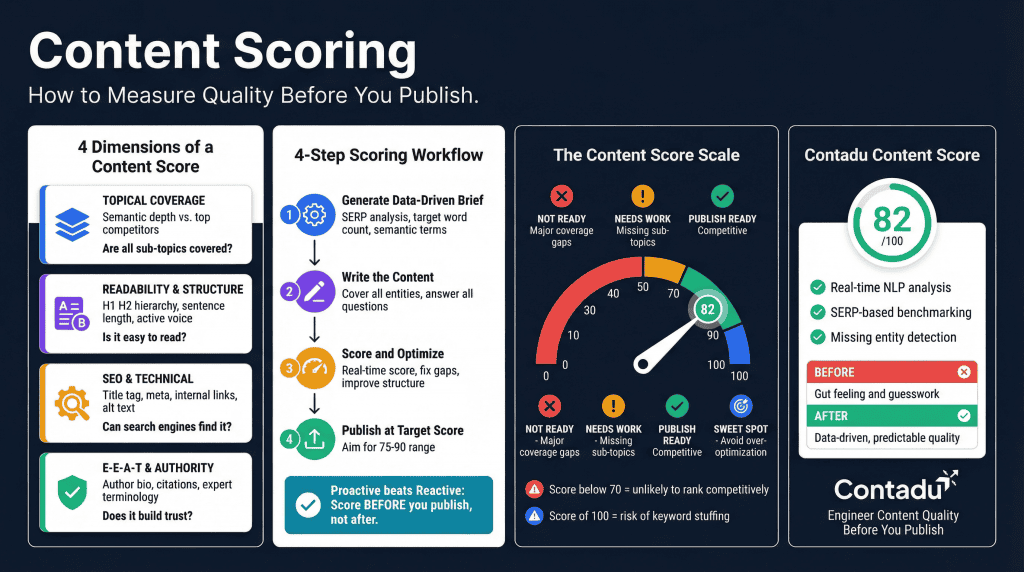
For decades, content marketers have operated in a reactive loop. We publish an article, wait weeks or months for it to rank (or not), and then perform a post-mortem analysis using tools like Google Analytics. We look at traffic, bounce rate, and time on page, trying to reverse-engineer what went right or wrong. This is like trying to steer a ship by looking at its wake.
Content Scoring flips this model on its head. It’s a proactive framework for quantifying content quality before you hit the publish button. Instead of waiting for performance data, you score your content against a set of data-driven benchmarks that are proven to correlate with ranking success. This guide will explain the methodology behind content scoring, the key dimensions of a robust scoring model, and how to use it to de-risk your content investment and create predictably high-performing assets.
What is Content Scoring? (And Why It’s Not Just a Checklist)
Content Scoring is the process of assigning a numerical score to a piece of content based on its alignment with a predefined set of quality and optimization criteria. It transforms the subjective idea of “quality” into an objective, measurable KPI. This score serves as a benchmark, indicating how likely a piece of content is to outperform competitors and achieve its goals in search.
It’s more than just a simple checklist. A true content scoring system is dynamic and data-driven, typically analyzing the top-ranking content for a target query to establish the criteria for success. It doesn’t just tell you if you used a keyword; it tells you if you’ve covered the topic as comprehensively as the current page-one results.
According to seo Clarity, content scoring turns subjective quality into measurable performance signals. By assigning data-backed scores to relevance, readability, and SEO alignment, teams can make smarter publishing decisions .
The 4 Dimensions of a Comprehensive Content Score.
A robust content score isn’t a single number; it’s a composite metric derived from several key dimensions. While different tools may weigh them differently, a best-in-class model evaluates content across these four critical areas.
| Dimension | Key Question | What It Measures |
| 1. Topical Coverage (Semantic SEO) | “Have we covered this topic comprehensively?” | The depth and breadth of your content against the top-ranking pages. It analyzes the use of semantically related keywords, entities, and sub-topics (LSI keywords) to determine if you’ve answered all the questions a user might have. |
| 2. Structural Quality & Readability | “Is this content easy to read and understand for both users and machines?” | The logical structure of your content (H1s, H2s, lists), sentence length, paragraph complexity, and use of active voice. A high readability score ensures your message is accessible and engaging. |
| 3. SEO & Technical Alignment | “Is this content technically optimized to be found by search engines?” | The fundamental on-page SEO elements: title tag optimization, meta description, URL structure, internal linking, and image alt text. This ensures there are no technical barriers to ranking. |
| 4. E-E-A-T & Authority Signals | “Does this content demonstrate expertise, experience, authority, and trustworthiness?” | The presence of signals that build trust, such as author bylines, outbound links to authoritative sources, clear data citations, and original insights. This is crucial for ranking in a post-Helpful Content Update world. |
The Content Scoring Workflow: From Brief to Optimization
Content scoring isn’t a final check; it’s a process that should be integrated throughout the content lifecycle.
Step 1: Generate a Data-Driven Brief
A great score starts with a great Content Brief. Before writing, use a tool like Contadu to analyze the SERP for your target keyword. This analysis should generate a data-backed brief that includes:
- Target word count.
- A list of semantically relevant terms and entities to include.
- A recommended content structure based on top competitors.
Step 2: Write the Content Against the Brief
With the brief as your guide, create the first draft. The goal is to produce a comprehensive, well-structured piece that naturally incorporates the recommended terms and entities.
Step 3: Analyze and Optimize with a Content Score
This is the core of the workflow. Paste your draft into a content optimization tool that provides a real-time content score. As you write and edit, the score updates, giving you immediate feedback. The tool will highlight:
- Missing terms and entities.
- Structural issues (e.g., missing H2s).
- Readability problems.
- Keyword stuffing or over-optimization.
Step 4: Iterate Until You Reach the Target Score
Continue refining the content adding missing sections, simplifying complex sentences, and improving the structure until you reach the target score recommended by the tool (typically 75-90). This iterative process ensures the final piece is far more competitive than a draft written on intuition alone.
The Contadu Content Score: Your Pre-Publication KPI.
Contadu’s Content Score is a real-time metric from 0 to 100 that measures the quality and optimization level of your content against the top-ranking competitors for your target keyword. It is built on a sophisticated NLP model that analyzes multiple factors, providing a single, actionable KPI for content quality.
How the Contadu Score Works:
SERP Analysis: When you start a project, Contadu analyzes the top 10-20 search results to understand what Google rewards for that query.
NLP-Driven Recommendations: It extracts key terms, entities, user questions, and structural patterns from the top results.
Real-Time Scoring: As you write in the Content Editor, the score updates in real-time, reflecting how well your draft incorporates these data-driven recommendations.
This transforms content creation from a guessing game into a data-driven exercise, dramatically increasing the probability that your content will perform before you invest in publishing and promotion.
Conclusion: Ship Less, Win More
Content scoring is the single most effective way to shift your content strategy from reactive to proactive. It allows you to de-risk your content investments, improve the baseline quality of every article you publish, and build a more predictable path to SEO success. By focusing on measuring quality before you publish, you can stop chasing lagging indicators and start creating content that is engineered to win from day one.
FAQ.
What is a “good” content score?
While it varies by tool, a score of 75-90 is generally considered a strong target. Aiming for a perfect 100 can often lead to over-optimization and unnatural-sounding text. The goal is to be better than the competition, not to stuff every possible keyword.
Can I get a high score and still not rank?
Yes. A content score is a powerful leading indicator of on-page quality, but it doesn’t account for off-page factors like backlinks, domain authority, or major technical SEO issues. However, a low score almost guarantees you won’t rank for a competitive term.
How does content scoring relate to E-E-A-T?
A good scoring model should incorporate E-E-A-T signals. For example, it might check for the presence of an author bio, outbound links to credible sources, or the use of specific, expert-level terminology, all of which contribute to demonstrating trustworthiness and expertise.
Is content scoring just for blog posts?
No. The principles can be applied to any content format, including landing pages, product descriptions, and knowledge base articles. The key is to analyze the correct set of competitors for the specific content type and user intent.
How do I avoid writing robotic, AI-sounding content just to get a high score?
Use the score as a guide, not a dictator. The best practice is to write the first draft for the user, focusing on clarity and value. Then, use the content scoring tool in the editing phase to identify gaps in your topical coverage and make targeted improvements without sacrificing your authentic voice.
