

Competitor Content Analysis: The Expert Framework to Win
In the saturated landscape of content marketing, creating “good content” is a losing strategy. Your content doesn’t exist in a vacuum; it competes directly with hundreds of other articles for the same audience and the same keywords. To win consistently, you need to move beyond simply being better and start being different. This requires a deep, systematic understanding of your competitors’ strategies what they do well, where they fall short, and where the untapped opportunities lie. This is the purpose of a Competitor Content Analysis.
This guide provides an expert-level, 5-step framework for dissecting your competitors’ content strategies. We’ll move beyond surface-level metrics to uncover actionable insights that will help you create content that is not just 10x better, but strategically positioned to win.
The Core Principle: It’s Not About Copying, It’s About Strategy.
A Competitor Content Analysis is the process of systematically identifying and evaluating the content of your direct and indirect competitors to assess their strengths and weaknesses and find strategic gaps in their coverage. The goal is to reverse-engineer what works for them and identify opportunities to create superior content that captures market share.
It’s not about creating a checklist of what your competitors have done and then doing the same. It’s about understanding the competitive landscape so you can find a unique angle, a different format, or a more comprehensive approach that your audience will value more.
As Search Engine Land notes, the modern approach requires a shift from tracking keyword overlap to evaluating content depth, originality, and entity coverage where your brand’s expertise can fill gaps or improve on generic AI-summarized answers.
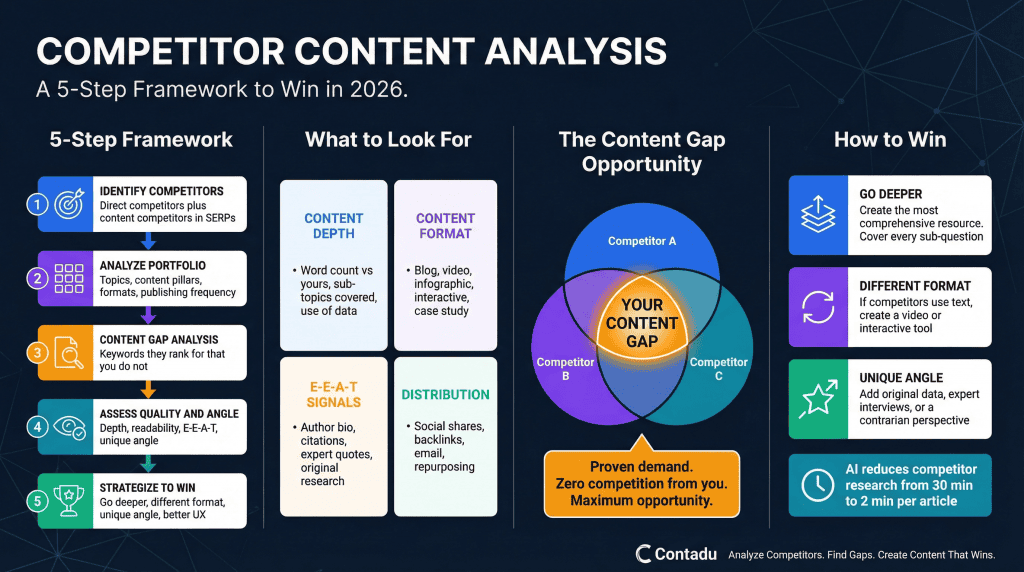
The 5-Step Expert Competitor Analysis Framework.
Follow this systematic process to move from raw data to a winning content strategy.
| Step | Key Question | Expert-Level Tactics |
| 1. Identify Your True Competitors | “Who is really competing for my audience’s attention in the SERPs?” | Identify direct competitors (offering similar products) and content competitors (ranking for your target keywords, e.g., industry publications). Use an SEO tool to find the top 3-5 domains with the highest keyword overlap for your core topics. These are your primary content rivals. |
| 2. Analyze Their Content Portfolio (The Macro View) | “What is their overarching content strategy and where do they place their bets?” | Map out their main content pillars and topic clusters. Look for their “Big Rock” assets—the comprehensive guides and cornerstone pieces that attract links and authority. Identify their publishing frequency, content formats (blog, video, case studies), and the channels they use for distribution. |
| 3. Perform a Content Gap Analysis (The Micro View) | “What proven topics with existing demand am I completely missing?” | This is the core of the analysis. Use an SEO tool to find keywords that two or more competitors rank for, but you don’t. Prioritize gaps where competitors have high rankings but relatively low-quality content. This is your low-hanging fruit. |
| 4. Assess Content Quality and Angle (The “How”) | “How are they covering these topics? What is their unique angle and where are they weak?” | For high-priority topics, manually review the top 3-5 competitor articles. Assess their depth, readability, use of visuals, and E-E-A-T signals. Identify their angle: Are they data-driven? Opinionated? Beginner-focused? Look for what they don’t say. |
| 5. Synthesize and Strategize (The “Win”) | “Where are the opportunities to create something 10x better and fundamentally different?” | Based on your analysis, identify opportunities to: Go deeper (more comprehensive), Use a different format (e.g., video instead of text), Take a unique angle (e.g., expert roundup vs. solo author), or Improve the user experience (better design, interactivity). |
Beyond Keywords: Analyzing SERP Intent and Content Angle.
The most common mistake in competitor analysis is focusing solely on keywords. The real insights come from understanding the intent behind the keywords and the angle competitors take to satisfy that intent.
For any given keyword, ask:
- What is the dominant intent? Is Google rewarding informational guides, transactional product pages, or comparison articles?
- What is the dominant format? Are the top results blog posts, videos, or interactive tools?
- What is the dominant angle? Are the top articles listicles, how-to guides, or case studies?
Your goal is to find a gap not just in keywords, but in the type of content being offered. If everyone has a “Top 10” list, your opportunity might be a single, in-depth case study.
The Power of AI in Scaling Your Analysis.
Traditionally, a thorough competitive analysis was a time-consuming manual process. Today, AI can automate the most laborious parts of this workflow, allowing you to focus on strategy instead of data collection.
As one agency found, automating the research and judgment layer of content creation can reduce research time from 30 minutes per article to just 2 minutes [2]. This is achieved by using AI to:
- Automatically scrape and parse the full text of competitor articles.
- Extract the content structure (H2s, H3s) of every competing page.
- Identify the main arguments and unique angles of each competitor.
- Detect common themes and, most importantly, content gaps across multiple sources simultaneously.
How Contadu Streamlines Competitor Analysis.
Contadu is built to integrate competitor analysis directly into your content workflow, turning insights into action.
SERP Analysis & Competitor Selection: When you create a project for a keyword, Contadu automatically pulls in the top-ranking pages. You can easily select the most relevant direct and content competitors to analyze.
Automated Content Gap & Structure Analysis: The platform analyzes the selected competitors to provide a list of semantically relevant terms, topics, and user questions you need to cover. It also shows you the common content structures, helping you build a comprehensive outline from the start.
Real-Time Content Scoring: As you write, Contadu’s Content Score benchmarks your draft against the top competitors in real-time. This ensures your content is not just well-written, but competitively optimized before you publish.
Conclusion: From Imitation to Innovation
A competitor content analysis is your roadmap to creating a content strategy that is both informed and innovative. By understanding the battlefield, you can move beyond simply adding to the noise and start creating content that is strategically designed to stand out, attract an audience, and drive results. Stop guessing what might work and start analyzing what already does—then do it better.
FAQ
How many competitors should I analyze?
For a high-level portfolio analysis, focus on 3-5 of your top direct and content competitors. For a specific keyword or topic, analyze the top 5-10 ranking pages, regardless of who they are.
What’s the difference between a content gap and a keyword gap?
They are closely related. A keyword gap identifies specific keywords you don’t rank for. A content gap is the broader topic or user question behind those keywords that you haven’t addressed with a dedicated piece of content.
How often should I perform a competitor content analysis?
Conduct a high-level portfolio analysis quarterly to track shifts in your competitors’ strategies. Perform a topic-level analysis every time you plan to create a new piece of strategic content.
What are the most common mistakes in competitor analysis?
The biggest mistake is focusing only on direct competitors and ignoring the content competitors who are actually winning in the SERPs. Another is getting bogged down in data without extracting actionable insights to inform your own strategy.
My competitor publishes 10x more content than I can. How can I compete?
Compete on quality, not quantity. Use your analysis to find a few high-impact topics where your competitors are weak or have shallow content. Create the single best resource on the web for those topics. One comprehensive, 10x better article can outperform ten mediocre ones.
