
Topic Clusters: Dominating Google
You will build a content architecture that allows you to dominate your niche in Google search results. This article is a complete guide to the Topic Clusters strategy, through which you will stop fighting for individual keywords and start building lasting topical authority. You will learn how to plan and
implement this powerful SEO strategy step by step, so that your content supports each other, creating synergy that Google cannot ignore.
The End of the Keyword Era, Time for Topics
For years, SEO was based on a simple principle: one page, one keyword. That era is gone forever. With the development of algorithms such as Hummingbird, RankBrain, and BERT, Google has stopped being a simple word-matching machine. It has become an engine for understanding intent and context. The search engine no longer asks “which page best matches this keyword?” but “which page (and entire domain) is the greatest expert on this topic?”.
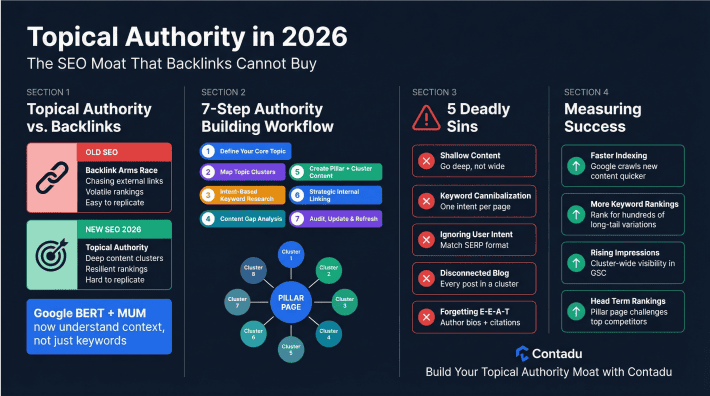
The answer to this change is precisely the topic cluster strategy. Instead of creating dozens of unrelated articles, you build an organized network of content around one central topic. This sends a powerful signal to Google: “We are an authority on this topic. We have an answer to every question a user might ask.”
Anatomy of a Topic Cluster: Pillar and Satellites
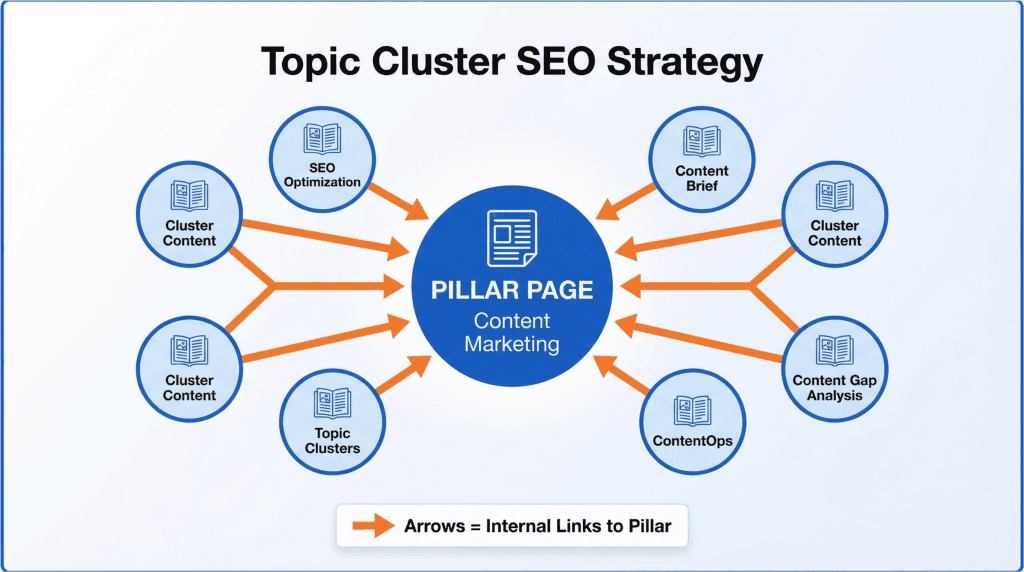
An effective topic cluster consists of two key elements that work like a solar system.
- Pillar Page: This is your “sun.” A comprehensive, extensive piece of content (typically 3000+ words) that broadly covers the main, general topic (e.g., “Content Marketing”). It acts as a hub to which all links from satellite content lead.
- Cluster Content (Satellites): These are your “planets.” A series of more detailed, shorter articles, each of which thoroughly discusses one specific aspect of the main topic (e.g., “How to create a brief for a copywriter“, “Content gap analysis“, “What is ContentOps?”)
This structure creates a logical, organized architecture that is extremely easy to understand for both users and Google bots.
Common Mistakes: Why Your Clusters Don’t Work
Simply creating a few articles on a similar topic is not a cluster. Here are the most common mistakes that undermine all efforts:
- Mistake #1: Pillar Page Too Broad or Too Narrow. Choosing “Marketing” as a pillar topic is doomed to failure – it’s too broad. On the other hand, the topic “How to write H1 headings in SEO” is too narrow for a pillar; it’s an ideal topic for satellite content.
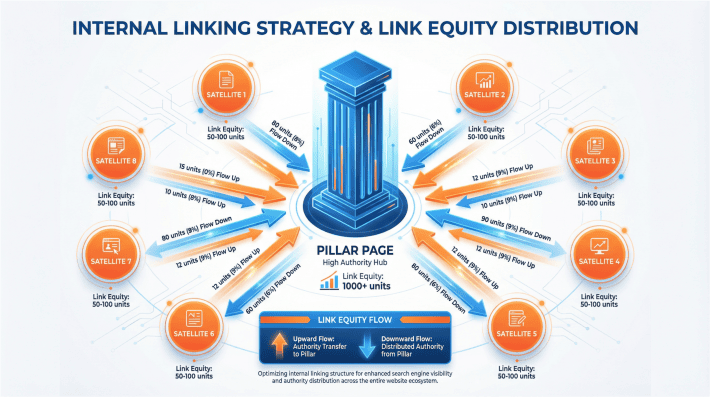
- Mistake #2: Lack of Strategic Internal Linking. This is the most common and most serious mistake. Linking must be intentional: every piece of satellite content MUST link to the pillar page. Optionally, satellites can link to each other if it makes thematic sense. The pillar page should link to the most important satellites.
- Mistake #3: Keyword Cannibalization. Two satellite articles in the same cluster cannot try to rank for the same main phrase. Each satellite must have its own unique, more detailed target (long-tail keyword) so they don’t compete with each other.
How to Build Your First Topic Cluster (Step by Step).
Building a cluster is a strategic process that can be divided into 5 simple steps.
Step 1: Identify Your Main Topic (Pillar). Think about the problems your product solves. Choose a topic that is broad enough to write at least 10-20 detailed articles about, but narrow enough to be relevant to your target audience. In Contadu, you can use the “Keyword Discovery” module to find topics with high search volume and assess their potential.
Step 2: Map Satellite Content (Clusters). Once you have your pillar, it’s time to find the planets. Your goal is to create a list of very specific, detailed topics. Use content gap analysis in Contadu to see what related topics your competition ranks for. Also analyze the “People Also Ask” section in Google to find real questions asked by users.
Step 3: Create the Pillar Page. This is the most important element. It must be one of the best pieces of content on the topic in the entire internet. It should be comprehensive, well-organized, and easy to navigate (e.g., with a table of contents).Before you start writing, create a detailed creative brief that will guide the entire creation process. The pillar page’s main goal is to provide tremendous value and encourage deeper exploration of the topic by clicking on links to satellite content.
Step 4: Write and Optimize Satellite Content. Each satellite article should be the best possible answer to one very specific question. Use Contadu’s editor to ensure that each piece of content is fully optimized for its unique long-tail keyword while containing semantic references to the pillar’s main topic. If you’re leveraging AI in your content creation process, make sure you’re using AI strategically to build competitive advantage, not just to produce generic content.
Step 5: Build an Internal Linking Network. After publishing all content, return to it and meticulously build a network of links. From each satellite article, place at least one contextual link to the pillar page. From the pillar page, in appropriate sections, place links to the most important satellite articles.
Contadu Role in Building and Managing Clusters
Building clusters manually is time-consuming and error-prone. Platforms like Contadu automate and simplify this process at every stage.
- Planning: The “Content Strategy” module allows for visual mapping of clusters. You can create a main topic (pillar) and attach all planned satellite articles to it, creating an interactive mind map of your strategy.
- Analysis: SERP analysis and content gap tools automatically provide you with topics for satellite content, saving hours of manual research.
- Creation: The intelligent editor with the “Content Score” function ensures that both the pillar page and satellite content are fully optimized and substantively complete.
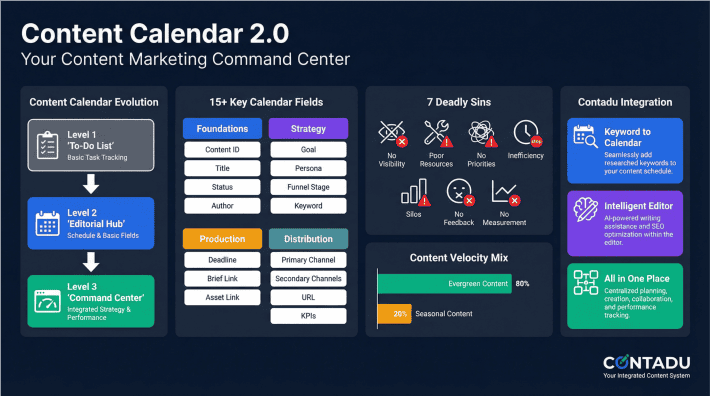
- Management: You can manage the entire cluster creation process – from idea to publication – in one place, assigning tasks and monitoring progress through a structured Content Operations system
FAQ
How many articles are needed for one topic cluster?
There is no hard rule, but a good starting point is one pillar page and 10 to 20 detailed satellite pieces of content. Completeness is most important – the goal is to cover all the most important aspects of a given topic.
Can old, existing content be part of a cluster?
Yes, and it’s an excellent strategy! Conduct an audit of your existing content. Many of them can probably be updated, optimized, and incorporated into a new cluster as satellite content. Sometimes several old, similar articles can be combined into one powerful pillar page.
How do you measure the success of a topic cluster?
You measure success by observing the ranking of the pillar page for the main, general keyword. If the strategy works, the pillar page, strengthened by dozens of links from satellite content, should systematically climb higher in search results.
Pillar page or pillar post? Which is better?
Technically, there is no difference whether the pillar page is published as a “page” or “post” in WordPress. What’s important is that it should be evergreen content, comprehensive, and easily accessible from the main navigation or blog menu.
Do topic clusters work in every industry?
Yes. This strategy is universal because it is based on the fundamental principle of how modern search engines work – rewarding authority and expertise. It works equally well in B2B SaaS, e-commerce, and niche hobby blogs.
Summary
The topic cluster strategy is a conscious transition from thinking about SEO as a battle for individual keywords to thinking about building lasting authority. It’s an investment that pays off in the form of stable, high positions in Google and the perception of your brand as a leader in a given field.
Suggested next step: Choose one topic that is most important to your business. Treat it as your first, test pillar. Use Contadu tools to find 5-10 related, detailed topics for satellite content. Write out this plan and start implementing it. This is the first step to dominating your niche.