
Content Operations (ContentOps): How to Build a Content Management System in the AI Era.
Everyone uses automation and AI today. But most do it chaotically. One team member generates text in ChatGPT, another uses a different tool for research, and a third tries to hold it all together in a crumbling spreadsheet. The result? A drop in quality, a loss of control, and growing frustration.
If this scenario sounds familiar, it’s a sign that the problem isn’t a lack of tools, but a lack of a system.
The solution is Content Operations (ContentOps)—an approach that transforms the chaotic content creation process into a predictable, scalable machine. In this article, we’ll show you how to build such a system based on three pillars: people, processes, and technology, so you can regain control and start creating content that truly delivers results in the age of AI.
What Is ContentOps ?
Content Operations (ContentOps) is a business discipline focused on centralizing and optimizing people, processes, and technology to efficiently plan, create, manage, and analyze content at scale.
Think of it as the “operating system” for your marketing department. In an era where AI allows for nearly limitless content production, ContentOps becomes the key quality control mechanism. It ensures that what you create is not only fast and cheap but, above all, strategic, consistent, and valuable to your audience.
Pillar 1: People – Defined Roles in a Hybrid Team (Human + AI)
An effective ContentOps system requires clearly defined roles that leverage the unique abilities of both humans and machines.
- Content Strategist: The brains of the operation. Their job is to plan and make data-driven decisions. With the help of AI, they conduct content gap analysis, define goals, and set the direction.
- Content Creator / AI Prompt Engineer: The executor of the first draft. This is the person who can fluently communicate with AI models to generate a high-quality “raw” draft.
- Subject Matter Expert (SME) / Editor: The guardian of quality and uniqueness. This is a domain expert who fact-checks the AI-generated text and then adds their own unique insights, examples, and personal experiences.
- Content Manager: The orchestra conductor. They manage the entire process within a central system, keep track of deadlines, and ensure a smooth flow of information between roles.
Pillar 2: Processes – From Chaotic “Prompting” to a Structured Workflow.
Even the best team will fail without a repeatable, clearly defined process. In ContentOps, standardization is key.
The Single Source of Truth: The Creative Brief
In a world where anyone can “prompt” on their own, a standardized brief becomes absolutely critical. It’s the central document that ensures both humans and AI are working toward the same goal. A well-prepared creative brief contains not just keywords, but also business goals and a defined persona.
The Structured Workflow:
Instead of chaotic actions, implement a repeatable, multi-stage process for every new piece of content:
- Ideation and Planning: (Domain: Content Strategist)
- Brief Creation: (Domain: Content Strategist)
- AI Draft Generation: (Domain: Content Creator)
- Expert Editing and Enrichment: (Domain: SME / Editor)
- SEO Optimization and Final Polish: (Domain: Content Manager / SEO Specialist)
- Publication and Distribution: (Domain: Content Manager)
- Performance Analysis: (Domain: Content Strategist)
Pillar 3: Technology – Building a “Content Stack” Around a Central Platform.
The chaotic use of dozens of disconnected tools is the antithesis of ContentOps. The goal is to build an integrated ecosystem (a “tech stack”) around a single, central platform that acts as the “operating system.”

Contadu Role:
A content management platform like Contadu becomes the heart of the entire operation. It’s where you:
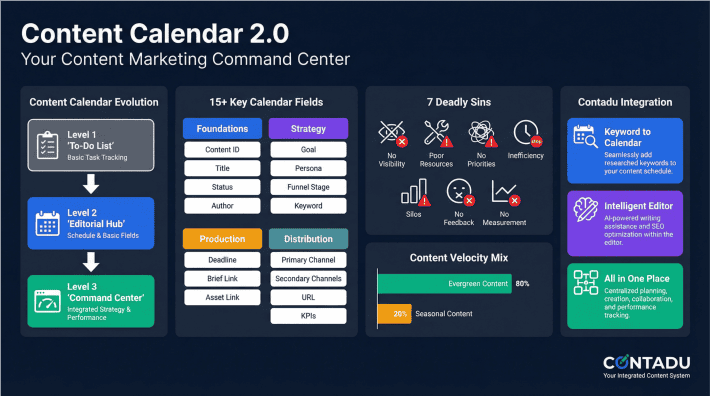
- Plan your strategy and manage your editorial calendar.
- Store and share creative briefs.
- Create and optimize content in an intelligent editor that supports both humans and AI.
- Manage the entire workflow, assigning tasks to specific people and tracking progress in real-time.
Other specialized tools (for analytics, social media management) should be integrated with this central platform to ensure a seamless flow of data.
FAQ
Is ContentOps only for large corporations?
Absolutely not. The principles of ContentOps scale both up and down. For a freelancer or a small team, implementing a simplified system (e.g., working in themed blocks, standardizing briefs) is the fastest way to avoid chaos and increase personal productivity without sacrificing quality.
What is the most important metric (KPI) in ContentOps?
Traditional metrics like “number of articles published” are becoming misleading. The key KPI for ContentOps is “Content Velocity,” which is the average time from idea to publication and achieving initial results. The main goal is to shorten this cycle while maintaining or increasing quality and business impact.
Doesn’t ContentOps kill creativity in a team?
This is a common myth. In reality, the opposite is true. Well-defined processes and automated administrative tasks free up the team’s time and energy from repetitive, boring work. This allows them to fully focus on what matters most strategy, creativity, and creating unique value for the reader, instead of wondering, “where is that file?”.
What is the difference between Content Strategy and Content Operations?
Content Strategy answers the question “WHAT are we creating and WHY?” (e.g., what topics we cover, what goals we want to achieve). Content Operations answers the question “HOW do we create it efficiently and scalably?” (e.g., what processes and tools we use). These two disciplines are inextricably linked, and one cannot exist effectively without the other.
Where should I start implementing ContentOps if our process is total chaos?
Start with one small but most painful problem. Most often, this is the lack of standardization at the beginning of the process. Implement a single, shared creative brief template for everyone. This one action alone will force more strategic thinking at the outset and drastically reduce the number of revisions and misunderstandings in later stages.
Summary
Stop managing individual tasks and authors. Start building and managing a system. This is the only way to create scalable, profitable, and—most importantly—unique content marketing in the saturated era of artificial intelligence.