
Content Gap Analysis: 5 Methods to Find Topics That Google and Your Customers Will Love.
Do you ever feel like your competition is always one step ahead of you in the search results? Do you create content that seems valuable, but no one ever finds it? You are likely suffering from “content gaps” topics your potential customers are searching for, but which you are completely ignoring.
Content gap analysis isn’t some secret art reserved for the chosen few. It’s a systematic process that lets you look over your competitor’s shoulder, understand the market’s needs, and find the “empty spaces” on Google’s map that are just waiting to be claimed.
In this article, we’ll show you 5 practical, proven methods for conducting a content gap analysis. You’ll learn how to stop guessing and start making data-driven decisions, creating content that not only attracts traffic but also builds your brand’s authority.
What Exactly Is a Content Gap?
In the simplest terms, a content gap is a topic or keyword that your competition is visible for in the search results, but you are not.
Imagine you sell invoicing software. Your site ranks for “invoicing program,” but your competitor is also visible for “how to issue a credit note,” “pro forma invoice template,” and “invoice payment terms.” These three topics are your content gaps. They are the questions your potential customers are asking, and by not answering them, you are ceding ground to your rivals.
The goal of the analysis is to systematically find these gaps and turn them into an action plan.
Method 1: Classic Competitor Analysis in SEO Tools.
This is the fastest and most scalable method, forming the foundation of any analysis. It utilizes the “Content Gap” or “Keyword Gap” features available in popular SEO tools and advanced content platforms.
How to do it step-by-step:
- Identify Competitors: Enter your domain into the tool.
- Add 2-4 Main Competitors: Choose companies that regularly appear alongside you in the search results for your most important phrases.
- Run the Analysis: The tool will show you a list of keywords. The key is to filter it correctly.
- Apply the “Gap” Filter: Select the option that shows phrases for which at least one of your competitors ranks, but your domain does not rank in the TOP 50 or TOP 100.
What do you gain? You get a list of hundreds, or even thousands, of topics that have already been validated by the market. This is your goldmine of ideas for the coming months. Your job is to pick the ones with the highest potential and create content that is 10x better than the competition’s.
Method 2: Analyzing the Structure of a Single Competitor Article.
This method is more granular and allows you to find gaps within a specific topic. It’s perfect for optimizing existing content or planning new, more comprehensive articles.
How to do it step-by-step:
- Choose a Topic: Let’s say you want to write an article about “SEO audit.”
- Analyze the TOP 5 in Google: Open the first 5 articles and analyze their heading structure (H2, H3).
- Create a “Topic Map”: In a spreadsheet, list all the unique subtopics (headings) that your competitors cover.
- Identify Gaps and Synergies: You’ll notice that one article excels at describing “audit tools,” another focuses on “technical audit,” and a third on “content audit.” Your gap—and your opportunity—is to create a single, comprehensive article that covers all these aspects in one place, becoming the most exhaustive resource available.
How Contadu Automates Finding Content Gaps.
Manual analysis is insightful but time-consuming. Modern content management platforms like Contadu automate this process, allowing you to focus on strategy, not on tedious clicking through search results.
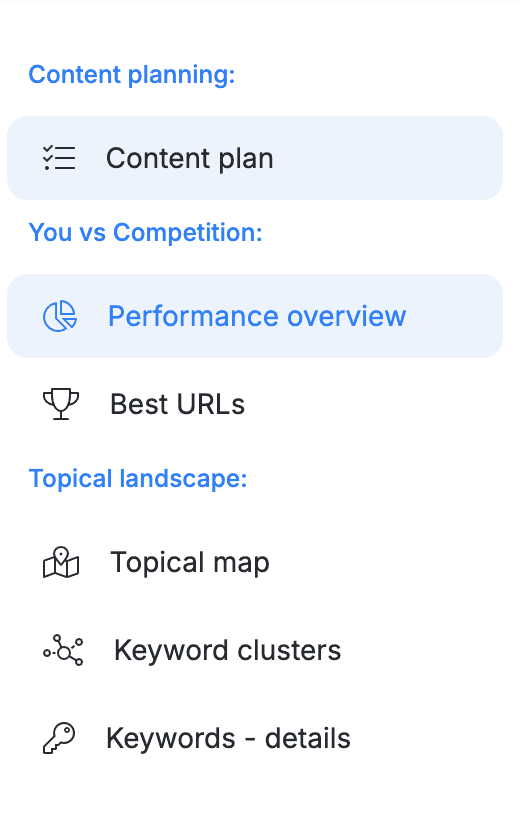
Here’s how Contadu helps at every stage:
- Strategic Planning (Method 1): In the “Keyword Discovery” module, you can instantly compare your domain with competitors. The platform will automatically show you keywords you’re not visible for, sorting them by potential and difficulty. This cuts hours of research down to minutes.
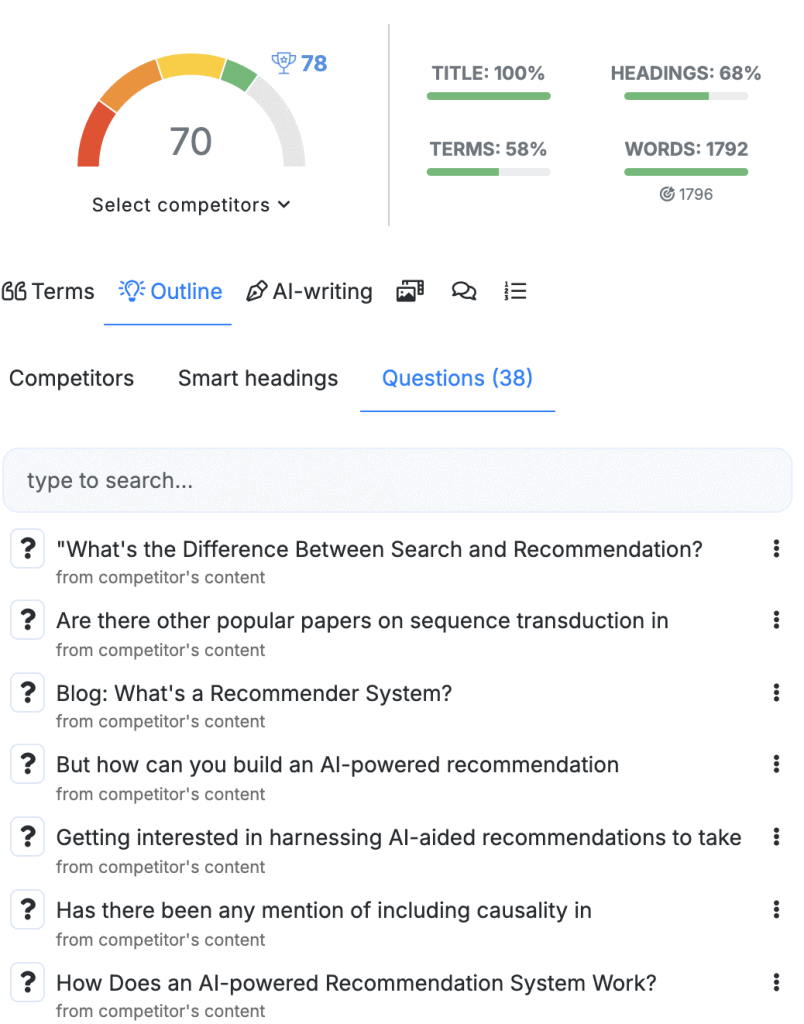
- Analyzing Topic Depth (Method 2): Once you’ve chosen a topic, the Content Editor in Contadu performs the TOP-10 structure analysis for you. In the side panel, you get a ready-made list of suggested headings, terms, and questions (from PAA) that are missing from your text. You see your gaps in real-time as you write.
- Building Clusters (Method 3): The strategy planning module allows you to visualize entire topic clusters. Contadu suggests related topics and questions from Google, helping you build a comprehensive content network with no room for accidental gaps.
With this kind of support, content gap analysis stops being a complex project and becomes a simple, integral part of your daily workflow.
Method 3: Suggestions and Questions Directly from Google.
Google itself tells you what users are searching for. This is a free and incredibly powerful source of information about content gaps.
Where to look:
- Google Autocomplete: Start typing your main phrase (e.g., “content marketing…”) and see what Google suggests (“…strategy,” “…examples,” “…for B2B”). These are the most popular related queries.
- “People Also Ask” (PAA) Section: This section is a goldmine. It shows specific questions users are asking.
- “Related Searches”: At the bottom of the search results page, Google shows 8-10 related phrases.
Method 4: Analyzing Your On-Site Search.
If you have a search bar on your website, its logs are a direct line of communication with your users.
How to do it step-by-step:
- Get Access to the Data: Set up site search tracking in Google Analytics or ask your developer for server logs.
- Analyze the Queries: Look for recurring phrases.
- Check the Results: For the most popular queries, enter them into your search bar yourself. Does the user get a satisfactory result? If not, you’ve just found a critical content gap that addresses a real need of your current visitors.
Method 5: Ask Your Sales and Customer Support Teams.
Your team members who have direct contact with customers hear about their problems, doubts, and needs every single day. This is the highest-quality source of information about content gaps.
How to do it step-by-step:
- Create a Shared Document: Set up a simple Google Sheet or a Slack channel called “Questions from Customers.”
- Establish a Process: Ask your sales and support teams to write down any question they hear from a customer that isn’t easily answered by your knowledge base or blog.
- Review the List Regularly: Once a month, go through the list. We guarantee you’ll find article topics that perfectly address the real problems of your target audience.
From Analysis to Action.
Finding the gaps is only half the battle. The real magic begins when you turn that data into action.
- Gather all the gaps you’ve found in one place (e.g., in the strategy planning module in Contadu).
- Prioritize them based on business potential, search volume, and difficulty.
- Transform the most important gaps into concrete article topics. Remember that a well-prepared brief is the foundation that ensures your new content will perfectly fill the identified gap.
Content gap analysis is a continuous process, not a one-time task. Make it a regular part of your content planning cycle, and you’ll never have to guess what to write about again.
FAQ
How often should I perform a content gap analysis?
A content gap analysis is not a one-off task. It’s recommended to conduct a large, comprehensive analysis once every 6-12 months to update your overall strategy. However, you should incorporate a smaller, simplified analysis into your content planning cycle every month or quarter to keep up with new trends and competitor moves.
Does content gap analysis make sense if I’m just starting and have no competitors?
Absolutely! If you’re entering a new niche, your “competitors” are the sites that are already answering your future customers’ questions, even if they don’t offer the same product. Analyze topic-specific blogs, forums, and news portals. The analysis then becomes a “market gap analysis”—a chance to be the first to provide a comprehensive answer to an unmet informational need.
I found 500 content gaps. Where do I start?
This is a common “problem of abundance.” The key is prioritization. Segment the topics you’ve found using a simple matrix:
High Business Potential / Low Difficulty: (so-called “low-hanging fruits”) – Do these immediately. These are topics closely related to your product where the competition is weak.
High Business Potential / High Difficulty: Plan these strategically. These are your future pillar pages that will require significant effort.
Low Business Potential / Low Difficulty: Do these when you have spare capacity. Good for quickly building content mass.
Low Business Potential / High Difficulty: Generally, ignore these.
Can I find content gaps in video or podcast content?
Of course. The principle is the same; only the tools change. Instead of analyzing blogs, analyze your competitors’ YouTube channels or podcast episode lists. Check the titles, descriptions, and comments. You’ll often find questions from the audience in the comments section that are perfect candidates for new content—both in video format and as a blog article.
My competition creates low-quality content. Is it still worth analyzing them?
Yes, this is actually an ideal situation! If your competition ranks for phrases that are important to you, but their content is superficial, outdated, or poorly written, it’s a signal of an “easy win” for you. The analysis will show you which topics are in demand, and you can come in and offer content that is an order of magnitude better, quickly taking over their positions in Google.