

Scalable Content Marketing: From Chaos to Efficiency
Do you feel that your content marketing activities have hit a glass ceiling? You’re creating more and more content, but the results aren’t growing proportionally to the effort invested? This is a sign that you need not more, but smarter. In this article, we’ll show you how to transition from chaotic creation to a fully scalable content marketing system. You’ll learn how to manage dozens of projects, maintain quality with growing volume, and build a machine that generates predictable business results, not just another blog post.
What is Scalability in Content Marketing (and What It Isn’t)?
Scalability in content marketing is your system’s ability to handle an increasing amount of work and generate better and better results without a proportional increase in costs and resources. It’s not simply “doing more of the same.” It’s a strategic approach that transforms one-time actions into a repeatable, optimized, and measurable process.
Contrast: Growth vs. Scalability.
Growth: You hire another copywriter to write 10 articles instead of 5. Your costs and production grow linearly (2x more work = 2x higher cost).
Scalability: You invest in templates, procedures, and tools, thanks to which one copywriter is able to create 10 articles in the time they previously wrote 5, maintaining or improving their quality. Production grows, but cost per unit decreases.
True scalability is about building foundations that will allow you to expand without implosion.
Problem Diagnosis: Why Your Content Marketing Isn’t Scaling?
Before you build a strategy, you must understand what’s holding you back. Most companies make the same, repeatable mistakes that block the potential of their activities.
Mistake #1: Lack of Documented Strategy and Processes
Operating “by feel” works at the beginning. However, when trying to scale, it leads straight to chaos. Without clearly defined goals, customer journey maps, and documented procedures, each new project means starting from zero. Your team wastes time establishing basics instead of focusing on creating value.
How to fix it (The “How”):
Create a “Content Marketing Playbook” – a central document containing:
Business goals and KPIs: What you want to achieve (e.g., 15% lead growth in Q3) and how you’ll measure it (e.g., number of MQLs from blog articles).
Personas and customer journey: Who you’re creating content for and what questions they ask themselves at each stage (awareness, consideration, decision).
Content Pillars: Main thematic categories in which you want to build authority. This provides focus and ensures that each piece of content adds a brick to building your expertise.
Style Guide: Define tone of voice, formatting, quality standards. This will ensure consistency even if 10 different people create the content.
Mistake #2: Creating Content Detached from Distribution
The best article in the world is worthless if no one reads it. The competition often focuses exclusively on production, forgetting that content promotion is equally important. Treating distribution as “something we’ll do later” is a straight path to failure.
How to fix it (The “How”):
Apply the 50/50 rule: dedicate as much time and resources to content promotion as to its creation.
Create a distribution checklist: For each new material, launch a series of planned activities.
Use Owned, Earned, and Paid Media channels:
- Owned: Newsletter, social media, push notifications.
- Earned: Mentions, shares by influencers, guest posts, conscious outreach.
- Paid: Ads on Facebook, LinkedIn, Google Ads, Taboola/Outbrain to promote the best content.
Plan distribution at the brief stage: Think about who and where will share this material before the first letter is even written.
Foundations of a Scalable System: Pillars on Which You’ll Base Your Growth.
Once you know what to avoid, it’s time to build a system. The following elements are not “nice additions” – they’re an absolute necessity if you’re thinking about scaling seriously.
Highlighted Section: From Repurposing to Content Atomization.
The competition talks about “repurposing,” meaning reusing content (e.g., turning a blog into social media posts). That’s a good start, but true scalability lies in atomization.
Content atomization is a strategic approach in which from the very beginning you plan one large asset (e.g., “Ultimate Guide to X,” webinar, research report) as a “mother,” from which dozens of smaller content “atoms” will be created.
Practical Scenario (The “How”):
You create a “Pillar Page” / “Ultimate Guide”: A comprehensive 3000-word article on “Scalability in Content Marketing.”
You atomize it into:
- 10 posts on LinkedIn/Twitter: Each discussing one key mistake or strategy.
- 5 short videos (Shorts/Reels): Visual presentation of the most important concepts (e.g., Growth vs. Scalability).
- Infographic: “Roadmap to scalable content marketing.”
- PDF checklist: “10-point checklist for scaling readiness” (as a lead magnet for newsletter signup).
- Newsletter fragments: Several emails in a drip campaign, each deepening one aspect from the article.
- Presentation: Slides based on the article structure for use in a webinar or meeting.
Benefit: Instead of creating 20+ separate pieces of content from scratch, you invest energy in one high-quality asset, then multiply its value with minimal additional effort. You build consistency and reach different audience segments in their preferred formats.
Highlighted Section: Building a “Content Engine” Based on Technology.
Manual management of 50 projects in a spreadsheet is impossible. Scalability requires technology that automates, centralizes, and optimizes work.
Tools are your force multiplier:
Project management (e.g., Contadu, Asana, Trello): Central dashboard for tracking progress, assigning tasks, and communication. Use Kanban boards to visualize workflow from idea to publication.
Automation and AI (e.g., built-in modules in SEO platforms, external AI writing tools, NLP-assisted editors):
- Brief and outline generation: Advanced platforms can analyze the TOP10 in Google and prepare an article structure in a few minutes.
- SEO optimization: Tools suggest which phrases and headlines to use to maximize visibility.
- First drafts: AI assistants can write a draft that the copywriter then refines, saving hours of work.
Why it works: This version replaces proper names with tool categories. It’s precise, shows market knowledge, and subtly positions Contadu as part of the ecosystem (“built-in modules in SEO platforms”).
Digital Asset Management (DAM): Central repository for all graphics, videos, and documents, which prevents chaos and facilitates asset reuse.
Analytics (e.g., Google Analytics 4): Measure what works and what doesn’t. Identify high-performing content and double your investment in it. Analyze those that don’t perform to optimize or remove them.
Practical Application in Contadu:
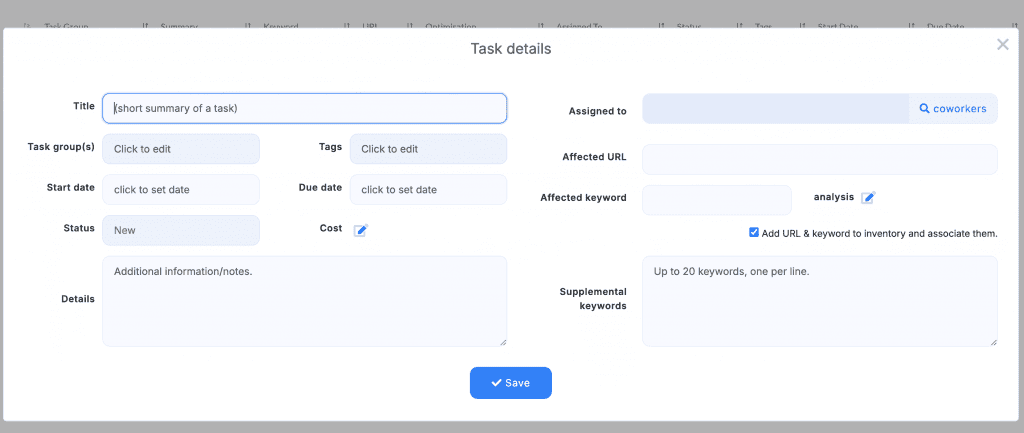
The “Team Management” panel in Contadu, where each project has an assigned author, deadline, status (e.g., “Briefing,” “Writing,” “Review,” “To Publish”), and a task checklist. The manager sees “bottlenecks” in the process at a glance and can react quickly instead of drowning in emails and files.
Most Common Mistakes When Scaling (and How to Avoid Them)
Scaling quantity at the expense of quality: Pressure for “more” leads to publishing mediocre content that damages brand image. How to avoid: Use technology to automate repetitive tasks (research, brief creation) so people can focus on what they do best – creativity, strategy, and narrative building.
Ignoring “content debt”: Focusing only on new content and forgetting to update and optimize existing assets. How to avoid: Regularly conduct content audits. Update “evergreen content” to maintain their high position in Google. Sometimes refreshing an old article gives better ROI than writing a new one.
Lack of defined roles in the team: When everyone is responsible for everything, no one is responsible for anything. How to avoid: Define clear roles: Content Strategist (planning), Content Creator (creation), Content Editor (quality), Content Manager (process and publication).
Summary: Your Path to Scalability.
Scalable content marketing is not a goal, but a continuous optimization process. Instead of chasing an ever-increasing number of publications, focus on building a system that works for you.
Start with strategy: Define goals, thematic pillars, and processes.
Think atomically: Plan large assets that you’ll break down into dozens of smaller ones.
Harness technology: Automate what you can to free human creativity.
Measure and optimize: Make decisions based on data, not hunches.
With this approach, you’ll stop being just a content producer and become an architect of predictable growth.
FAQ .
From what team size is it worth thinking about scaling content marketing?
Scalable thinking is worth implementing from the very beginning, even with a one-person team. Building good habits, such as creating templates and documenting processes, will pay off when the team starts growing. The real need appears when one person can no longer manage all tasks and quality begins to suffer.
Does scaling always mean using AI to write texts?
Absolutely not. Scaling means smart use of resources. AI is a powerful tool to support the process – it’s ideal for research, creating outlines, generating title ideas, or paraphrasing. However, the final text should always pass through expert hands to ensure its quality, unique brand voice, and factual correctness.
How to measure ROI of scalable content marketing?
The key is linking content metrics with business goals. Instead of just looking at views, track:
- Number and quality of leads generated by specific content (e.g., after downloading an e-book).
- Conversion rate from blog traffic to demo sign-ups or newsletter subscriptions.
- Impact on sales (pipeline value): How many transactions in CRM had a touchpoint with your content?
- Cost per lead (CPL) from content marketing compared to other channels.
What’s more important: creating new content or updating old content?
It depends on your strategy’s maturity stage. At the beginning, you need to build a base of new content. However, after 6-12 months, auditing and optimizing existing assets becomes crucial. Updating a well-performing article to keep it in Google’s TOP3 often brings faster and cheaper results than fighting for position with a completely new topic.
How to manage brand consistency when content is created by many freelancers?
This is one of the biggest scaling challenges. The solution is solid onboarding and precise documentation:
Detailed Style Guide: Not just logo and colors, but above all tone of voice, examples of desired and undesired phrasings.
Brief templates: Make sure each freelancer receives the same comprehensive information about the goal, target group, key phrases, and expected structure.
Dedicated editor: One person (or small team) responsible for final polish and maintaining consistency of all published materials.
